A child in a striped sweater, two skeleton brothers and a suspiciously cheerful flower do not sound like the cast of an emotional RPG. Somehow, Undertale makes them unforgettable.
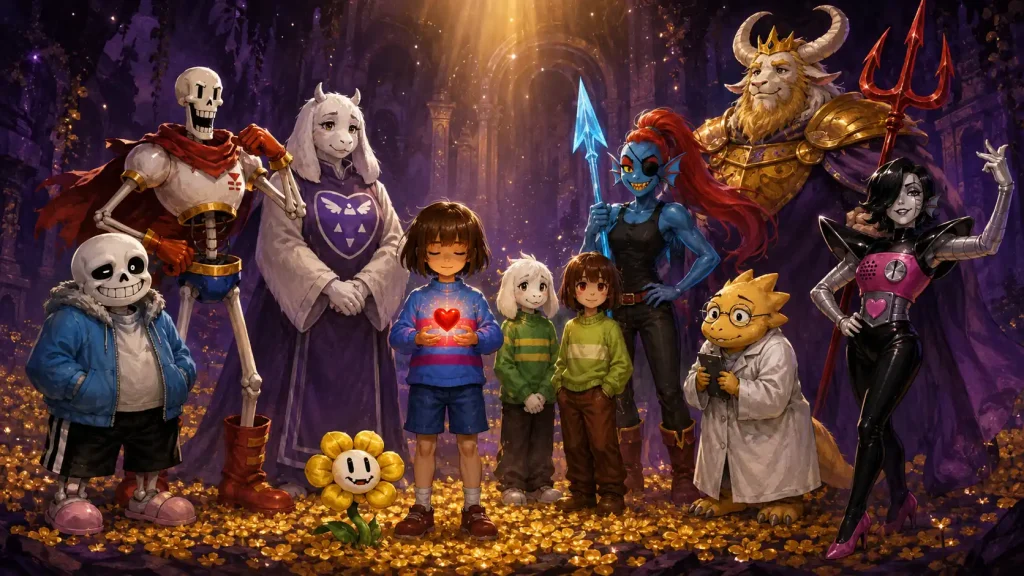
The game has dozens of enemies and minor NPCs, but its story is built around 11 main characters. Each has a distinctive appearance, personality and role in the Underground. Some become friends, others stand in your way, and several can be either depending on the choices you make.
You only directly control Frisk, but learning how to approach the other characters is a major part of the gameplay. Fighting is always available, yet it is rarely the only answer.
Spoiler warning: This guide discusses the identities and story roles of Undertale’s main characters, including details revealed near the end of the game.
Frisk
Frisk is the human child controlled by the player. They have straight brown hair, a largely expressionless face and a light-blue sweater with two magenta stripes. Their simple design leaves plenty of room for players to interpret their personality.
Unlike a traditional RPG hero, Frisk has no fixed combat style or detailed backstory. Their identity is shaped through your actions. They can attack monsters, talk to them, run away or search for a peaceful solution.
Frisk’s red SOUL is moved during enemy attacks, turning each battle into a small bullet-dodging challenge. Different opponents can change how the SOUL behaves, introducing new movement rules as the game progresses.
To play Frisk effectively, pay attention to dialogue and experiment with ACT before choosing FIGHT. The unusual option is often the correct one. Most importantly, remember that Frisk is not the name entered at the beginning of the game. Their real name is only revealed during the True Pacifist ending.
Flowey
Flowey is a small golden flower with six yellow petals, a white face and a green stem. His harmless appearance is deliberate. He welcomes Frisk to the Underground, pretends to explain its rules and then tries to kill them with so-called “friendliness pellets.”
What makes Flowey unique is his awareness of the game itself. He understands SAVE files, resets and alternate timelines. He may remember decisions even after the player attempts to undo them.
Flowey is not a normal enemy that can be defeated during the opening encounter. The lesson is simply to dodge his bullets and distrust easy promises. He later becomes central to the Neutral and True Pacifist endings.
After his major Neutral-route battle, the player is given a choice to spare or kill him. That decision affects some later dialogue, but Flowey’s real importance goes far beyond a single moment. His history is closely connected to Asriel and the Dreemurr family.
Toriel
Toriel is a tall, white-furred Boss Monster with long ears, small horns and a purple robe decorated with the Delta Rune. Her warm appearance matches her personality: she protects Frisk, teaches the game’s basic mechanics and offers them a home in the Ruins.
She differs from the other bosses because she acts more like an overprotective parent than a true enemy. Her battle tests whether the player has understood that persistence can be more useful than violence.
To resolve the encounter peacefully, continue selecting MERCY even when it appears to have no effect. Toriel’s fire attacks also begin avoiding Frisk when their health becomes dangerously low, revealing that she never truly wants to hurt them.
Killing Toriel changes later dialogue and influences the way other characters judge Frisk. Sparing her establishes one of Undertale’s central ideas: an opponent may continue fighting while still hoping you will find another solution.
Sans
Sans is a short, round skeleton who wears a blue hoodie, black shorts and slippers. He spends much of the game telling bad jokes, taking shortcuts and avoiding anything that resembles work.
Behind that relaxed personality is one of Undertale’s most observant characters. Sans understands more about timelines and resets than he openly admits. Near the end, he judges Frisk according to the EXP and LV they have gained, explaining what those familiar RPG statistics really mean.
During most playthroughs, Sans is not a boss. He talks to Frisk, follows their progress and reacts to what happened to his brother. Only the darkest route leads to a full battle with him.
That encounter breaks several of the game’s established rules. Sans dodges attacks, damages Frisk through KARMA and uses bones and Gaster Blasters in relentless patterns. Blue attacks must be avoided by staying still, while white attacks require movement. There is no peaceful trick that ends this battle—the way to avoid it is through the choices made long before it begins.
Papyrus
Papyrus is Sans’s taller and much louder brother. He wears a red scarf, white battle armor, red gloves and matching boots. He dreams of joining the Royal Guard and believes capturing a human will finally make him popular.
His confidence is enormous, but his intentions are remarkably innocent. Papyrus constructs puzzles, prepares spaghetti and attempts to act like a dangerous rival, yet he is far more interested in friendship than violence.
His battle introduces the blue SOUL mode. Gravity pulls the SOUL downward, so the player must jump over incoming bones instead of moving freely around the battle box.
Papyrus eventually offers mercy if Frisk survives his attacks. He will not deliver a fatal blow during a normal encounter, and repeated defeats can even unlock an option to skip the fight. Sparing him leads to a humorous hangout or date and allows him to become one of Frisk’s most loyal friends.
Undyne
Undyne is a blue, fish-like monster with sharp teeth, an eyepatch and a long red ponytail. As captain of the Royal Guard, she initially appears in heavy armor and hunts Frisk through Waterfall with magical spears.
She stands apart from the other characters through sheer intensity. Undyne approaches cooking, friendship and combat with the same explosive enthusiasm. She genuinely wants to protect monsterkind and sees Frisk’s SOUL as the key to breaking the barrier.
Her battle turns the SOUL green and locks it in place. The player must use a shield to block spears arriving from four directions. When the SOUL turns red again, the correct strategy for a peaceful run is to flee rather than continue fighting.
After escaping into Hotland, give Undyne water when she collapses from the heat. If Papyrus is alive and Frisk has not gained EXP, she can later be befriended. This relationship is required for the True Pacifist route.
Alphys
Alphys is a short yellow reptilian monster with glasses and a white lab coat. She works as the royal scientist and spends much of her time watching anime, following Frisk through security cameras and worrying about almost everything she says.
Unlike most of the main cast, Alphys never fights Frisk directly. She assists by upgrading the protagonist’s phone and offering advice throughout Hotland, although her attempts to appear useful are more complicated than they first seem.
What makes Alphys unique is the contrast between her comic awkwardness and the serious secrets she carries. Her experiments with determination created consequences hidden inside the True Lab. They also connect her directly to Flowey’s origin.
There is no battle strategy for Alphys. To explore her full story, spare every monster, befriend Papyrus and Undyne, complete a Neutral ending and follow the later invitation involving Undyne’s letter. Doing so unlocks Alphys’s date and the True Lab, both essential steps toward the complete Pacifist ending.
Mettaton
Mettaton begins as a rectangular silver robot with a screen, control dial and wheeled base. After the switch on his back is activated, he transforms into Mettaton EX: a glamorous humanoid performer with black hair, long legs and a talent for dramatic poses.
He is a television host, entertainer and brand all at once. Instead of simply trying to win a fight, Mettaton wants to create a spectacular show for his audience.
During the Mettaton EX battle, Frisk’s SOUL turns yellow and can shoot at incoming targets. The goal of a peaceful encounter is to raise the audience rating rather than destroy him. Posing, boasting, changing equipment and shooting the heart on his exposed core all help make the performance more exciting.
Once the ratings become high enough, Mettaton realizes that his viewers care about him and ends the battle. It is one of the clearest examples of Undertale replacing a conventional boss fight with a challenge built around the character’s personality.
Asgore
Asgore is the king of the Underground and one of its largest monsters. He has white fur, a golden mane and beard, curved horns, a crown, golden armor and a long purple cape. In battle, he carries a large red trident.
His appearance suggests a fearsome final villain, but Asgore is gentle, polite and deeply uncomfortable with his own decisions. He believes collecting human SOULs is necessary to free his people, even though he does not enjoy taking human lives.
Unlike many bosses, Asgore destroys the MERCY button when the battle begins. Frisk must fight until he becomes vulnerable. Talking to him under the right conditions can weaken his attack and defense, while using Toriel’s Butterscotch Pie lowers them further.
After his health is reduced, the player receives another chance to choose mercy. Whatever they select, Flowey interrupts the outcome. Asgore’s encounter is less about defeating an evil king and more about confronting a kind person trapped by a promise he no longer wants to keep.
Asriel
Asriel Dreemurr is the son of Toriel and Asgore and the former prince of the Underground. As a child, he resembles a small white goat with long ears and wears a green sweater with yellow stripes. His transformed appearance is much larger and more dramatic, with horns, dark facial markings and a robe bearing the Delta Rune.
Asriel is not just another member of the royal family. His story explains Flowey’s identity, the origin of the golden flowers and much of the tragedy that shaped the Underground.
He serves as the final boss of the True Pacifist route. This encounter cannot be won through ordinary damage. Frisk must survive his attacks and use SAVE to reach the souls of their friends. Eventually, the player can save Asriel himself.
The battle is designed around emotional persistence rather than combat strength. Refusing to give up is the strategy, and understanding why Asriel is fighting matters more than overpowering him.
Chara
Chara is the first human who fell into the Underground, long before Frisk arrived. They have brown hair, rosy cheeks and a green sweater with a single light-colored stripe. Their appearance resembles Frisk’s, which helps the game hide the difference between the two children.
The name entered by the player at the beginning belongs to Chara, not Frisk. They were adopted by Toriel and Asgore and became Asriel’s closest friend and sibling. Their actions helped set the game’s central tragedy in motion.
Chara is not directly playable in the conventional sense and does not have a standard battle. Much of their personality remains deliberately ambiguous. The clearest version appears at the end of the darkest route, where they confront the player after the Underground has been emptied.
There is no strategy for defeating or sparing Chara. Their role is to reflect the consequences of pursuing power simply because the game allows it. The way players understand Chara often depends on the path they chose to reach them.
Other Familiar Faces
The 11 central characters carry most of Undertale’s story, but they are not the only memorable residents of the Underground. Napstablook and Monster Kid have smaller roles, yet both capture the game’s unusual mixture of humor, vulnerability and meaningful choices.
Napstablook
Napstablook is a shy, melancholic ghost with a simple white body and long dark eyes. They are first encountered lying on the floor of the Ruins, where they reluctantly begin one of the game’s earliest miniboss battles. Later, Frisk can visit their home in Waterfall and discover their interest in music.
Napstablook stands out because the encounter is less about defeating an enemy and more about improving someone’s mood. Selecting Cheer three times encourages them to demonstrate their “dapper blook” trick, using their tears to create a small top hat. Cheering or flirting once more peacefully ends the encounter.
They are also part of Undertale’s ghost family. Napstablook is related to Mettaton and Mad Dummy, and the True Pacifist ending gives them an opportunity to work as a musician and sound mixer.
Monster Kid
Monster Kid is a small yellow monster with a striped shirt, a tail and spikes behind their head. They have no visible arms, frequently trip while running and speak with the restless enthusiasm of a child who is somewhere they should not be.
Their hero is Undyne. Throughout Waterfall, Monster Kid follows Frisk in the hope of seeing the captain of the Royal Guard in action, without initially realizing that Frisk is the human she is hunting.
Monster Kid does not have a conventional boss battle during a normal playthrough. Instead, the important gameplay moment comes when they fall from a bridge and need help. Frisk’s decision to rescue or ignore them changes the following scene with Undyne and reveals more about the kind of person the protagonist is becoming.
On the darkest route, Monster Kid also finds the courage to stand between Frisk and the remaining monsters. Despite being young, frightened and unable to fight effectively, they attempt to imitate Undyne and protect others. That moment turns an enthusiastic supporting character into one of the clearest examples of bravery in the game.
Why Undertale’s Characters Still Stand Out
Undertale’s cast works because each character changes the way the game is played. Papyrus turns combat into a jumping challenge. Undyne forces the player to defend and run. Mettaton transforms a boss fight into live entertainment, while Asriel asks the player to save people instead of defeating them.
Their personalities are not confined to dialogue or cutscenes. They become part of the mechanics.
That connection is what makes the cast so memorable. Undertale does not simply tell players that its monsters deserve understanding. It creates battles in which understanding them is often the most effective way forward.

I’m Alex Mercer, a senior gaming and esports writer at GamingImba. I’ve been involved in gaming for as long as I can remember, and for more than a decade I’ve been writing about competitive play, industry trends, and the culture that grows around games.
My work focuses on esports, online gaming platforms, and how technology continues to shape the way people play, compete, and connect. I’m especially interested in meta shifts, balance changes, and the business decisions that influence modern games behind the scenes.
At GamingImba, I aim to break down complex topics in a way that’s clear, honest, and useful—whether that means analyzing a major tournament, exploring new gaming platforms, or looking at how player behavior evolves over time.
I follow global esports scenes closely, experiment with different games and mods in my free time, and enjoy digging into the details that most players notice but rarely stop to question.