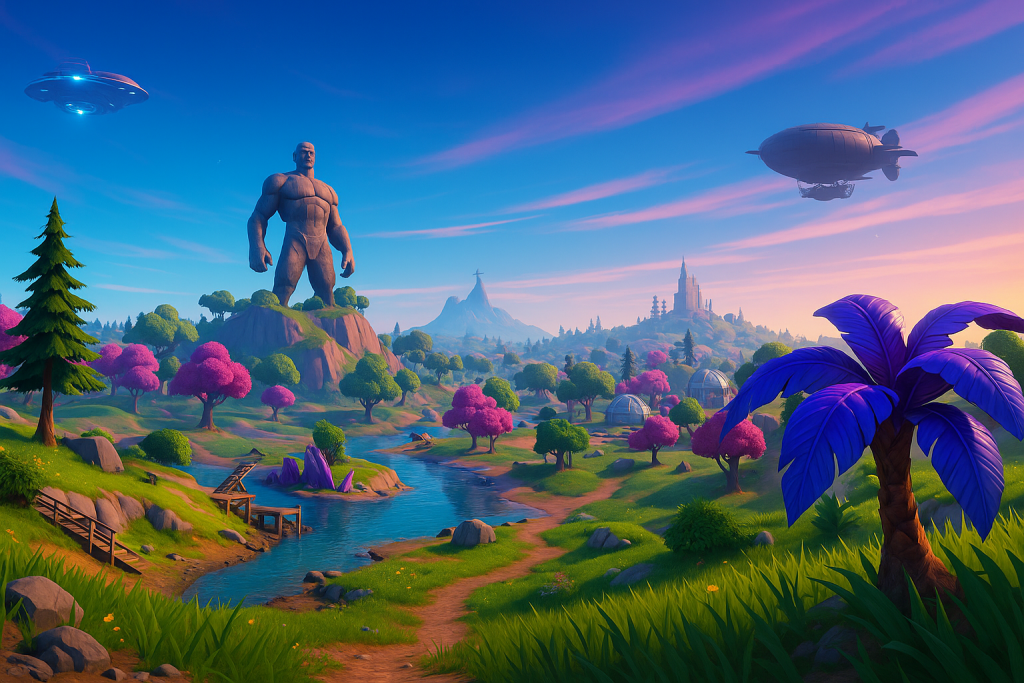
Ah, Fortnite. The game that started with a few people building weird wooden towers in the middle of a gunfight… and somehow turned into a Travis Scott concert simulator. If you’ve been out of the loop since 2017, you might be confused why your little cousin is using a banana in a tuxedo to out-dance an alien with a lightsaber on a neon island in the sky. But that’s Fortnite for you—what began as a scrappy battle royale now looks more like the Metaverse in sneakers.
So, how did we get here?
The humble beginning: shoot, build, panic
Back in 2017, Fortnite launched its Battle Royale mode. It wasn’t the first of its kind—PUBG had already staked that claim—but Fortnite had one thing going for it: it was free. And bright. And cartoony. And most importantly, it lets players build walls at breakneck speed like caffeinated carpenters.
Soon, kids, teens, streamers, and probably a few confused grandparents were all dropping from the Battle Bus. The loop was simple: land, loot, build something ridiculous, and try not to get sniped while dancing.
Then came the seasons… and things got wild
Epic Games, never the company to sit still, introduced seasonal updates faster than you could finish learning how to do a 90. Each new season came with a theme: pirates, superheroes, futuristic sci-fi, primal wilderness—at one point, it felt like Fortnite was trying to win “Most Costume Changes in a Single Year.”
With every update, something unexpected happened. They started telling stories. Yes, that goofy game with chicken skins and shopping carts began adding live in-game events with actual lore. Players watched black holes, cube monsters, alien invasions, and multiverse rifts unfold live.
It was like playing inside a blockbuster movie. Except, you could still get eliminated by a guy named xxQuickScopezxx wearing a hot dog outfit.
Then came the crossovers: The Great Pop Culture Grab
Here’s where Fortnite fully leaned into its identity as a digital playground rather than just a game. Epic said, “What if… everything existed in one place?” And somehow, they got away with it.
Marvel superheroes, DC characters, Halo’s Master Chief, Kratos from God of War, Rick and Morty, Ariana Grande, John Wick, Naruto… it was like a Comic-Con panel exploded inside the game. And the craziest part? It worked.
Want to throw a boogie bomb at Darth Vader while dressed as Spider-Man? Fortnite says, “Sure, why not?”
The line between “video game” and “pop culture blender” had officially disappeared.
Fortnite concerts: the weirdest (and coolest) thing you didn’t know you needed
Let’s talk about that time Fortnite became a concert venue. When Travis Scott’s Astronomical performance dropped in-game, over 12 million players showed up to watch a digital giant version of the rapper teleport through space and drop beats while you bounced around in zero gravity.
It was bizarre. It was incredible. It also turned Fortnite into a legitimate platform for live virtual events. Since then, we’ve seen Ariana Grande soaring through dreamscapes and entire interactive experiences based on real-world events, movies, and collaborations.
It’s no longer just a game—it’s where Gen Z hangs out on a Friday night.
Creative mode and UEFN: players becoming developers
Fortnite wasn’t content with just being Fortnite. So they added Creative Mode, letting players build their own maps, mini-games, obstacle courses, and whatever else their chaotic imaginations could conjure. Think Minecraft, but with rocket launchers.
Then came UEFN (Unreal Editor for Fortnite)—a more advanced tool for creators that turned the game into a platform for game development itself. Suddenly, people were making racing games, horror maps, music stages, and experiences completely separate from battle royale.
This isn’t a game anymore. It’s a game engine wearing Fortnite’s clothes.
So… what is Fortnite now?
Let’s recap:
- It started as a PvE tower defense game. No one remembers that.
- It became a battle royale sensation.
- Then it turned into a seasonal, lore-driven blockbuster.
- Then it became a live concert venue.
- Then a digital Comic-Con.
- Then a game development platform.
So what is Fortnite now? It’s a bit of everything. A social space, a creation tool, a competitive esport, and a chaotic pop culture multiverse all rolled into one cartoonish, banana-wearing, dance-emoting package.
It’s less of a game and more of a digital entertainment hub. Which is exactly what Epic Games wants it to be.
Fortnite’s evolution is one of the strangest and most fascinating stories in gaming. While most titles either grow stale or cling desperately to their original formula, Fortnite reinvented itself—constantly, aggressively, and sometimes hilariously.
Whether you love it, avoid it, or just wonder why your nephew keeps flossing in public, you can’t deny one thing: Fortnite changed what a game can be.
And at this rate, don’t be surprised if next season lets you fight Godzilla while DJ Marshmello teaches a dance class inside a giant floating llama head.
Because, well… it’s Fortnite.

Hello, my name is Lora Zaharieva. I love video games and I spend a big chunk of my time in front of my pc. I have studied English language for the past 10 years. There is nothing better than combining the pleasant with the useful, and for this reason I decided to start writing articles in English related to the gaming industry. I am an ambitious person and when I like something, I want to improve as much as possible.