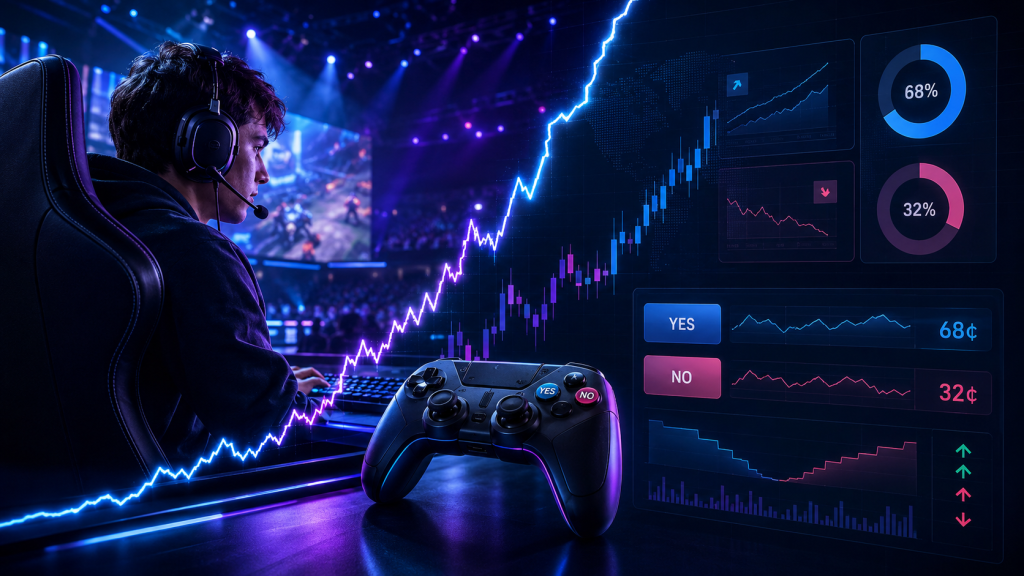
Prediction markets have expanded far beyond elections and economic forecasts. Gaming now represents one of their most natural growth areas, covering esports matches, anticipated releases, industry awards, review scores and sales milestones. The connection makes sense: gaming communities already analyze incomplete information, compare strategies and react quickly to patches, trailers, roster changes and developer announcements. Prediction markets turn that collective debate into a live price.
But are gaming prediction markets genuinely useful forecasting tools, or are they simply another form of betting dressed in the language of trading?
The answer depends partly on how the market is structured and why someone uses it. A well-designed market can combine information held by thousands of players and produce a useful estimate of what may happen. At the same time, a fast-moving contract with real money at stake can create many of the same behavioral and financial risks associated with gambling.
What Is a Gaming Prediction Market?
A prediction market allows participants to trade contracts based on the outcome of a future event. Many use a simple yes-or-no format. A contract might ask whether a particular game will launch before the end of the year, whether a team will win an esports tournament or whether a title will receive a certain review score.
A “Yes” contract priced at $0.70 is commonly interpreted as the market assigning roughly a 70% probability to that outcome. If the event occurs, the contract generally settles at $1. If it does not, it settles at zero. Prices can change continuously as traders respond to new information.
The Commodity Futures Trading Commission describes prediction markets as venues where event contracts can help users forecast, plan for and respond to future events. Unlike fixed sportsbook odds, a market price is created through buying and selling among participants. Traders can often exit before settlement instead of waiting for a final result.
Within gaming, these markets generally fall into two groups:
- Esports contracts based on competitive matches, tournaments and player performance
- Video game industry contracts covering launches, awards, sales, features and corporate decisions
Both depend on gaming knowledge, but they behave differently. An esports market may resolve within hours, while a contract tied to a delayed release or a future console announcement could remain active for months.
Esports Creates the Most Familiar Use Case
Esports prediction markets closely resemble sports markets because they are built around organized competition. Contracts can cover match winners, tournament champions or measurable statistics within games such as League of Legends, Counter-Strike 2 and Valorant.
Official platform listings show that these are no longer theoretical products. Kalshi, for example, maintains an active esports prediction market category with contracts linked to teams, leagues and individual matches.
Experienced viewers may believe they have an advantage because they understand map pools, team composition, current form and tactical tendencies. However, gaming expertise alone does not guarantee a profitable trade. The relevant question is not merely which team is more likely to win. A trader must decide whether the current price already reflects that likelihood.
Suppose a team appears to have a 60% chance of winning, while its contract trades at $0.75. The team may still be the favorite, but the price could be too expensive relative to the estimated probability. Prediction markets reward accurate pricing, not simply picking the stronger side.
Esports also introduces specific integrity risks. Players, coaches, tournament staff and developers may possess information that the public does not have. A last-minute illness, private roster dispute or undisclosed technical issue can materially change the probability of an outcome. Lower-tier competitions may be especially vulnerable because they attract less oversight and may offer participants smaller salaries.
Markets Can Track the Entire Gaming Industry
Some of the most interesting contracts are not tied to matches at all. Gaming provides a steady stream of uncertain, measurable events: release dates, console announcements, review scores, award winners and commercial milestones.
Current video game markets listed by Kalshi illustrate the range. Traders can encounter questions involving upcoming hardware, anticipated titles and major industry moments. A market can even estimate which game will win Game of the Year before critics and award voters make their final choices.
These contracts can aggregate information scattered across several communities. One trader may follow supply-chain reports, another may monitor developer interviews, while someone else understands a publisher’s history of delaying ambitious releases. Their combined trades produce a probability that can be easier to interpret than thousands of disconnected comments and rumors.
This has value beyond speculation. Journalists can use market movement as one indicator of changing expectations. Developers and publishers may observe how audiences respond to announcements. Fans gain a numerical snapshot of what the wider community currently believes.
However, a market price should never be treated as verified news. It reflects the opinions and financial positions of the people participating, not direct knowledge of the future.
Why Gaming Communities Fit Prediction Markets
Gamers are already comfortable with systems governed by probability. Critical-hit rates, item drops, matchmaking rankings and tactical risk are familiar parts of play. Competitive players regularly make decisions without having complete information.
Gaming communities are also unusually active in producing analysis. Fans inspect trailers frame by frame, track professional players’ match histories, study patches and compare developer statements. Prediction markets give that research an immediate outlet.
The format also makes passive viewing more interactive. A tournament becomes more engaging when its outcome is represented by a price that changes after every map or round. A long wait for a major release becomes a continuing debate as trailers, leaks and financial reports alter expectations.
That engagement has a less positive side. Rapid prices, push notifications, leaderboards and constant opportunities to trade can make a financial product feel like a game. When the interface emphasizes excitement more than risk, users may focus on being right while overlooking how much money they can lose.
Are They Trading or Gambling?
Prediction market operators generally describe their products as exchanges for event contracts rather than traditional sportsbooks. Participants trade with one another, prices move according to supply and demand, and the platform typically collects transaction fees instead of setting a conventional betting line.
From a user’s perspective, however, the distinction may feel less clear. Money is placed on an uncertain outcome, and an incorrect prediction can result in losing the full cost of the position.
Regulators are still debating where the boundary should sit. The CFTC has specifically examined event contracts involving “gaming” and whether certain products may conflict with the public interest. Its proposals and reviews demonstrate that terminology alone does not settle the matter.
Consumer advocates focus more on how the product affects users than on what it is called. A 2026 National Council on Problem Gambling survey found strong public support for applying gambling-like consumer protections to prediction markets.
The legal position also varies by jurisdiction and continues to change. A platform operating under one regulatory framework may be unavailable or treated differently elsewhere. Users should confirm local rules and the platform’s status before depositing money.
The Accuracy Problem
Prediction markets are often associated with the “wisdom of the crowd,” but a crowd becomes informative only under the right conditions. A useful market needs enough independent participants, access to relevant information and sufficient liquidity for prices to adjust.
Gaming markets do not always meet those conditions. A niche contract may be dominated by a small number of highly confident fans. Online rumors can cause traders to copy one another, while coordinated communities may temporarily push prices away from reasonable estimates.
Settlement rules matter just as much as participation. A question such as “Will the game launch this year?” sounds straightforward until an early-access version appears in one country or the publisher changes the meaning of “launch.” Reliable markets need an objective source, a precise deadline and clear treatment of ambiguous outcomes.
Where Gaming Prediction Markets Go Next
Gaming offers prediction markets an almost continuous supply of measurable events and an audience that already understands competition, probability and digital marketplaces. That makes further growth likely across esports, releases, awards and industry performance.
Their long-term credibility will depend on more than adding new contracts. Platforms will need clear settlement rules, meaningful protections for younger users, transparent fees, controls against insider activity and tools that help participants manage financial risk.
Used carefully, gaming prediction markets can reveal what an informed community believes and how those expectations change. Used impulsively, they can become little more than rapid-fire wagering with a trading interface. The technology can support both outcomes. What ultimately separates them is the quality of the market, the strength of its safeguards and the discipline of the people using it.

I’m Alex Mercer, a senior gaming and esports writer at GamingImba. I’ve been involved in gaming for as long as I can remember, and for more than a decade I’ve been writing about competitive play, industry trends, and the culture that grows around games.
My work focuses on esports, online gaming platforms, and how technology continues to shape the way people play, compete, and connect. I’m especially interested in meta shifts, balance changes, and the business decisions that influence modern games behind the scenes.
At GamingImba, I aim to break down complex topics in a way that’s clear, honest, and useful—whether that means analyzing a major tournament, exploring new gaming platforms, or looking at how player behavior evolves over time.
I follow global esports scenes closely, experiment with different games and mods in my free time, and enjoy digging into the details that most players notice but rarely stop to question.