
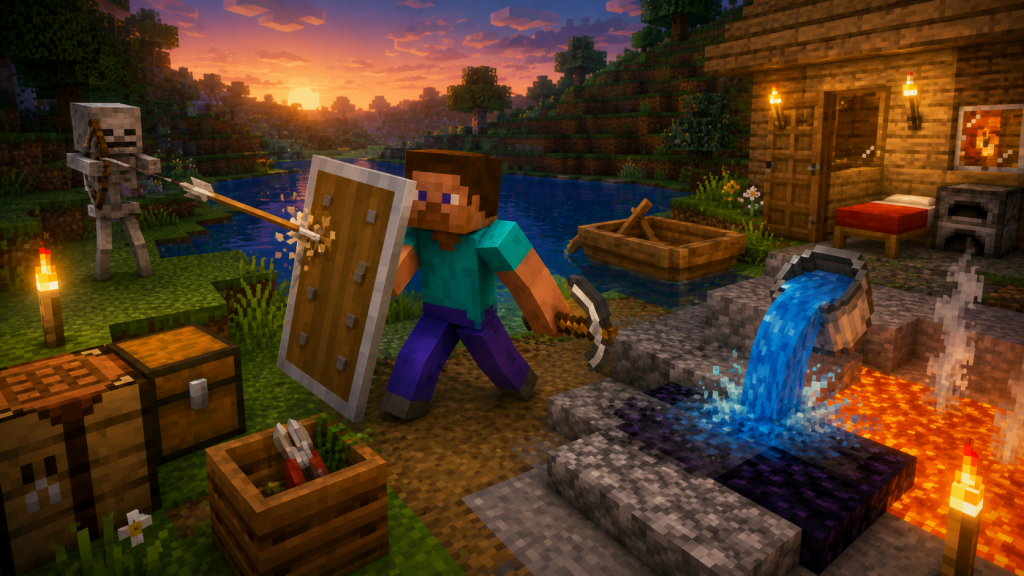
Minecraft beginners usually focus on the obvious items first: swords, pickaxes, armor, diamonds and maybe a nice-looking starter house. Those things are important, of course, but they are not always what keeps you alive, organized and progressing smoothly.
Some of the most useful Minecraft items are actually simple, cheap and easy to get. The problem is that many new players do not realize how powerful they are until much later. A shield can save you from a creeper. A bucket can turn danger into safety. A boat can help you travel faster, trap mobs and escape awkward situations. These are not “fancy” items, but they can completely change the way you play.
If you are still learning Survival Mode, here are the most useful Minecraft items beginners often ignore, what they do, how to get them and why they deserve a permanent place in your inventory.
Shield

The shield is one of the best early-game items in Minecraft, yet many beginners delay crafting it because they are focused on making better weapons. That is a mistake. A shield can block many incoming attacks from the front, including arrows and melee hits, making it extremely valuable before you have strong armor.
To craft a shield, you need wood planks and one iron ingot. That means you can make one very early, usually after your first short mining trip. Once equipped, the shield can be used to protect yourself when skeletons shoot at you, zombies approach or you are exploring dangerous caves.
The shield is especially useful because it gives new players more time to react. Instead of panicking when a skeleton appears, you can block, move closer and attack safely. It also makes nighttime exploration less stressful. Even if you are not confident in combat yet, a shield gives you a simple defensive option that can prevent many early deaths.
Water Bucket

A water bucket looks ordinary, but experienced players treat it like a survival tool. It can stop fall damage if placed at the right moment, turn lava into obsidian or cobblestone, push mobs away, help you climb or descend safely and protect you during mining.
To get one, you need three iron ingots to craft a bucket. Then you can fill it with water from any water source block. It is a good idea to carry a water bucket whenever you go mining, exploring caves or traveling through mountains.
For beginners, the biggest advantage is safety around lava. Instead of losing all your items in a lava pool, you can place water to cool the lava and create a safer path. It is also useful if you catch fire, because stepping into water quickly puts you out. Later, once you get more comfortable, the water bucket becomes one of the most flexible movement tools in the game.
Boat

Most new players think of boats only as a way to cross rivers and oceans. That is useful enough, but boats can do much more than that. They are cheap, fast and surprisingly helpful for controlling mobs.
A boat is crafted from wood planks. Depending on your version, the exact recipe may vary slightly, but it is still one of the easiest items to make early. Once placed, you can ride it across water much faster than swimming. This makes exploration easier, especially when you are looking for villages, shipwrecks, ocean ruins or new biomes.
The overlooked part is that boats can trap many mobs. If a hostile mob walks into a boat, it can get stuck sitting inside it. This can help you deal with zombies, skeletons, villagers, animals and other mobs without complicated redstone or fences. For example, if you find a zombie villager and want to cure it later, a boat can help keep it in place. For a beginner, this is a simple trick that feels almost like a cheat code.
Bed

Most players know they need a bed, but many underestimate how useful it really is. A bed is not just for skipping the night. It also sets your spawn point, which means you respawn there after dying instead of going all the way back to the original world spawn.
To craft a bed, you need three wool and three wood planks. Wool usually comes from sheep, and planks come from logs. You can collect wool by killing sheep, but shears are better once you have iron, because they let you gather wool without killing the animal.
A bed is essential when you travel far from home. If you build a temporary base, sleep in the bed before exploring nearby caves or villages. That way, if something goes wrong, you do not lose half an hour trying to find your way back. Just remember that beds work normally in the Overworld, but using them in the Nether or the End is dangerous because they explode.
Torches and Charcoal
Torches are one of the most important survival items in Minecraft, but beginners often do not bring enough of them. Darkness is dangerous because hostile mobs can spawn in dark areas. Good lighting makes your base, mine and paths much safer.
Torches are made with sticks and coal or charcoal. Coal is found while mining, but charcoal is often easier at the start. You can make charcoal by smelting logs in a furnace. This is helpful when you cannot find coal right away but still need light.
The best habit is to craft more torches than you think you need before entering a cave. Place them regularly as you explore, not only to prevent mob spawns but also to mark where you have been. Some players place torches on one side of cave walls so they can follow them back to the exit. It is a simple trick, but it can save you from getting lost underground.
Shears
Shears are easy to ignore because they do not look as exciting as tools or weapons. However, they are very useful in the early and mid-game. Their most obvious use is collecting wool from sheep without killing them, which gives you a renewable source of wool for beds, carpets and decoration.
To craft shears, you need two iron ingots. Once you have them, you can use them on sheep, leaves, vines, cobwebs and other blocks depending on your version. For beginners, the main benefit is wool. Instead of searching for new sheep every time you need another bed, you can keep a small sheep pen and shear them whenever their wool grows back.
Shears also help with building and decoration. Leaves can be collected and used for hedges, trees, gardens or natural-looking builds. Cobwebs can be gathered in certain places and used later for traps or decoration. They are not required for survival, but they make your world easier to manage and more creative.
Composter
The composter is one of those blocks many players walk past without thinking about it. It does not seem exciting, but it is extremely useful if you farm crops or collect lots of plant materials.
A composter is crafted from wooden slabs. You can put many organic items into it, such as seeds, crops, leaves and other plant-based materials. As it fills up, it eventually produces bone meal. Bone meal can then be used to speed up crop growth, grow trees faster or produce flowers and grass.
This is especially useful for beginners who want a steady food supply. Instead of waiting for crops to grow naturally, you can use bone meal to speed up wheat, carrots, potatoes or other farm items. It also gives a purpose to extra seeds and plant materials that would otherwise sit uselessly in a chest.
A composter is also connected to villager professions, because it can turn an unemployed villager into a farmer. That becomes useful later if you want to start trading for food and emeralds.
Bundle
The bundle is a very useful inventory item, especially for players who love exploring but always end up with messy inventories. It lets you store different small stacks of items inside one inventory slot, making it easier to carry random loot without filling every slot.
A bundle can be crafted with leather and string. Leather can be obtained from cows, horses, donkeys, llamas and similar animals, while string often comes from spiders, cobwebs or other sources. Once you have a bundle, you can place different items inside it and carry them together.
This is great during mining trips, when you pick up a little bit of everything: seeds, flowers, flint, bones, string, copper, lapis, redstone and random mob drops. Instead of using ten separate inventory slots for tiny amounts of items, you can store many of them in one bundle.
Beginners often underestimate inventory management, but it matters a lot. A full inventory can force you to throw away useful items or leave loot behind. Bundles help reduce that problem before you have access to late-game storage options.
Scaffolding
Scaffolding is not usually a day-one item, but beginners who start building bigger houses, towers or farms should learn about it early. It makes building upward and downward much easier and safer than stacking dirt blocks under your feet.
Scaffolding is crafted from bamboo and string. Bamboo can be found in jungle biomes and sometimes through other exploration methods, while string is usually obtained from spiders or cobwebs. Once crafted, scaffolding can be placed quickly and climbed like a temporary structure.
The main advantage is convenience. You can build walls, roofs, towers and tall structures without constantly placing and breaking random blocks. Scaffolding is also easy to remove, because breaking the lower support can cause connected scaffolding to fall. For players who enjoy building, it is one of the best quality-of-life items in the game.
Lead
A lead is useful for moving animals, and many beginners do not realize how much time it can save. Instead of pushing animals slowly or trying to lure them with food, you can attach a lead and guide them where you want.
Leads can be obtained in several ways, including crafting with string and a slimeball, finding them in some loot sources or getting them from wandering traders’ llamas if the lead drops. The crafting route requires slimeballs, which usually come from slimes, so leads may not always be available immediately. Still, once you get one, keep it.
Leads are helpful for moving cows, sheep, horses and other animals to your base. They also help when setting up farms, transporting animals across short distances or tying animals to fence posts so they do not wander away. If you want a reliable food source, leather source or wool source, leads make animal management much easier.
Lava Bucket
A lava bucket is dangerous in careless hands, but very useful when handled properly. It can be used as fuel in a furnace, as a defense tool, or as part of simple farms and builds. For beginners, the most practical use is fuel.
To get one, craft a bucket with three iron ingots and fill it from a lava source block. Lava is commonly found underground, especially deeper in the world, and also in pools on the surface or in the Nether.
One lava bucket can smelt many items, making it far more powerful than a single piece of coal. This is useful if you are smelting large amounts of ore, stone, sand or food. However, always be careful where you place lava. It can spread, burn items and destroy parts of your base if used badly. Keep it in a controlled area and do not place it near wood.
Final Thoughts
The most useful Minecraft items are not always the rarest ones. Many of the best beginner tools are simple items made from wood, iron, string, wool or basic farm materials. A shield can keep you alive. A water bucket can save your items from lava. A boat can help you travel and trap mobs. A composter can turn leftovers into faster crops. A bundle can keep your inventory under control.
Beginners often chase diamonds too early, but Minecraft becomes much easier when you learn to use the small items well. Before your next mining trip or adventure, check your inventory. If you have a shield, water bucket, boat, bed, torches and some food, you are already much better prepared than most new players.
In Minecraft, survival is not only about having the strongest gear. It is about knowing which simple items can solve big problems.

I’m Alex Mercer, a senior gaming and esports writer at GamingImba. I’ve been involved in gaming for as long as I can remember, and for more than a decade I’ve been writing about competitive play, industry trends, and the culture that grows around games.
My work focuses on esports, online gaming platforms, and how technology continues to shape the way people play, compete, and connect. I’m especially interested in meta shifts, balance changes, and the business decisions that influence modern games behind the scenes.
At GamingImba, I aim to break down complex topics in a way that’s clear, honest, and useful—whether that means analyzing a major tournament, exploring new gaming platforms, or looking at how player behavior evolves over time.
I follow global esports scenes closely, experiment with different games and mods in my free time, and enjoy digging into the details that most players notice but rarely stop to question.


