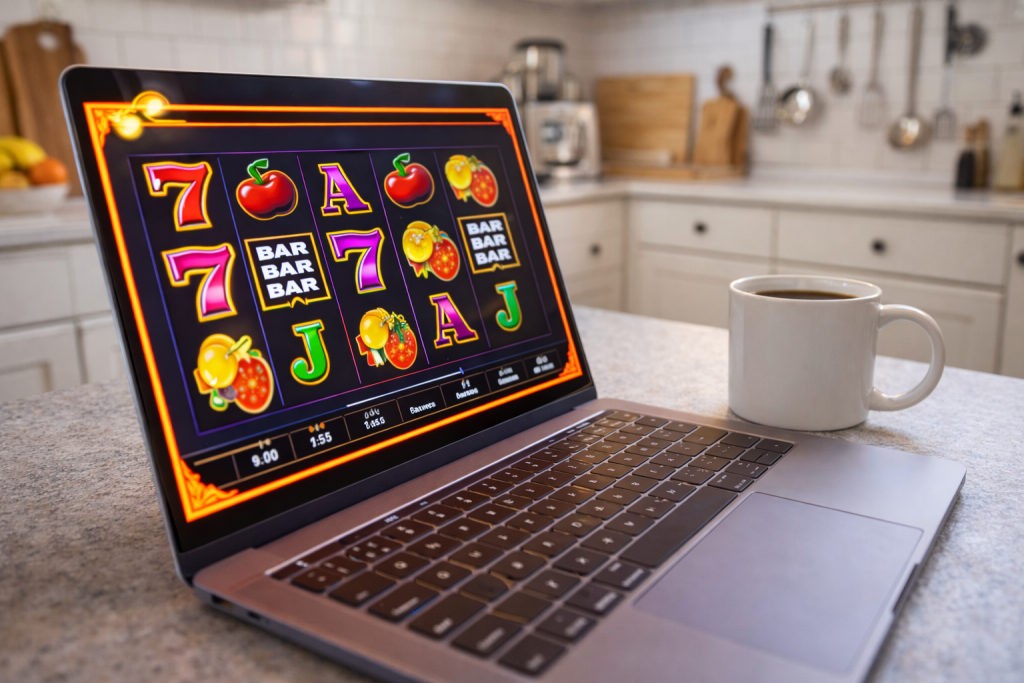
Online slots combine a simple way to start playing with a wide range of themes, features and mobile-friendly designs. Those qualities help explain their visibility in online casinos. Revenue figures also show their commercial importance, although revenue alone cannot tell us why individual players choose them.
My view is that the format is easy to understand at the surface: choose a stake and start a spin. Understanding the financial side takes more attention. An accessible interface does not make a game forgiving, and attractive graphics do not change the meaning of its published odds.
What U.S. Market Figures Actually Show
The Pennsylvania Gaming Control Board’s September 2026 report separates online slots from other gambling categories. It records $197.37 million in iGaming slots revenue, compared with $181.09 million in September 2025, an increase of 8.99%.
The same report lists $249.31 million in total online casino revenue for September 2026. Online slots therefore accounted for approximately 79.2% of that total, calculated from the published figures. This supports a clear claim about their commercial importance in Pennsylvania during that month.
Revenue is not profit, player numbers or total wagers. A 79.2% revenue share does not mean 79.2% of customers played slots. Pennsylvania’s figures should not be presented as a nationwide share, and its online slots revenue must not be confused with revenue from physical casino machines.
For broader context, the American Gaming Association’s revenue tracker provides national and state-level commercial gaming data. Our separate article on the U.S. online casino market explores the wider industry.
Online Casino Availability Is State-Specific
This article concerns real-money online casino slots offered through state-authorized operators. It does not assume that online casino play is available throughout the United States or that a sportsbook license authorizes online casino games.
Check the relevant state regulator’s information for authorization and eligibility. For example, the Michigan Gaming Control Board maintains a list of authorized platform providers that identifies their permitted activities. A familiar brand name alone does not establish authorization for every product in every state.
Why the Basic Format Is Accessible
Compared with a game that asks you to make repeated strategic decisions, a conventional slot has a straightforward core interaction. The rules can still be detailed, particularly when there are multipliers, special symbols or feature rounds, but the action needed to begin is simple.
I think this distinction matters. “Easy to start” describes the interface. It does not mean the player can skip the paytable, understand every feature immediately, or influence a random result through better timing.
Variety Changes the Presentation and Sometimes the Rules
Slots can use different settings, reel layouts, symbol combinations and bonus structures. Some use fixed paylines; others use ways-to-win systems or changing reel arrangements. A theme can make two games feel different even when their basic interactions are similar.
Features can also change how a game works. Our coverage of Redtail Robber: Cash Vault Heist is an example of looking at a specific title rather than treating every slot as identical.
My preference is to separate the visual appeal from the rules. A cinematic bonus animation tells you something about presentation; the paytable and game information tell you what triggers it and how awards are calculated.
Mobile Access Explains Convenience, Not Better Odds
A spin button and a compact play area can fit comfortably on a touchscreen. That makes the format adaptable to phones, provided the developer keeps the stake, balance, rules and controls legible.
I would judge a mobile layout by whether that information is easy to find. A large spin button is not enough if the current stake is unclear or the paytable is difficult to read.
Mobile access is part of the broader shift toward online gambling products. It does not establish that slots benefited more than every other category, or that short sessions have little financial consequence.
RTP, House Edge and Volatility Explained
These terms answer different questions. Treating them as interchangeable can create misleading expectations.
| Term | What it describes | What it does not promise |
|---|---|---|
| RTP | The theoretical proportion of total stakes returned as prizes over a very large volume of play | A personal refund or a fixed return during one session |
| House edge | For the same theoretical model, the proportion remaining after subtracting RTP from 100% | The exact amount any individual will lose |
| Volatility | How widely results can vary around the expected return | A timetable for wins or a guarantee that losses will be recovered |
RTP is a mathematical expectation over a very large volume of play, not a promised outcome for one session. Volatility describes variation in results around that expectation. Michigan’s internet game laboratory submission instructions require paytable information, RNG details and RTP calculation sheets. Those are concrete examples of the mathematical documentation behind regulated games.
A Hypothetical 96% RTP Example
Suppose a game has a theoretical RTP of 96%. Across $10,000 in aggregate stakes, its mathematical expectation would be $9,600 returned in prizes and a $400 difference. This is an illustration of the model, not a prediction for a particular $10,000 of play.
It does not mean a $100 deposit will leave $96 in your account. Total stakes can include money wagered repeatedly, and short-term outcomes can differ substantially from the theoretical average.
I would read RTP as information about the game’s mathematics, never as a reason to expect money back after a losing run. Check the information for the specific game version offered by the state-authorized operator.
Near-Misses Do Not Mean a Win Is Approaching
A result that looks close to a large award is still a losing result if the required combination did not occur. On an independently random base-game spin, previous losses do not make the next spin “due” to win. Persistent features, where present, must be understood through their specific rules.
For an independently random spin, a near-miss is not evidence of progress toward a future award. Michigan’s laboratory submission requirements include information about the game’s random number generator. The important distinction is between a game’s documented mechanics and a visual impression that a result was “almost” a win.
Sounds and animations can make a result feel significant. My assessment is that the relevant information remains the actual award compared with the stake. A return smaller than the amount wagered is still a net loss on that spin.
In-Game Bonuses and Casino Promotions Are Different
A bonus round is a feature within a game’s rules. Promotional free spins or bonus funds are an offer from an operator, with separate conditions. The same word can describe very different things.
For a promotion, check:
- Whether a deposit is required and which games qualify.
- The stake value assigned to any promotional spins.
- Any wagering requirements and which funds they apply to.
- Expiry dates, withdrawal restrictions and other significant conditions.
New Jersey’s internet gaming regulations require bonus and promotional wagering offers to be clearly stated and readily accessible. That is a New Jersey requirement, not a claim that every state uses identical rules. I would evaluate an offer’s conditions before treating its headline value as a benefit.
New Formats Need Clear Descriptions
Not every product using the word “slots” is presented in the same way. For example, our report on live-streamed slots in New Jersey and Pennsylvania concerns a different format from simply opening a conventional digital slot. It should not be described interchangeably with live-dealer table games.
Clear labels help readers understand what is actually being offered. Novel presentation alone does not establish better returns or more favorable rules.
My Assessment of Their Continuing Appeal
The clearest explanation combines an accessible core interaction, varied presentation and convenient distribution. The Pennsylvania revenue figures show that slots are commercially central in that state’s online casino market; the design observations help explain how the format accommodates many different titles.
Online slots remain prominent in U.S. online casinos because they combine straightforward controls, varied themes and a format that works well on mobile. Pennsylvania’s revenue figures show their commercial importance in one regulated market, though they don’t establish a nationwide pattern. To me, that combination of familiar gameplay and constantly changing presentation best explains the format’s staying power.

I’m Alex Mercer, a senior gaming and esports writer at GamingImba. I’ve been involved in gaming for as long as I can remember, and for more than a decade I’ve been writing about competitive play, industry trends, and the culture that grows around games.
My work focuses on esports, online gaming platforms, and how technology continues to shape the way people play, compete, and connect. I’m especially interested in meta shifts, balance changes, and the business decisions that influence modern games behind the scenes.
At GamingImba, I aim to break down complex topics in a way that’s clear, honest, and useful—whether that means analyzing a major tournament, exploring new gaming platforms, or looking at how player behavior evolves over time.
I follow global esports scenes closely, experiment with different games and mods in my free time, and enjoy digging into the details that most players notice but rarely stop to question.