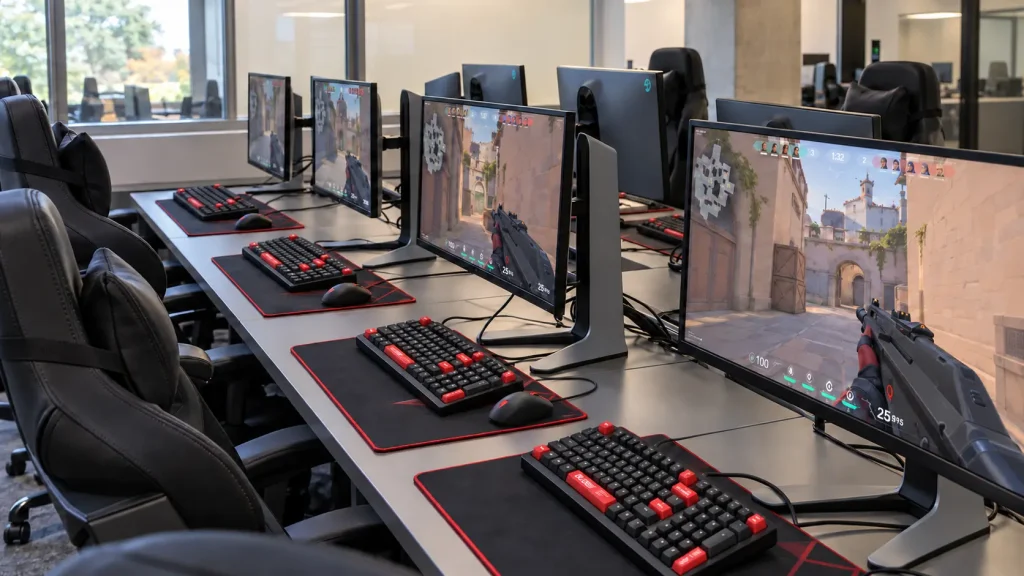
Can you go to university and play esports? Yes. Can you earn a degree connected to the industry? Also yes. But those two opportunities are not necessarily part of the same program.
Some universities recruit competitive players to represent them in tournaments. Others teach students how to organise events, produce broadcasts or manage an esports business. Many also have gaming clubs where students can participate without needing an exceptional competitive ranking.
That distinction matters when comparing institutions. A university with a successful League of Legends team might not offer an esports degree. A university teaching esports business might have no intention of training future professional players.
This guide looks at universities in the United States and Europe, drawing on their published program information checked in October 2026. It is a selection of established examples, rather than a ranking of the best institutions worldwide.
What Does a University Esports Program Include?
Before looking at individual universities, it helps to understand the different options.
A varsity esports program is an officially supported university competitive program. Players represent their institution, usually with organised practices and some level of coaching or staff support. Places are typically awarded through recruitment or tryouts.
A gaming club generally offers a broader social or competitive experience. Students may organise tournaments, form teams or simply meet people who enjoy the same games. Some clubs compete seriously, so “club” does not automatically mean casual.
An esports scholarship provides financial support under specified conditions. It might cover part of a student’s costs, but the word scholarship should never be assumed to mean a fully funded education.
An esports degree or certificate is an academic qualification. Depending on the course, students might study business, broadcasting, event management, coaching or competitive performance.
I would start any comparison by asking which of these opportunities I actually wanted. Otherwise, it is surprisingly easy to compare institutions that are offering quite different things.
Universities with Esports Programs in the USA
The American examples below are particularly useful for understanding university-supported competition. Students can pursue an academic qualification while also trying to earn a place on a team.
However, admission to the university and selection for an esports roster are separate decisions. Being accepted academically does not automatically guarantee a team position or scholarship.
University of California, Irvine
University of California, Irvine, usually called UCI, offers a clear example of a university esports program with published information about its teams and financial support.
Its official program pages list varsity teams in League of Legends and Valorant. Players must be enrolled UCI students, and team selection involves tryouts assessed by program staff.
The university states that esports athletes receive partial scholarships of $3,000 or $6,000 per year. These are useful figures, but they need to be understood in context: they are partial awards, rather than a promise that the university will cover every expense.
The program also describes a commitment of around 15 hours per week during the season for practices, matches and meetings, with additional individual practice expected.
What I find useful here is the visibility of the commitment. Joining a university team is not simply an extension of playing whenever you feel like it. There is a schedule, and academic work still needs to fit alongside it.
UCI is an example to consider for its competitive teams and esports scholarships. Those features should not be confused with confirmation of a dedicated esports degree.
Maryville University
Maryville University, in Missouri, offers several routes into its esports community.
Its structure includes a high-level competitive program, an Academy and a student-led gaming club. That gives students different ways to participate depending on their experience and ambitions.
The Academy lists games including League of Legends, Overwatch, Rocket League, Valorant, Apex Legends, Call of Duty and Super Smash Bros. Its teams range from more demanding competitive groups to those offering a less intensive experience.
The program’s published information lists $2,000 club scholarships for accepted students participating on an active Academy team. That should not be presented as the standard award for every esports participant or every varsity recruit.
The distinction between the competitive tiers is worth keeping. A player hoping to compete at the highest collegiate level is looking for a different experience from someone who mainly wants regular matches and a gaming community.
Personally, I like seeing those options explained openly. University gaming should have room for students who enjoy competition without making professional play their central goal.
Harrisburg University
Harrisburg University, in Pennsylvania, operates its esports program under the HU Storm name.
The university lists competition in Valorant, Rocket League, League of Legends, Overwatch 2 and Super Smash Bros. Ultimate. Its program includes varsity and junior varsity opportunities, alongside activities for students interested in supporting the teams.
The university also has a student-led gaming club. That provides another route for students who want to participate without securing a place on a selected competitive roster.
Harrisburg describes scholarship support and dedicated facilities, including an esports housing opportunity. However, applicants should request current details rather than assume that older reports about scholarship packages apply to every new recruit.
An important feature is that students pursue their academic studies while taking part in esports. Playing for HU Storm does not mean that esports itself must be their degree subject.
There are also opportunities around the competition. Students interested in organising activities or working with a team may find that involvement more relevant than trying out as a player.
Boise State University
Boise State University, in Idaho, publishes detailed information about recruitment and its expectations of players.
Its recruitment page includes Overwatch 2, Valorant, Super Smash Bros. and Street Fighter 6, among other titles. The program describes coaching, organised practice, broadcasts and possible travel opportunities.
Players can be considered for scholarships, although awards vary and are subject to eligibility and availability.
One of the more interesting details is how the university discusses selection. Competitive ability matters, but so do communication, teamwork and willingness to accept coaching.
That feels like a useful corrective to the idea that a high ranking automatically makes someone the ideal teammate. A player needs to contribute to a group, follow a schedule and respond to feedback.
Boise State also expects students to maintain academic performance and meet conduct requirements. The program is therefore worth examining for both its competitive opportunities and the responsibilities attached to them.
University of Akron
The University of Akron, in Ohio, offers varsity esports alongside club and recreational gaming.
Its published information lists games including Rocket League, Valorant, Overwatch 2, Call of Duty, Rainbow Six Siege, Fortnite and Super Smash Bros. Ultimate.
The university advertises scholarship opportunities for varsity participants. Applicants should confirm the current amount, conditions and availability directly with the program.
Akron also invites participation from students interested in areas such as broadcasting, design and the support work surrounding competition.
On the academic side, it offers an Esports Business Certificate. This is an important detail to describe accurately: a certificate is not the same qualification as a full bachelor’s degree.
Akron is therefore a useful example of an institution where competitive play, student participation and academic study connected to esports can exist alongside one another.
Universities with Esports Degrees in Europe
The European examples below show different approaches to academic study.
Although each course uses esports in its title, the content is not identical. One might concentrate on producing events, while another includes practical work on competitive performance.
I would pay more attention to the module list than the course name. The title tells you the subject area; the modules give a much better indication of how you will spend your time.
University of Staffordshire, United Kingdom
University of Staffordshire offers a BA (Hons) Esports and states that it was the first university in the UK to introduce an esports degree.
The course covers areas including broadcasting, digital media, event management, marketing and business. Facilities include a 60-seat esports arena, a multi-camera studio and production galleries.
A particularly important clarification appears on the course page: gaming skills are not taught on the BA. Competitive gaming opportunities are available through extracurricular activities, but the degree focuses on the work surrounding the industry.
That makes it relevant to students who enjoy esports but are more interested in organising a tournament, managing a broadcast or building a business than becoming a professional player.
The university describes practical opportunities involving events and industry projects. Applicants should examine how those activities are incorporated into their chosen course and intake.
For me, Staffordshire illustrates why “studying esports” needs explanation. Much of the work concerns the people and processes that allow a competition to happen.
University of Chichester, United Kingdom
University of Chichester offers a BA (Hons) Esports at its Bognor Regis campus.
Its published curriculum combines competitive gameplay development, sports science, psychology, coaching, business and event production.
That makes its approach different from a course focused mainly on broadcasting or commercial operations. Students examine performance as well as the wider organisation of esports.
The university describes work involving game analysis, physical and psychological demands, and the planning of live events. Later study also includes coaching and management.
Chichester is therefore a useful example for someone interested in how players prepare and improve, alongside how competitions are organised.
However, a degree that includes gameplay is not a guarantee of a professional playing career. It remains an academic course with assessments, projects and broader learning requirements.
I think that is worth stating plainly. Enjoying games can be a reason to explore the course, but applicants should also be interested in the subjects they will study around them.
Kajaani University of Applied Sciences, Finland
Kajaani University of Applied Sciences, commonly called KAMK, offers an Esports Business program leading to a Bachelor of Business Administration.
The published structure is 3.5 years and 210 ECTS credits, with studies based in Kajaani.
Its focus includes business operations, digital marketing and event management. Students study business principles through examples and activities connected to esports.
KAMK explicitly states that the program is not a player training course and is not primarily intended to improve students’ in-game ability.
Practical opportunities include involvement with its KAMK.GG organisation and campus activities.
This is an example for students who want to work with teams, sponsors, events or commercial projects. The degree title also makes the underlying academic direction clear: it is business education with an esports focus.
As with the British courses, applicants should check the intake-specific requirements, teaching arrangements and fees rather than rely on a general description.
Can You Get an Esports Scholarship?
Yes, some universities offer scholarships connected to esports participation. However, the size and conditions differ.
An award may depend on selection for a particular roster, continued eligibility or other program requirements. It may cover only part of the cost of attendance.
Before comparing offers, students should establish:
- The actual amount awarded
- Which costs it covers
- Whether it can be renewed
- What academic and participation conditions apply
- Whether international students are eligible
- What happens if the student leaves the team
A scholarship figure has limited meaning without the overall cost of studying and living at that institution.
For an international applicant, it is especially important to separate university admission, team recruitment, financial support and immigration requirements. Success in one area does not automatically settle the others.
Do You Need to Be an Excellent Player?
That depends on what you are applying for.
A place on a highly competitive university team can require strong results, relevant team experience and a successful tryout. A gaming club may welcome a much wider range of abilities.
An academic esports course can have different priorities again. Its entry requirements may concern previous qualifications, English-language ability and readiness for the coursework rather than an elite gaming rank.
Being good at a game and being suited to an esports degree are different questions.
I would also look at what happens if your interests change. A student who stops competing may still want useful academic skills, supportive staff and a university they enjoy attending.
How Should You Compare Universities?
Start with the experience you want.
If the goal is to compete, examine the games supported, recruitment process, coaching and weekly commitment.
If the goal is to work in the industry, compare course content, practical assignments, facilities and opportunities to gain experience.
If the goal is to meet people and enjoy gaming, a well-run student club may be enough.
Some universities can offer several of those things, but no institution should be chosen on esports facilities alone.
My view is that the strongest option is one where both sides make sense: the esports opportunity interests you, and the education remains worthwhile even if your playing plans change.
The examples across the USA and Europe show that there is no single university esports model. There are competitive teams, partial scholarships, social communities and academic qualifications. Understanding which one you want makes the search far more useful.

I’m Alex Mercer, a senior gaming and esports writer at GamingImba. I’ve been involved in gaming for as long as I can remember, and for more than a decade I’ve been writing about competitive play, industry trends, and the culture that grows around games.
My work focuses on esports, online gaming platforms, and how technology continues to shape the way people play, compete, and connect. I’m especially interested in meta shifts, balance changes, and the business decisions that influence modern games behind the scenes.
At GamingImba, I aim to break down complex topics in a way that’s clear, honest, and useful—whether that means analyzing a major tournament, exploring new gaming platforms, or looking at how player behavior evolves over time.
I follow global esports scenes closely, experiment with different games and mods in my free time, and enjoy digging into the details that most players notice but rarely stop to question.