Last updated: November 5, 2026
You can legally bet on an NFL game in Indiana, but try doing the same with a Counter-Strike tournament and you’ll run into a problem. The state doesn’t allow esports betting. Drive west to Kansas, however, and you’ll find a different set of rules, with several major gaming competitions approved for wagering.
It’s a strange situation for an industry that attracts millions of viewers and has professional players competing for enormous prize pools. A tournament might be watched across the country, yet fans in different states don’t necessarily have the same options when it comes to placing a bet.
Esports betting is legal in parts of the United States, but the rules depend on where you live, which game you’re interested in, and sometimes the exact tournament you want to bet on. Even states with established online sportsbooks don’t always permit competitive gaming wagers.
And the rules are still changing. Missouri opened its regulated sports betting market in December 2025, while Massachusetts approved a limited selection of competitive gaming events in February 2026.
So, where can you legally bet on esports in the USA, and which states still restrict it?
Is Esports Betting Legal in the United States?
The short answer is yes, although there isn’t a single law covering the entire country.
To understand why, we need to go back to May 14, 2018. That was when the U.S. Supreme Court struck down the Professional and Amateur Sports Protection Act (PASPA), a federal law that had prevented most states from authorizing sports betting.
The decision didn’t make gambling legal everywhere overnight. What it did was give individual states room to establish their own sports betting systems, including rules about licenses, customer age limits, and eligible events.
Esports ended up in a rather awkward position.
Some lawmakers treated professional gaming as another competitive sport and included it in their betting legislation. Others were less convinced. Questions about cheating, match-fixing, younger players, and how tournaments are organized made certain regulators cautious.
That’s why legal sports betting and legal esports betting aren’t necessarily the same thing.
A state might allow bets on the Super Bowl or NBA Finals while refusing wagers on the League of Legends World Championship. Another might approve League of Legends but not a smaller tournament featuring exactly the same game.
There is also a difference between allowing esports betting under state law and having a sportsbook that actually offers it. Operators aren’t required to list every approved competition, and their selections can change.
Personally, I would start with the state’s gaming regulator rather than assume that an esports market is legal simply because a sportsbook displays odds for it somewhere else.
Where Is Esports Betting Legal? All 50 States Explained
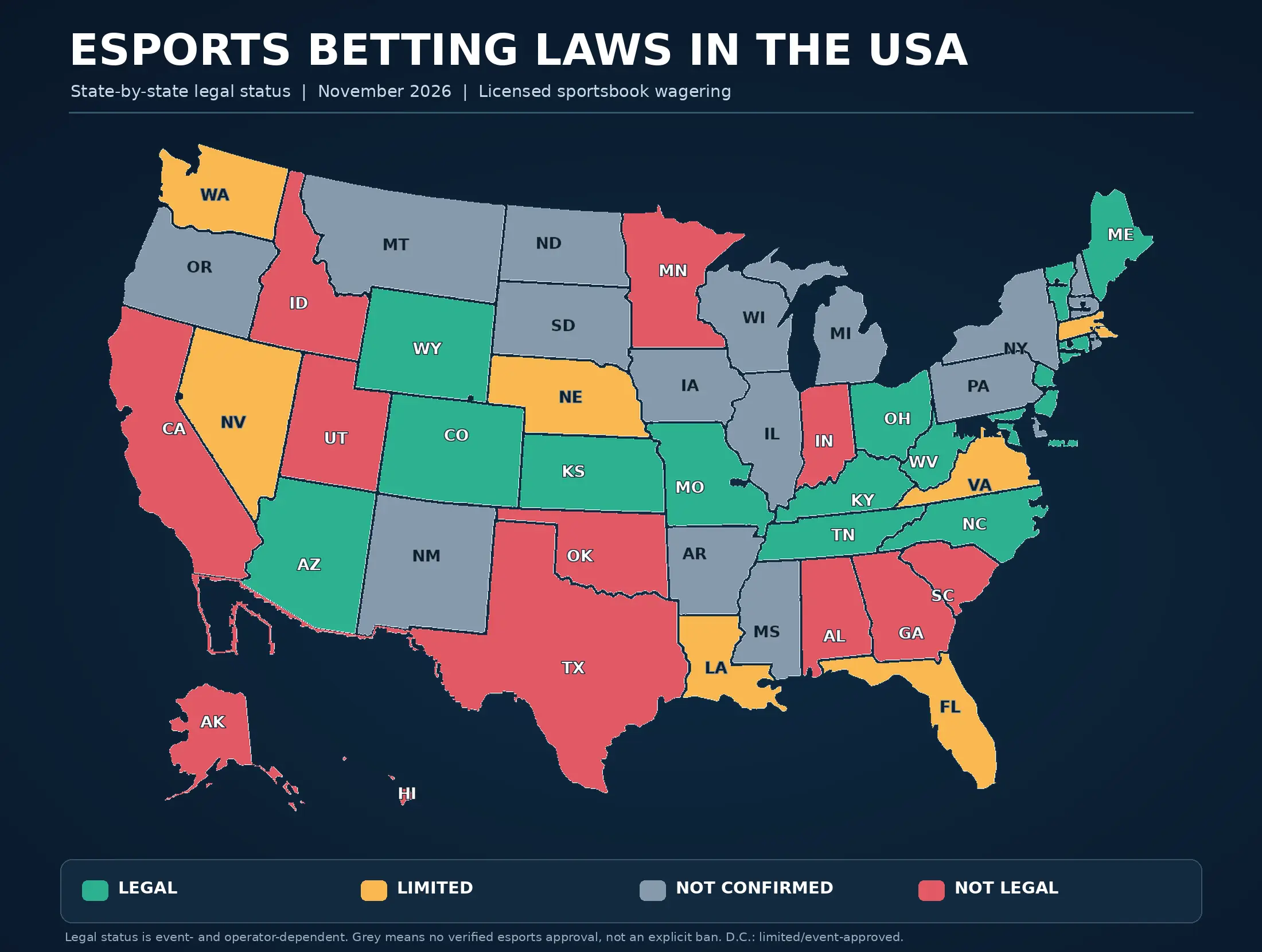
Here’s how the rules stand in November 2026. The table covers conventional real-money esports betting through licensed sportsbooks. It doesn’t include offshore websites, fantasy esports contests, or prediction-market contracts, which can fall under different regulations.
| State | Status | What you should know |
| Alabama | Not legal | No regulated sportsbook market. |
| Alaska | Not legal | Sports betting hasn’t been legalized. |
| Arizona | Legal | Esports is covered by the state’s 2021 betting framework. |
| Arkansas | Not authorized | Legal sports betting, but no approved esports offering established. |
| California | Not legal | Conventional sports betting remains illegal. |
| Colorado | Legal | Only qualifying events and approved wagers. |
| Connecticut | Legal | Licensed operators and event restrictions apply. |
| Delaware | Not authorized | Sportsbooks operate, but esports isn’t an approved category. |
| Florida | Limited, confirmed esports offerings | Hard Rock Bet operates legally; individual esports market approval needs checking. |
| Georgia | Not legal | No regulated sportsbook market. |
| Hawaii | Not legal | Sports betting remains prohibited. |
| Idaho | Not legal | No licensed sportsbooks. |
| Illinois | No confirmed approval | Sports betting is legal, but general esports authorization hasn’t been established. |
| Indiana | Prohibited | State law specifically forbids esports wagers. |
| Iowa | Not authorized | Esports isn’t included in the approved sportsbook offerings. |
| Kansas | Legal | Numerous games and tournaments appear in the official catalog. |
| Kentucky | Legal | Esports is expressly recognized under the 2023 law. |
| Louisiana | Restricted | Esports events require individual approval. |
| Maine | Legal | Approved sportsbook catalogs include major esports titles. |
| Maryland | Legal, restricted | State law expressly includes esports competitions involving participants aged 18 or older. Approved markets are subject to regulator rules. |
| Massachusetts | Limited | Selected competitive gaming events were approved in 2026. |
| Michigan | No confirmed approval | No established general esports authorization. |
| Minnesota | Not legal | No general licensed sports betting market. |
| Mississippi | No confirmed approval | Retail sportsbooks operate, but esports approval isn’t established. |
| Missouri | Legal | Esports is included in the sports betting framework. |
| Montana | Not authorized | Limited sports betting, without established esports offerings. |
| Nebraska | Restricted | Approved events only, with bets placed in person. |
| Nevada | Legal | Regulated esports wagering with specific integrity requirements. |
| New Hampshire | Not authorized | Esports isn’t a generally approved sportsbook category. |
| New Jersey | Legal | Selected events and betting markets are permitted. |
| New Mexico | No confirmed approval | Tribal sportsbooks operate, but general esports approval is unconfirmed. |
| New York | Not authorized | Traditional sportsbooks operate, but esports wagering isn’t generally approved. |
| North Carolina | Legal | Esports is recognized under the state’s betting law. |
| North Dakota | No confirmed approval | Limited tribal sports betting arrangements. |
| Ohio | Legal | Esports is recognized, subject to event approval. |
| Oklahoma | Not legal | No general regulated sportsbook market. |
| Oregon | No confirmed approval | Sports betting exists, but esports authorization is unestablished. |
| Pennsylvania | Not authorized | Conventional esports wagering isn’t an approved sportsbook category. |
| Rhode Island | No confirmed approval | No established general esports wagering approval. |
| South Carolina | Not legal | No licensed conventional sports betting. |
| South Dakota | Not authorized | Limited retail sports betting, without established esports approval. |
| Tennessee | Legal, restricted | Online sportsbooks operate under state oversight; event eligibility matters. |
| Texas | Not legal | No licensed conventional sportsbooks. |
| Utah | Not legal | Gambling remains prohibited. |
| Vermont | Legal, approved events | Only events approved under the state’s regulated system qualify. |
| Virginia | Limited | Specific competitive gaming events may be approved. |
| Washington | Legal, tribal only | Sports wagering is restricted to authorized tribal casino arrangements. |
| West Virginia | Legal | Esports was expressly added to state legislation in 2022. |
| Wisconsin | No confirmed approval | Tribal sports betting exists, with no general esports approval established. |
| Wyoming | Legal | Electronic sports are recognized in the 2021 law. |
| Washington, D.C. | Legally recognized; event approval required | Esports is recognized within the District’s betting framework. |
There are a couple of things worth explaining about this table.
First, “not authorized” doesn’t always mean there’s a law specifically banning esports. Sometimes the state simply hasn’t approved it as a betting category. The result for customers may be similar, but legally these are different situations.
Second, a state marked as legal can still impose restrictions on particular tournaments. You won’t necessarily find odds for every professional competition.
For states where approval couldn’t be independently confirmed, I’ve avoided treating the lack of information as proof of a ban.
Why Can You Bet on Esports in Some States but Not Others?
If you follow competitive gaming, the difference between major and minor tournaments probably makes sense. A big Counter-Strike event organized by ESL or BLAST isn’t run the same way as a small online competition with relatively unknown teams.
The larger events generally have more established rules, identifiable tournament staff, official results, and measures designed to prevent cheating. Smaller competitions may not have the same resources.
Gambling regulators care about those details because real money is involved.
Consider a match played remotely, where competitors aren’t sitting in a supervised tournament environment. How does an organizer make sure nobody is receiving outside assistance? What happens when a player disconnects? Who investigates a suspicious result?
These aren’t problems unique to esports, but the number of games, organizers, and competition formats makes oversight more complicated.
There’s also the age issue. Professional gaming tournaments sometimes include teenagers, and certain states are uncomfortable allowing wagers on events involving underage competitors.
Others take a more flexible approach. They may permit betting on a team event while restricting individual player-performance markets involving someone under 18.
You can see how different those approaches are by looking at a few states.
Indiana has one of the clearest restrictions in the country. Its sports betting law, introduced in 2019, expressly prohibits wagers on esports, whether the event involves a single competitor or an entire team.
Kansas went in another direction. Its approved events catalog includes Counter-Strike tournaments, League of Legends competitions, Dota 2, Valorant, and other professional gaming events. It’s a much more detailed system, where regulators identify which competitions qualify.
Louisiana sits somewhere between those two approaches. Its law provides a route for esports wagering, but the Gaming Control Board requires individual event approval and compliance with relevant integrity standards.
Then there’s Massachusetts. On February 26, 2026, the state’s Gaming Commission voted 4–1 to authorize a limited selection of SIS competitive gaming products. This wasn’t a general approval for every esports tournament. The decision concerned specific organized gaming competitions, rather than the entire professional esports industry.
And Nebraska has a different problem altogether. Even where a tournament appears on its approved betting menu, customers cannot simply open a mobile sportsbook and place a wager from home. Sports betting is restricted to designated areas at licensed racetrack casinos.
For someone checking whether a particular wager is legal, those differences matter much more than a simple yes-or-no label.
How Esports Betting Laws Have Changed Since 2018
The first major step came in 2018, when the Supreme Court’s PASPA ruling allowed states to move forward with their own sports betting legislation.
New Jersey quickly became an important market. By 2019, its regulators were approving selected esports competitions, including the League of Legends World Championship. Indiana legalized traditional sports betting that same year but specifically excluded esports.
Over the following years, more states began recognizing competitive gaming. Arizona and Wyoming adopted sports wagering frameworks that expressly included esports in 2021, and Kansas launched its legal market in September 2022 with a detailed approved-events catalog.
West Virginia also changed its legislation in 2022, adding esports events to the state’s sports wagering framework.
The expansion continued in 2023. Kentucky included electronic sports in its legislation, while Nevada developed more detailed rules addressing the integrity of esports competitions.
North Carolina’s online sports betting market launched in March 2024, bringing another regulated jurisdiction where electronic sports can qualify.
Missouri followed on December 1, 2025. Its constitutional sports wagering framework specifically includes esports among eligible competitive events.
Massachusetts made another notable move in February 2026, although its approval remained limited to selected competitive gaming competitions.
What I find interesting is that the laws haven’t developed in one consistent direction. Some states recognized esports relatively early, while others with mature sports betting markets still haven’t approved conventional competitive gaming wagers.
There’s no guarantee they’ll all eventually adopt the same rules, either.
Which Esports Games Can You Legally Bet On?
Counter-Strike, League of Legends, Dota 2, and Valorant are among the best-known competitive games appearing in U.S. esports wagering catalogs.
But being popular isn’t enough to make a game eligible.
Kansas provides a useful example. Its official catalog lists Counter-Strike events connected with organizations such as ESL, BLAST, and Intel Extreme Masters. It also covers Riot Games-sanctioned League of Legends and Valorant competitions, along with certain Dota 2 tournaments.
Maine offers another example. A DraftKings wagering catalog dated March 19, 2026, includes Counter-Strike, League of Legends, Dota 2, Call of Duty, Rainbow Six, and Valorant events.
This doesn’t mean that every match involving those games can be offered by licensed sportsbooks. The tournament still needs to fall within the relevant approval.
Competitive sports simulation games can have different treatment as well. An NBA 2K match organized through a controlled professional gaming league may be approved even where ordinary Counter-Strike or League of Legends tournaments aren’t.
It’s a distinction worth remembering when comparing esports betting options between states. Sometimes the game isn’t the deciding factor at all. It’s the competition behind it.
Can You Bet on Esports at 18?
That depends on the state.
Most U.S. jurisdictions with licensed sportsbooks set the minimum betting age at 21, although there are exceptions. Wyoming and Washington, D.C., allow qualifying sports wagering from age 18 under their respective rules.
Sportsbooks may also apply stricter age requirements.
The age of the players competing in a tournament is a separate issue. A 17-year-old esports professional taking part in an approved competition doesn’t mean a 17-year-old viewer can legally wager on the match.
Some states also restrict individual player bets involving minors, even when the tournament itself is eligible.
Can I travel to another state to place an esports bet?
Generally, yes, provided you’re physically in a state where the sportsbook and the specific esports market are legally authorized. You must also meet the local age and eligibility requirements.
Licensed online sportsbooks use geolocation technology, so having an account in a legal state won’t allow you to place wagers from somewhere that prohibits them.
It’s easy to assume that once a state legalizes sports betting, esports will be included. The reality is more complicated.
Kansas has a long list of approved competitive gaming events. Indiana doesn’t allow esports wagers at all. Massachusetts has taken a narrower approach, while Nebraska still requires customers to visit a licensed retail sportsbook.
And in states like California and Texas, there’s no regulated conventional sportsbook market to begin with.
If you’re looking at esports odds, check the rules where you’re physically located and make sure the tournament is approved. A sportsbook offering bets somewhere in the United States doesn’t mean those same bets are legal in every state.
Disclaimer: This article reflects U.S. sports wagering laws and publicly documented esports approvals as of November 5, 2026. Regulations and approved-event lists may change. The information is provided for general reference and should not be considered legal advice.

I’m Alex Mercer, a senior gaming and esports writer at GamingImba. I’ve been involved in gaming for as long as I can remember, and for more than a decade I’ve been writing about competitive play, industry trends, and the culture that grows around games.
My work focuses on esports, online gaming platforms, and how technology continues to shape the way people play, compete, and connect. I’m especially interested in meta shifts, balance changes, and the business decisions that influence modern games behind the scenes.
At GamingImba, I aim to break down complex topics in a way that’s clear, honest, and useful—whether that means analyzing a major tournament, exploring new gaming platforms, or looking at how player behavior evolves over time.
I follow global esports scenes closely, experiment with different games and mods in my free time, and enjoy digging into the details that most players notice but rarely stop to question.