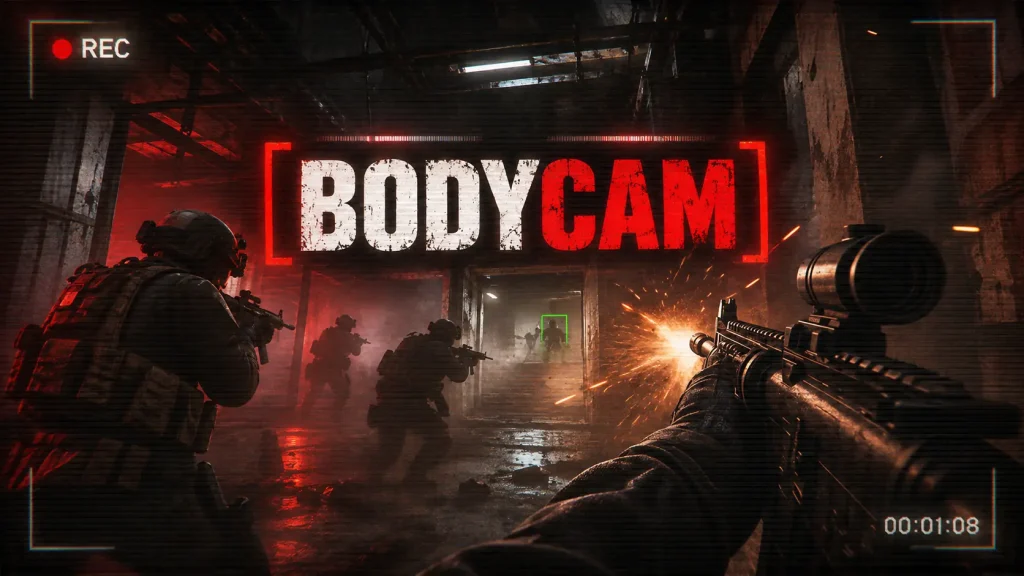
Some games spend years trying to look realistic. Bodycam took a slightly stranger approach: its creators deliberately made parts of the image look worse. Blurry edges, camera distortion, visual noise, and imperfect lighting became part of the recipe. The result was a multiplayer shooter that could occasionally pass for genuine body-camera footage, especially when viewed in short gameplay clips.
What’s even more surprising is who made it. Bodycam started as a project by two French brothers, Luca and Léo, who were still teenagers or barely out of their teens during its early development. Neither had the resources of a major FPS studio, yet their game would eventually attract tens of thousands of simultaneous players on Steam.
Their story involves an abandoned direction, a few clever camera tricks, and a lot of experimentation with Unreal Engine 5.
Before Bodycam, There Was Worst World
Long before Bodycam appeared on Steam, Luca and Léo were working on a completely different game called Worst World. It was an ambitious sandbox project built around player creativity and experimentation. Rather than focusing on a single type of gameplay, the brothers wanted to create systems that could support different interactions and experiences.
Worst World also gave them somewhere to practice. In a September 2023 interview with 80 Level, the brothers explained that Léo had been working with Unreal Engine for years, concentrating on gameplay features and multiplayer systems. Luca focused more on 3D visuals, environments, and effects. That division of work proved useful when they began experimenting with Unreal Engine 5.
Around 2022, the brothers started testing how far they could push the engine’s realistic rendering. Bodycam emerged as a secondary project rather than the original goal. It wasn’t initially about building another Call of Duty competitor. They wanted to see whether a playable game could produce images convincing enough to resemble actual camera footage.
Their Best Graphics Trick Was Making the Image Look Worse
Here’s the part of Bodycam’s development that I find particularly interesting. Most developers spend enormous amounts of time trying to eliminate visual imperfections. They sharpen textures, remove noise, improve image clarity, and polish reflections. Luca and Léo experimented with doing almost the opposite.
They discovered that degrading the image, introducing visual noise, and presenting a large amount of environmental detail could make the scene feel more believable. Think about the difference between a professionally rendered game screenshot and footage captured by a cheap action camera. The real video often has blurred edges, uneven exposure, compression artifacts, and lens distortion.
Your brain is familiar with those imperfections because you’ve seen them in actual recordings. The brothers decided to use that familiarity to their advantage.
Why the Bodycam Perspective Works
A normal first-person shooter usually places the camera around the player’s eyes. Weapons and hands appear in front of it, often with a relatively clean view of the environment. Bodycam tries to imitate footage from a camera attached to someone’s body instead.
That changes how everything looks. Movement feels less perfectly controlled, the lens distorts the edges of the image, and the player’s surroundings don’t always remain perfectly framed. The developers added a fisheye effect, camera borders, noise, and other visual treatments to sell the illusion.
One surprisingly simple detail was the black border around the camera image. In their 2023 interview, the brothers explained that the border was essentially an image placed in front of the virtual camera. This allowed it to react naturally to camera movement and certain lighting effects.
It’s not the sort of trick that requires a groundbreaking new graphics engine. It’s a creative use of existing tools.
Unreal Engine 5 Did the Heavy Lifting, but Not Everything
Bodycam wouldn’t look the way it does without Unreal Engine 5. The brothers used its Lumen lighting system to create more convincing illumination. They also worked with HDRIs, which capture lighting information from real environments and help reproduce natural lighting conditions in digital scenes.
Building every environment asset themselves would have been unrealistic for such a small team. Instead, Reissad Studio used resources from Quixel Megascans and the Unreal Engine Marketplace. High-quality materials and environmental assets provided a foundation, while the team’s camera effects, lighting, and gameplay systems brought the scenes together.
There’s nothing particularly unusual about using asset libraries, especially for indie developers. What’s interesting is how effectively Bodycam combines those resources. A room doesn’t need to contain entirely original furniture to feel convincing. The lighting, scale, materials, sound, and camera perspective have to work together.
Bodycam demonstrates that distinction particularly well.
Making It Look Real Was Only Half the Problem
An impressive screenshot is one thing. Building a multiplayer shooter around it is considerably harder. Reissad wanted Bodycam to feel different from conventional FPS games, and that affected the shooting mechanics as well as the visuals.
The developers deliberately avoided a traditional crosshair and persistent interface elements. Instead of relying on an aiming indicator fixed to the center of the screen, players have to pay attention to the weapon itself. The team also described designing its early shooting system around projectiles originating from the gun barrel rather than simply treating the center of the screen as the firing point.
This created its own challenges. Weapons needed to remain usable despite the unusual camera perspective. Character movements had to look convincing to other players, and the multiplayer systems needed to handle those movements without ruining the experience.
In the 2023 interview, the developers estimated that the multiplayer side accounted for roughly three-quarters of the work. That is quite a revealing detail for a game that initially attracted attention because of its graphics.
People Had Trouble Believing Bodycam Was a Real Game
Imagine spending years developing a game, showing the footage online, and discovering that one of your biggest marketing problems is convincing people it’s actually playable.
That’s something Reissad encountered. The studio said potential players questioned whether the footage represented a working game rather than a graphics demonstration. Others wondered whether the experience would require an absurdly powerful computer. There was also confusion about whether Bodycam offered actual multiplayer gameplay.
The developers responded by emphasizing unedited gameplay footage and explaining how the game worked. It was a strange problem to have, but also an indication that the visual concept had attracted attention. For a small studio competing in a market dominated by established shooters, getting people to stop scrolling was already a considerable achievement.
Bodycam Finally Arrived on Steam in 2024
Bodycam launched in Steam Early Access on June 7, 2024. The first month produced a peak of more than 13,000 concurrent players, according to SteamCharts. That’s a substantial audience for a multiplayer project created by such a small development team.
The game offered tactical firefights built around its distinctive camera perspective, with modes including Deathmatch, Team Deathmatch, and Wingman. But an unusual visual style doesn’t automatically guarantee long-term success. Player numbers fell sharply after the initial launch period, and the team faced the challenge that confronts almost every live multiplayer game: giving people reasons to return.
Over time, Bodycam added more content, experimented with Zombies, and expanded its development ambitions. The studio itself was changing too.
From Two Brothers to a Larger Development Studio
By September 2026, Reissad was no longer just two brothers working on a passion project. The team had grown, and its priorities had shifted toward building a more complete shooter.
Bodycam v0.8: Locked & Loaded was the clearest example, released on September 2, 2026. Rather than simply adding more maps and weapons, the developers rebuilt important parts of the experience, including character movement, procedural animations, sound, weapon handling, and customization.
The update introduced a new Trenches map, more extensive loadout options, and physical reactions designed to make characters feel less rigid. It also helped Bodycam reach a new all-time player peak in September, surpassing its original Early Access launch.
That comeback deserves its own story, but it reveals something important about Reissad’s approach. The studio didn’t treat its first successful launch as the end of development. It kept changing the game, sometimes substantially.
Is Bodycam Really One of the Most Realistic FPS Games?
Visually, Bodycam is certainly among the more convincing multiplayer shooters available. Its combination of camera distortion, detailed environments, lighting, and sound can produce striking results. But visual realism isn’t the same thing as a perfect simulation of real combat.
Bodycam still makes deliberate gameplay compromises, and some of its systems have changed significantly since launch. What looks believable through a camera doesn’t necessarily behave exactly like its real-world equivalent.
That distinction matters when describing what the developers accomplished. They didn’t invent realistic graphics, and Unreal Engine 5 isn’t exclusive to Bodycam. Their achievement was finding a visual presentation that made familiar graphics technology feel unusually convincing.
For a project that began with two young developers experimenting on the side, that’s a remarkable result. And perhaps the best lesson from Bodycam’s history is that realism doesn’t always come from making every pixel sharper.
Sometimes the imperfections are what make the illusion work.

I’m Alex Mercer, a senior gaming and esports writer at GamingImba. I’ve been involved in gaming for as long as I can remember, and for more than a decade I’ve been writing about competitive play, industry trends, and the culture that grows around games.
My work focuses on esports, online gaming platforms, and how technology continues to shape the way people play, compete, and connect. I’m especially interested in meta shifts, balance changes, and the business decisions that influence modern games behind the scenes.
At GamingImba, I aim to break down complex topics in a way that’s clear, honest, and useful—whether that means analyzing a major tournament, exploring new gaming platforms, or looking at how player behavior evolves over time.
I follow global esports scenes closely, experiment with different games and mods in my free time, and enjoy digging into the details that most players notice but rarely stop to question.