
You’ve probably seen prediction markets mentioned somewhere recently, especially if you follow sports, politics, or financial news. Maybe you’ve even come across a market asking whether Bitcoin will hit a certain price or which team will win the next championship.
The interesting part is that you’re not simply picking an answer and waiting to see what happens. You’re buying a contract that other people can trade, and its price can change quite dramatically before the event is over.
So, how do prediction markets work, and where does the money actually come from? We’ll go through the basics, look at some real calculations, and explain a few things that aren’t immediately obvious when you first open one of these platforms.
What Exactly Is a Prediction Market?
Think of a prediction market as a place where people buy and sell contracts tied to future events. These could be elections, sporting results, economic announcements, movie awards, or even the release date of a video game.
Let’s say a market asks whether a new game will launch before the end of the year. Some people believe the developer will meet the deadline, while others expect another delay. Instead of simply arguing about it online, they can trade contracts based on their expectations.
The price of those contracts changes as people buy and sell them. If more traders become confident that the game will arrive on time, the price of the Yes contract may rise. If a developer announces problems with production, that price could quickly fall.
That’s what makes prediction markets interesting. You’re not just predicting the outcome of an event. You’re also dealing with a market where other people’s expectations affect how much your position is worth.
How Do Prediction Markets Work?
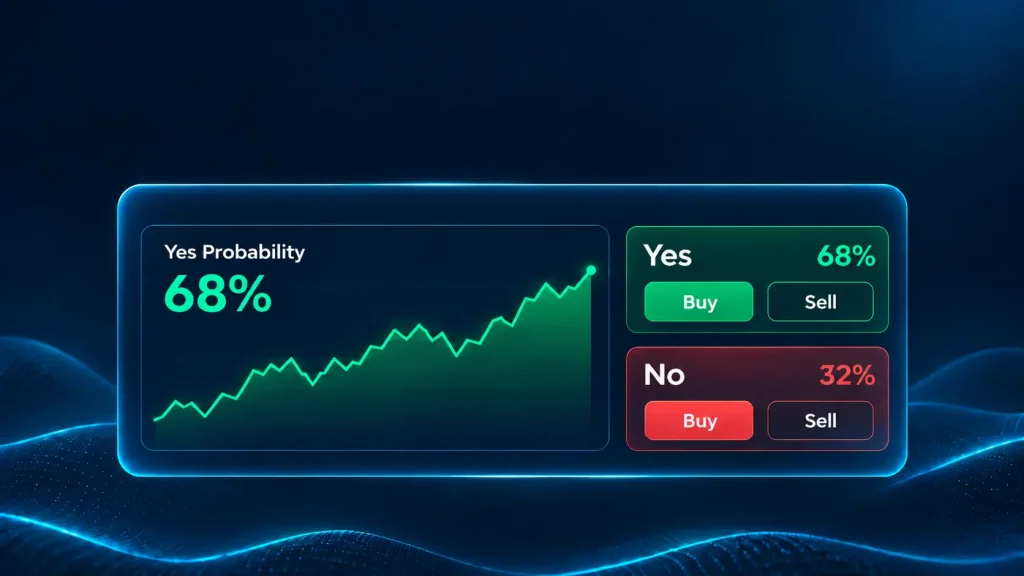
Most prediction markets that beginners encounter use contracts with two possible outcomes: Yes or No. These are known as binary contracts, and they’re fairly easy to understand once you’ve seen a few examples.
A standard binary contract pays $1 if your chosen outcome happens and nothing if it doesn’t. The amount you pay to buy that contract depends on its current market price.
Here’s how a typical trade unfolds.
1. Someone Creates a Market
Every prediction market starts with a question about something that hasn’t happened yet.
For example:
Will Team A win the championship this season?
You can buy a Yes contract if you think the team will win, or a No contract if you expect it to lose.
There is one detail worth paying attention to, though. The question itself isn’t always enough to understand what you’re buying. Markets also have rules explaining exactly how the outcome will be decided.
For a championship market, that might include which competition counts, how the winner is determined, and what happens if the tournament is canceled. Those rules become particularly important when something unusual happens.
2. You Choose Yes or No
Imagine opening that championship market and finding these prices:
| Contract | Price | Implied probability |
| Yes | $0.65 | About 65% |
| No | $0.35 | About 35% |
If you buy a Yes contract for 65 cents and Team A wins, you receive $1 when the market settles. That leaves you with a profit of 35 cents before fees.
If Team A loses, your contract pays nothing and you lose the 65 cents you spent.
The No contract works the other way around. Buying it for 35 cents would give you a 65-cent profit if Team A doesn’t win, assuming the standard $1 settlement.
These are simplified prices to show how binary contracts work. On an actual exchange, the available prices for buying Yes and No don’t always add up neatly to $1 because of trading spreads and the orders currently available.
3. Prices Move as Traders Change Their Minds
This is where prediction markets get more interesting than they might initially appear.
Suppose Team A starts the season looking unbeatable. Its Yes contract trades at 65 cents, but then the team’s best player gets injured. Suddenly, plenty of people aren’t quite so confident.
Some traders start selling their contracts, while others are only prepared to buy at lower prices. The Yes contract could drop to 45 cents, even though the championship is still weeks away.
The reverse could happen if Team A signs a brilliant replacement or its biggest rival suffers an unexpected defeat.
Unlike a result that’s already been decided, the market price is constantly open to change. Every significant piece of news gives traders another reason to reconsider what they’re willing to pay.
4. You Don’t Always Have to Wait for the Result
Here’s something that surprises people who are used to traditional sports betting: you can often sell your prediction market contracts before the event finishes.
Say you bought a Yes contract for 40 cents because you thought the market was underestimating a team’s chances. A few days later, the price rises to 70 cents.
You could hold on and hope for the full $1 payout. Or, if there’s a buyer willing to pay 70 cents, you could sell the contract and take a 30-cent profit before fees.
You wouldn’t even need the team to win. Your profit would come from buying at one price and selling at a higher one.
The catch? You need someone willing to buy what you’re selling. If trading activity is low, getting out of a position might be harder than you expected.
5. The Market Eventually Settles
When the event finishes, the platform checks the result against the contract’s published rules.
For a normal binary market, winning contracts settle at $1 and losing contracts at $0. If you still hold the winning side, you receive the appropriate payout.
Not every market is settled immediately. Some events require an official announcement, while others can involve disputes about what actually happened.
That’s why I wouldn’t skip the resolution rules, especially for contracts involving unusual events or complicated conditions.
Why Do Prediction Market Prices Change?
Prediction market prices aren’t usually calculated by someone sitting behind a desk and deciding the odds. On exchange-based platforms, they largely come from traders placing orders to buy and sell contracts.
The more people are prepared to pay for a particular outcome, the higher its price can go. When traders become less confident, they’re often unwilling to pay as much.
A contract trading at 80 cents is commonly interpreted as suggesting an 80% probability of that outcome happening. At 20 cents, the implied probability would be around 20%.
But don’t confuse a market price with the actual probability of something happening.
A Yes contract priced at 80 cents doesn’t mean the outcome has been scientifically established as 80% likely. It means that’s roughly how the market is pricing it. Traders can be overly optimistic, overlook important details, or simply get things wrong.
What Is an Order Book?
If you’ve ever traded stocks or cryptocurrencies, the idea of an order book will probably feel familiar.
An order book shows the prices people are offering to pay for contracts and the prices sellers are asking for them.
Here’s a simplified example for Yes contracts:
| Buyers are offering | Sellers are asking |
| $0.61 | $0.64 |
| $0.60 | $0.65 |
| $0.58 | $0.67 |
At the moment, the highest buyer is offering 61 cents, while the cheapest seller wants 64 cents.
That three-cent gap is called the bid-ask spread. If you want to buy immediately, the best available asking price is 64 cents. If you’re looking to sell immediately, the highest bid is 61 cents.
You can also place an order at a price you prefer and see whether somebody accepts it.
This matters more than you might think. A market could display a price of 64 cents, but that doesn’t necessarily mean you can buy hundreds of contracts at that price. There might only be a few available before the next, more expensive offers come into play.
How Do People Make Money on Prediction Markets?
There are two ways people commonly try to make money with binary prediction contracts. They either buy the correct outcome and hold their contracts until settlement, or they sell at a higher price than they paid.
Both sound simple enough. Making the right decisions consistently is another matter.
Making Money From a Correct Prediction
Let’s go back to Team A.
You feel confident about its chances of winning the championship, so you buy 100 Yes contracts for 65 cents each.
Here’s what that looks like:
| Amount | |
| Number of contracts | 100 |
| Purchase price | $0.65 |
| Total spent | $65 |
| Payout if Team A wins | $100 |
| Profit before fees | $35 |
| Loss if Team A loses | $65 |
If Team A wins, your contracts settle for a total of $100. Since you originally spent $65, you’ve made $35 before fees.
If the team loses, you get nothing back from those contracts. Your initial $65 is gone, along with any fees you paid.
Making Money Without Waiting for the Outcome
Now imagine you buy 100 Yes contracts at 40 cents each. That’s a $40 investment.
A few days later, news breaks that makes the outcome look much more likely. Other traders start buying, and you’re able to sell your contracts for 70 cents each.
You collect $70 from the sale, giving you a $30 profit before fees.
The event might still be months away, but your trade is finished. Whether the prediction eventually turns out to be correct no longer affects that closed position.
Of course, the price can just as easily move in the opposite direction. Buying something at 40 cents doesn’t guarantee you’ll find a buyer willing to pay more later.
What Happens When You Get It Wrong?
Let’s say a contract costs 80 cents. That sounds like a fairly confident market, so you decide to buy 100 Yes contracts for $80.
Unfortunately, the event doesn’t happen. The market settles at No, your Yes contracts become worthless, and you lose the $80 you spent, before any additional fees.
Notice the difference between this example and the earlier one. Buying at 80 cents leaves you with just 20 cents of potential profit per winning contract, but 80 cents at risk if you’re wrong.
That’s something worth remembering when a contract looks like an almost certain winner.
Market Orders, Limit Orders, and Why Liquidity Matters
Before placing a trade, it’s useful to understand how you actually get the price you want.
A market order attempts to buy or sell using the available orders in the market. It’s convenient when you want to trade quickly, but you might not get the exact price you first saw, particularly if you’re placing a large order.
A limit order gives you more control. You decide the maximum price you’re willing to pay or the minimum price you’ll accept when selling. The downside is that nobody has to accept your offer, so the order might sit there without being filled.
Then there’s liquidity, which is simply about how easy it is to find someone to trade with.
Imagine a popular election market with thousands of active traders. There might be plenty of buyers and sellers, making it relatively easy to enter or exit a position.
Now picture a market asking whether a little-known indie game will reach a particular sales milestone. Maybe only a handful of people are interested. You might buy a contract, watch its displayed price rise, and then discover that nobody wants to purchase your entire position at that price.
The number on the screen can look great, but it doesn’t mean much if you can’t actually sell.
What Happens When a Prediction Market Closes?
A market closing doesn’t always mean the result has been confirmed.
Take a contract asking whether a game will launch before December 31. Sounds easy to settle, right? But what if it enters early access in November and doesn’t receive a full release until January? Or launches in one country several days before another?
Different market rules could produce different answers to what initially looks like the same question.
Platforms specify how events will be resolved and which sources they’ll use to confirm the outcome. Once the required information is available, settlement can take place.
Occasionally, things get messy. Events are canceled, official results are delayed, or the circumstances don’t match what people originally expected.
Reading the resolution rules might not be the most exciting part of prediction markets, but it’s far better than discovering after the event that you misunderstood the contract.
Prediction Markets vs. Traditional Sports Betting
If you’re familiar with sports betting, you might be wondering whether prediction markets are just sportsbooks with different terminology.
There are similarities, especially with contracts tied to sporting events. In both cases, you’re risking money based on an uncertain result.
The differences become clearer when you look at how prices are set and how positions are handled.
| Feature | Prediction markets | Traditional sportsbooks |
| Pricing | Often driven by trader orders | Generally set by the sportsbook |
| What you buy | Outcome contracts | Bets |
| Selling early | Often possible during trading | Cash-out may be available |
| Price format | Usually cents or probabilities | American, decimal, or fractional odds |
| Who takes the other side | Often another market participant | Usually the sportsbook |
| Regulation | Depends on contract and jurisdiction | Depends on gambling laws |
On a conventional sportsbook, the operator generally sets the odds and accepts your wager. With an exchange-style prediction market, traders place orders, and those orders help determine the prices.
That doesn’t automatically make prediction markets cheaper, fairer, or more profitable. Trading fees and spreads still matter, and some sportsbooks offer exchange-style products of their own.
There’s also the legal side. In the United States, certain event contracts fall under federal derivatives regulation, but the status of sports-related contracts remains disputed in some jurisdictions. The rules aren’t identical everywhere, and federal regulation doesn’t mean every contract is free from legal challenges.
Where Can You Trade Prediction Markets?
Two names you’ll probably encounter quite quickly are Kalshi and Polymarket. They both offer markets based on future events, although their products, trading arrangements, and access requirements differ.
Kalshi
Kalshi is a US exchange regulated by the Commodity Futures Trading Commission (CFTC) as a designated contract market.
Its markets cover areas such as economics, politics, sports, and other events with measurable outcomes. Traders can review available contracts, place buy and sell orders, and follow price changes as new information emerges.
Kalshi is also a useful platform to study when learning about order books, limit orders, and the way exchange-style event contracts are settled.
Polymarket
Polymarket is another prominent prediction market name, particularly associated with events that attract attention in politics, economics, entertainment, and online communities.
Its outcome shares can change in price as traders respond to new information or adjust their expectations.
Before using any particular Polymarket service, it’s worth checking which products are available to you, how the contracts settle, and which fees or eligibility restrictions apply. The rules can vary depending on the service and jurisdiction.
Can Prediction Markets Actually Predict the Future?
Sometimes they’re surprisingly useful. Other times, not so much.
The theory behind prediction markets is that many people bringing their knowledge and opinions into one marketplace can produce a useful collective forecast. Since traders have money at stake, there’s an incentive to pay attention to information that could affect the outcome.
Think about a major esports tournament. Fans might follow roster changes, team performance, injuries, and balance updates. When something important happens, traders can adjust their positions, causing prices to move.
That can provide an interesting picture of what people currently expect.
But there are obvious limitations. A market with very few traders might reflect the enthusiasm of a small group rather than a broad assessment. Popularity can influence prices, rumors can spread quickly, and even experienced participants get predictions wrong.
Personally, I’d treat market prices as one more piece of information rather than an answer to what will happen. They’re useful for seeing where expectations stand, but they don’t make uncertainty disappear.
What Are the Risks of Prediction Markets?
The biggest risk is fairly obvious: you can lose money, including the entire amount you paid for a binary contract.
But a bad prediction isn’t the only thing that can hurt your returns. Trading itself comes with a few complications.
- Low liquidity: You might struggle to find buyers when you want to sell, especially in smaller markets.
- Trading costs: Fees and bid-ask spreads can eat into profits, particularly when you’re making frequent trades.
- Sudden price changes: Breaking news can move prices sharply before you have a chance to react.
- Unclear outcomes: Misunderstanding the resolution rules can leave you holding a contract that settles differently from what you expected.
- Legal restrictions: Certain markets or platforms might not be available in your location.
- Unfair information advantages: Some traders may have access to better information than others, while attempts to manipulate prices are another potential concern.
It’s also easy to get carried away when a contract looks almost certain to win.
Imagine paying 95 cents for something that can only return $1. Even if you turn out to be right, you’re making just five cents before fees. If you’re wrong, you’ve lost 95 cents.
That doesn’t mean expensive contracts are always bad trades. It means you need to look at what you’re risking compared with what you could realistically earn.
What Do Prediction Markets Have to Do With Gaming?
Gaming is a particularly interesting area for prediction markets because fans are already used to debating future events.
Will a major game be delayed? Which team will win the next esports championship? Could an unexpected title take Game of the Year?
These are exactly the kinds of questions that generate arguments on Reddit, Discord, and gaming forums. Prediction markets turn some of those expectations into contracts that people can buy and sell, where such markets are offered.
We’ve previously looked at how gaming and esports prediction markets work, including the different types of gaming-related outcomes that can attract traders.
There’s also our article about popular and controversial gaming prediction markets, which explores why subjects such as GTA 6 and major esports events generate so much speculation.
Being knowledgeable about gaming might help you evaluate certain events, but there’s still a difference between making a good prediction and making a good trade. If you pay too much for a contract, even being right might leave you with very little profit.
So, Are Prediction Markets Complicated?
Not particularly, at least when it comes to the basic idea. You buy a contract linked to an outcome, its price can change as other people trade, and it eventually settles according to the market’s rules.
The tricky part is judging whether the price is worth paying.
You might be convinced a team will win, a game will be delayed, or a particular economic announcement is coming. But if everyone else already expects the same thing, the contract could be expensive enough that there’s very little money to make.
That’s probably the biggest thing to understand about prediction markets. Getting the outcome right and making a profitable trade aren’t always the same thing.
Before buying, check the price, look at the available orders, and make sure you understand exactly how the contract will settle. It’s a lot easier to enjoy following a market when you know what the numbers actually mean.

I’m Alex Mercer, a senior gaming and esports writer at GamingImba. I’ve been involved in gaming for as long as I can remember, and for more than a decade I’ve been writing about competitive play, industry trends, and the culture that grows around games.
My work focuses on esports, online gaming platforms, and how technology continues to shape the way people play, compete, and connect. I’m especially interested in meta shifts, balance changes, and the business decisions that influence modern games behind the scenes.
At GamingImba, I aim to break down complex topics in a way that’s clear, honest, and useful—whether that means analyzing a major tournament, exploring new gaming platforms, or looking at how player behavior evolves over time.
I follow global esports scenes closely, experiment with different games and mods in my free time, and enjoy digging into the details that most players notice but rarely stop to question.
Related posts:
 Gaming in Prediction Markets: How Esports and Video Game Trading Work
 From GTA 6 Delays to Esports Drama: Gaming’s Most Popular and Controversial Prediction Markets
 What is iGaming, How Key Segments Differ, and Global Legality Rules Explained
 Why Online Slots Are Popular in the U.S.: Design and Data