Terraria looks fairly harmless when you first start playing. There are trees to chop down, caves to explore, and a few slimes bouncing around. Then night falls, something enormous appears on your screen, and you quickly realize there’s a lot more to this little pixel-art world.
Boss fights are a huge part of Terraria. Some introduce new enemies and equipment, while others unlock entire stages of the game. A few are completely optional, although skipping them means missing out on some interesting encounters and valuable rewards.
There are 33 bosses and boss-type encounters in modern Terraria, including event bosses and one special-world boss. Three additional bosses existed in older versions but are no longer available in the current game. Here’s the full list, organized by progression, with a look at where each boss appears and why it matters.
Terraria also happens to be one of the best-known indie games, showing just how much content a small independent team can build around exploration and progression.
Terraria Bosses in Order: Quick List
Terraria divides its main progression into two stages: Pre-Hardmode and Hardmode. Defeating the Wall of Flesh activates Hardmode, changing the world and introducing more powerful enemies, equipment, and bosses. The order below is recommended, not a strict sequence. Several bosses are optional, and some can be challenged much earlier or later depending on your equipment and experience.
| # | Boss | Stage | Optional? |
| 1 | King Slime | Pre-Hardmode | Yes |
| 2 | Eye of Cthulhu | Pre-Hardmode | Yes |
| 3 | Eater of Worlds | Pre-Hardmode | Yes* |
| 4 | Brain of Cthulhu | Pre-Hardmode | Yes* |
| 5 | Queen Bee | Pre-Hardmode | Yes |
| 6 | Skeletron | Pre-Hardmode | Required for final progression |
| 7 | Deerclops | Pre-Hardmode | Yes |
| 8 | Wall of Flesh | Pre-Hardmode | No, unlocks Hardmode |
| 9 | Queen Slime | Hardmode | Yes |
| 10 | The Destroyer | Hardmode | No, for normal progression |
| 11 | The Twins | Hardmode | No, for normal progression |
| 12 | Skeletron Prime | Hardmode | No, for normal progression |
| 13 | Plantera | Hardmode | No, for normal progression |
| 14 | Golem | Hardmode | No, for normal progression |
| 15 | Duke Fishron | Hardmode | Yes |
| 16 | Empress of Light | Hardmode | Yes |
| 17 | Lunatic Cultist | Hardmode | No, for normal progression |
| 18 | Moon Lord | Hardmode | Final boss |
Eater of Worlds and Brain of Cthulhu are associated with different world evil biomes. Neither is strictly mandatory for reaching Hardmode, although defeating one is part of the usual early-game progression.
Skeletron is another special case: you can enter Hardmode without defeating him, but he’s required to unlock the normal Lunatic Cultist encounter later in the game.
Other Terraria Bosses and Special Encounters
The 18 bosses above make up the standard progression list. Terraria also includes 14 event bosses and one special-world boss, bringing the modern total to 33.
| Event or Category | Bosses |
| Old One’s Army | Dark Mage, Ogre, Betsy |
| Pirate Invasion | Flying Dutchman |
| Pumpkin Moon | Mourning Wood, Pumpking |
| Frost Moon | Everscream, Santa-NK1, Ice Queen |
| Martian Madness | Martian Saucer |
| Lunar Events | Solar Pillar, Nebula Pillar, Vortex Pillar, Stardust Pillar |
| Special World Seed | Mechdusa |
These encounters have their own requirements and aren’t all part of the standard boss progression. We’ll cover them after the Pre-Hardmode and Hardmode sections.
All Pre-Hardmode Bosses in Terraria
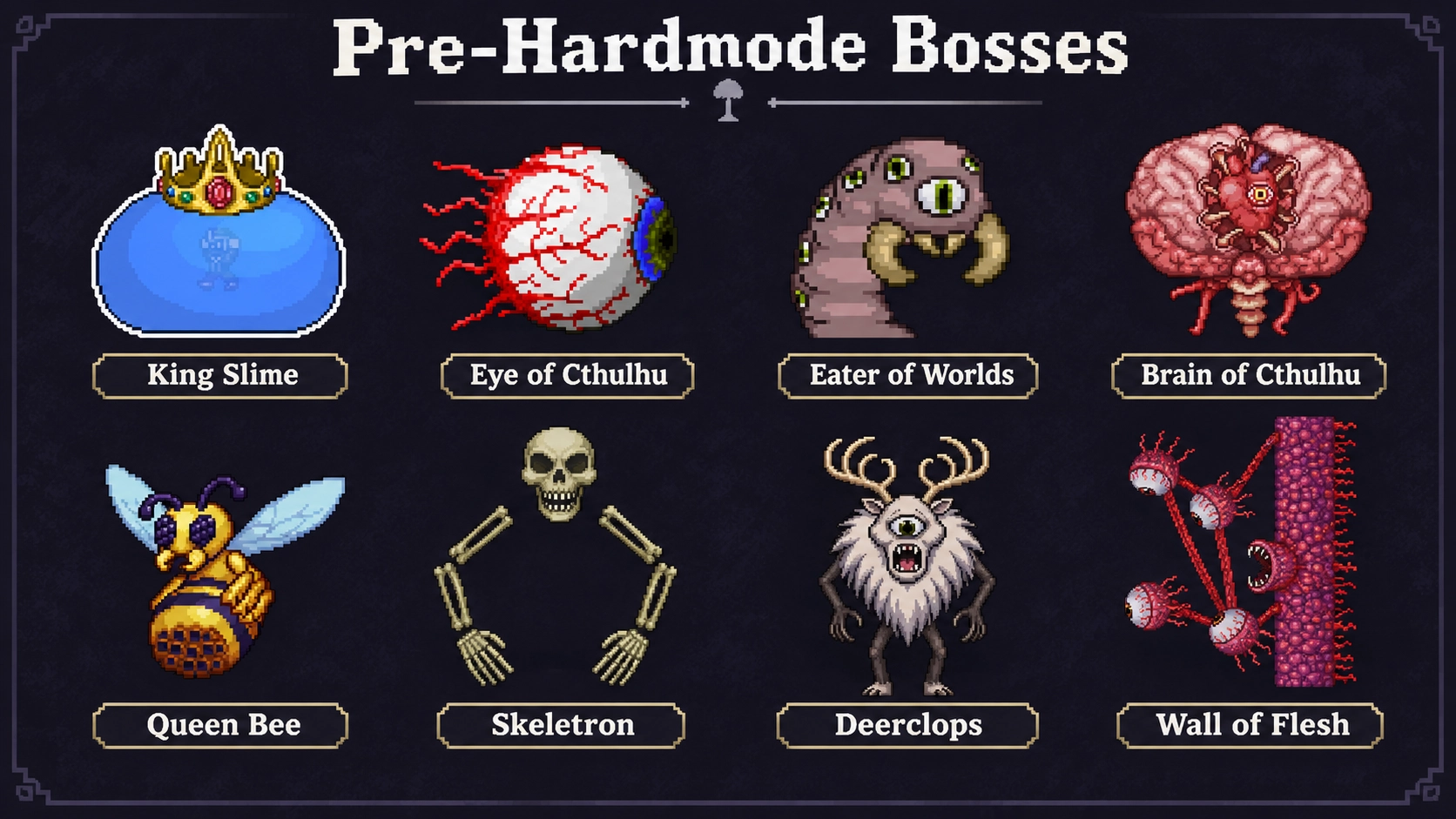
Pre-Hardmode is the opening stage of Terraria. It’s where players learn the basics, explore different biomes, and gradually collect enough equipment to survive more dangerous encounters. There are eight bosses in this stage, although most newly generated worlds naturally feature either Eater of Worlds or Brain of Cthulhu, rather than both.
1. King Slime
King Slime is a giant blue slime wearing a small golden crown. He looks more amusing than threatening, especially compared with some of the creatures you’ll meet later, but he’s still capable of overwhelming an unprepared character. He can appear during a Slime Rain event, spawn under certain conditions near the outer edges of the world, or be summoned with a Slime Crown. Defeating him can reward players with useful early-game items, including the Slimy Saddle and pieces of the Ninja outfit. He’s completely optional, but a reasonable first boss for anyone getting familiar with Terraria’s larger enemies.
2. Eye of Cthulhu
The Eye of Cthulhu is probably one of Terraria’s most recognizable bosses. It’s an enormous flying eyeball that charges at players and summons smaller eyes during the fight. It can appear naturally at night once certain progression conditions are met, or players can summon it using a Suspicious Looking Eye. This is often the first boss that feels like a proper test of movement and combat. Defeating it provides useful materials, including Demonite or Crimtane Ore, depending on the world’s evil biome. It’s optional, but I’d include it in any recommended progression list for beginners.
3. Eater of Worlds
The Eater of Worlds is a massive segmented worm found in worlds containing the Corruption biome. It can be summoned by destroying three Shadow Orbs or by using Worm Food in the Corruption. Unlike most Terraria bosses, the Eater of Worlds consists of many connected body segments. Breaking it apart can create smaller worms, turning the encounter into a much busier fight. Its drops include Demonite Ore and Shadow Scales, which are useful for crafting Shadow equipment and other items. Defeating this boss also contributes to early-game progression and helps unlock additional content.
4. Brain of Cthulhu
The Brain of Cthulhu is the Crimson counterpart to the Eater of Worlds. Players encounter it in Crimson worlds by destroying three Crimson Hearts or using a Bloody Spine. It’s a particularly strange-looking enemy, even by Terraria standards. The boss begins surrounded by smaller creatures called Creepers, which must be defeated before the brain itself becomes vulnerable. Its main rewards include Crimtane Ore and Tissue Samples, materials used to craft Crimson equipment. You don’t need to defeat both the Brain of Cthulhu and the Eater of Worlds to progress through a normal playthrough, although it’s possible to encounter both with the appropriate resources.
5. Queen Bee
Hidden inside the Underground Jungle are Bee Hives containing larvae. Breaking one of these larvae summons Queen Bee, a giant insect capable of charging, firing stingers, and releasing smaller bees. Players can also summon her using an Abeemination in the Jungle. Queen Bee is optional, but her rewards make the encounter worthwhile. These include bee-themed weapons and equipment, with the Bee Gun and Beenades being particularly memorable examples of Terraria’s unusual weapon designs. Defeating Queen Bee also allows the Witch Doctor NPC to move into a suitable house.
6. Skeletron
Skeletron guards the entrance to the Dungeon, one of Terraria’s most important exploration areas. At night, players can speak to the Old Man standing outside the Dungeon and choose to lift his curse. The result is a battle against an enormous floating skull with two skeletal hands. Defeating him makes the Dungeon accessible without the Dungeon Guardian immediately killing unprepared visitors. Although Skeletron isn’t required to enter Hardmode, he must be defeated before the Lunatic Cultists can appear, making him necessary for the normal route to Moon Lord. The Dungeon also contains valuable equipment and materials that become relevant again much later in the game.
Terraria 1.4.5 also introduced a special Red Hat Skeletron variant associated with ChippyGaming. This is a variation of the existing boss rather than an additional entry in the official boss count.
7. Deerclops
Deerclops is a crossover boss introduced through Terraria’s collaboration with Don’t Starve Together. If you’ve played that game, you’ll probably recognize the towering one-eyed creature immediately. In Terraria, Deerclops can appear naturally during a Blizzard in the Snow biome under specific conditions. Players can also summon it with a Deer Thing in the Snow or Ice biome. The encounter is completely optional, and its rewards include items inspired by Don’t Starve Together. Deerclops doesn’t fit neatly into the usual progression, either. Players can encounter it relatively early or leave it until much later.
8. Wall of Flesh
The Wall of Flesh is the final Pre-Hardmode boss and one of the most important encounters in Terraria. Found in the Underworld, it appears when the Guide is killed by lava under the appropriate conditions, most commonly by dropping a Guide Voodoo Doll into lava while the Guide is alive. Rather than fighting a creature in an ordinary arena, players face an enormous moving wall with eyes, a mouth, and attached enemies. Defeating the Wall of Flesh permanently activates Hardmode in that world, introducing stronger enemies, new resources, biome changes, and an entirely new set of bosses. This is where Terraria changes significantly, and there’s no going back to the original Pre-Hardmode world state.
All Hardmode Bosses in Terraria
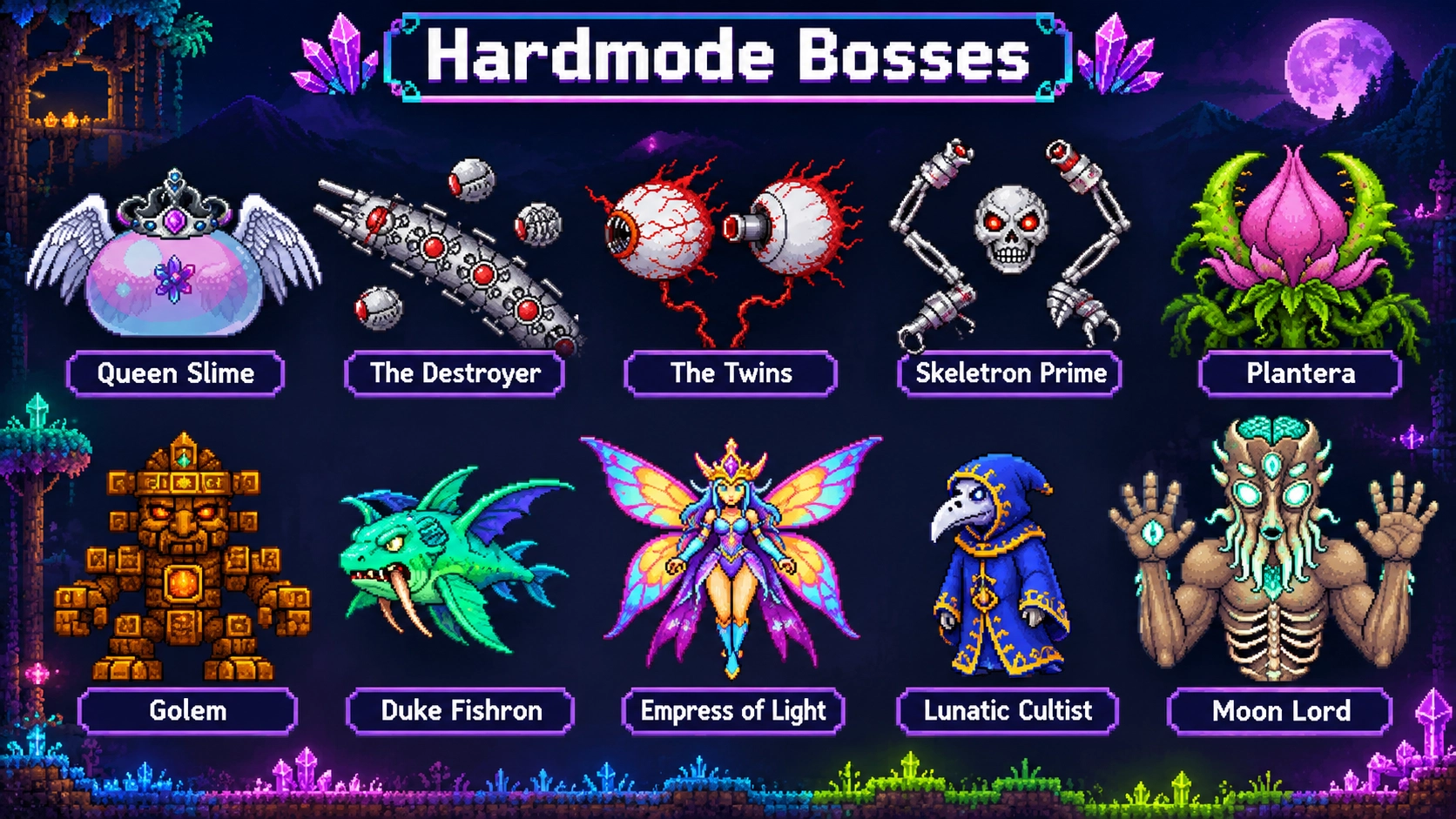
Hardmode isn’t a separate difficulty setting that players select from the menu. It’s a major progression stage unlocked by defeating the Wall of Flesh. There are ten standard Hardmode bosses, and several are essential for reaching the final encounter. Some can be fought in different orders, giving experienced players quite a bit of freedom in how they approach this stage.
9. Queen Slime
Queen Slime is a Hardmode boss associated with the Hallow biome. She’s a much stronger relative of King Slime, complete with a crown, wings during her later phase, and plenty of dangerous attacks. Players summon her using a Gelatin Crystal in the Hallow. Queen Slime doesn’t have to be defeated to complete the game, but her drops include Crystal Assassin armor pieces and the Gelatinous Pillion mount. She’s generally considered an early Hardmode option, although that doesn’t necessarily make her an easy fight.
10. The Destroyer
The Destroyer is a mechanical version of the Eater of Worlds, replacing the organic worm design with a gigantic metal body. It can be summoned at night using a Mechanical Worm and may also appear naturally under certain conditions during Hardmode. The Destroyer is one of Terraria’s three mechanical bosses, and defeating it rewards players with Souls of Might and Hallowed Bars, both important crafting resources. All three mechanical bosses must be defeated before Plantera’s Bulbs begin appearing in the Underground Jungle.
11. The Twins
The Twins consist of two mechanical eyes named Retinazer and Spazmatism. They’re connected during the encounter but have different attacks and individual health pools. Players can summon them at night using a Mechanical Eye. Retinazer relies on laser attacks, while Spazmatism uses cursed flames and aggressive charges. Defeating them rewards Souls of Sight and Hallowed Bars. The Twins are often compared with the Eye of Cthulhu, although the mechanical version is considerably more demanding.
12. Skeletron Prime
Skeletron Prime is the mechanical counterpart to Skeletron, but with a much more intimidating appearance. Instead of two skeletal hands, he has four mechanical arms fitted with different weapons. Players summon him at night using a Mechanical Skull, or he may spawn naturally under the appropriate Hardmode conditions. Defeating Skeletron Prime provides Souls of Fright and Hallowed Bars. Alongside The Destroyer and The Twins, this boss is necessary for unlocking the next major stage of normal Terraria progression.
13. Plantera
Plantera is a giant plant-like boss found in the Underground Jungle after all three mechanical bosses have been defeated. Rather than using a crafted summoning item, players find and destroy one of the glowing pink Plantera’s Bulbs that begin growing in the biome. Plantera is particularly important because defeating her opens the way to the Jungle Temple’s next major encounter and changes several other parts of the world. The Dungeon also becomes considerably more dangerous after her defeat, with new enemies and valuable equipment becoming available.
14. Golem
Golem is a large stone-and-metal creature encountered inside the Jungle Temple. To summon him, players use a Lihzahrd Power Cell at the temple’s Lihzahrd Altar after defeating Plantera. The boss has multiple body parts, including detachable fists and a head that changes behavior as the battle progresses. Defeating Golem unlocks important late-game opportunities, including the appearance of the Lunatic Cultists at the Dungeon entrance, provided Skeletron has also been defeated. It also allows players to access the final tier of the Old One’s Army event.
15. Duke Fishron
Duke Fishron might be one of Terraria’s strangest creatures: a flying hybrid of a pig, dragon, and fish. Players summon him by fishing in the Ocean using a Truffle Worm as bait. Unlike many other Hardmode bosses, Duke Fishron doesn’t require players to defeat specific earlier bosses before attempting the encounter. That freedom can be deceptive, as he’s a powerful optional boss and fighting him early can be a serious challenge. His rewards include several strong weapons and the Fishron Wings, making him attractive to players looking for powerful equipment.
16. Empress of Light
The Empress of Light is a colorful, fairy-like boss associated with the Hallow. Her appearance is beautiful, but the fight is anything but gentle. She can be summoned after Plantera has been defeated by killing a Prismatic Lacewing, a rare creature that appears in the surface Hallow at night. Empress of Light is optional, but she offers some distinctive rewards, including the Terraprisma summon weapon, which requires defeating her during the daytime. Her daytime encounter is especially notorious because her attacks become capable of instantly killing players under normal circumstances.
17. Lunatic Cultist
The Lunatic Cultist appears near the Dungeon entrance after both Skeletron and Golem have been defeated. Players initiate the encounter by killing the cultists gathered outside the Dungeon. The boss uses magical attacks and can create deceptive copies of himself during combat. Defeating the Lunatic Cultist triggers the Lunar Events, bringing four Celestial Pillars into the world. Although he appears relatively late in the game, the Lunatic Cultist isn’t the final boss. He’s the gateway to Terraria’s last major progression sequence.
18. Moon Lord
Moon Lord is the final boss of Terraria’s main progression and one of its most recognizable enemies. He appears after all four Celestial Pillars have been destroyed or can be summoned using a Celestial Sigil once the relevant conditions are met. The encounter involves attacking different parts of his enormous body before exposing his core. Defeating Moon Lord rewards players with endgame materials and powerful weapons, including those used in some of Terraria’s strongest equipment. For players following the main progression, Moon Lord is the final destination, but there’s still plenty to do afterward, especially for anyone who enjoys collecting rare items, building, or replaying boss encounters on higher difficulties.
Terraria Event Bosses: The Complete List
Not every boss in Terraria belongs to the main progression. Some appear during invasions, seasonal-themed events, or special challenges. These encounters are easy to overlook when reading ordinary boss lists, but they’re still part of the full set of 33 bosses and boss-type encounters.
Old One’s Army Bosses
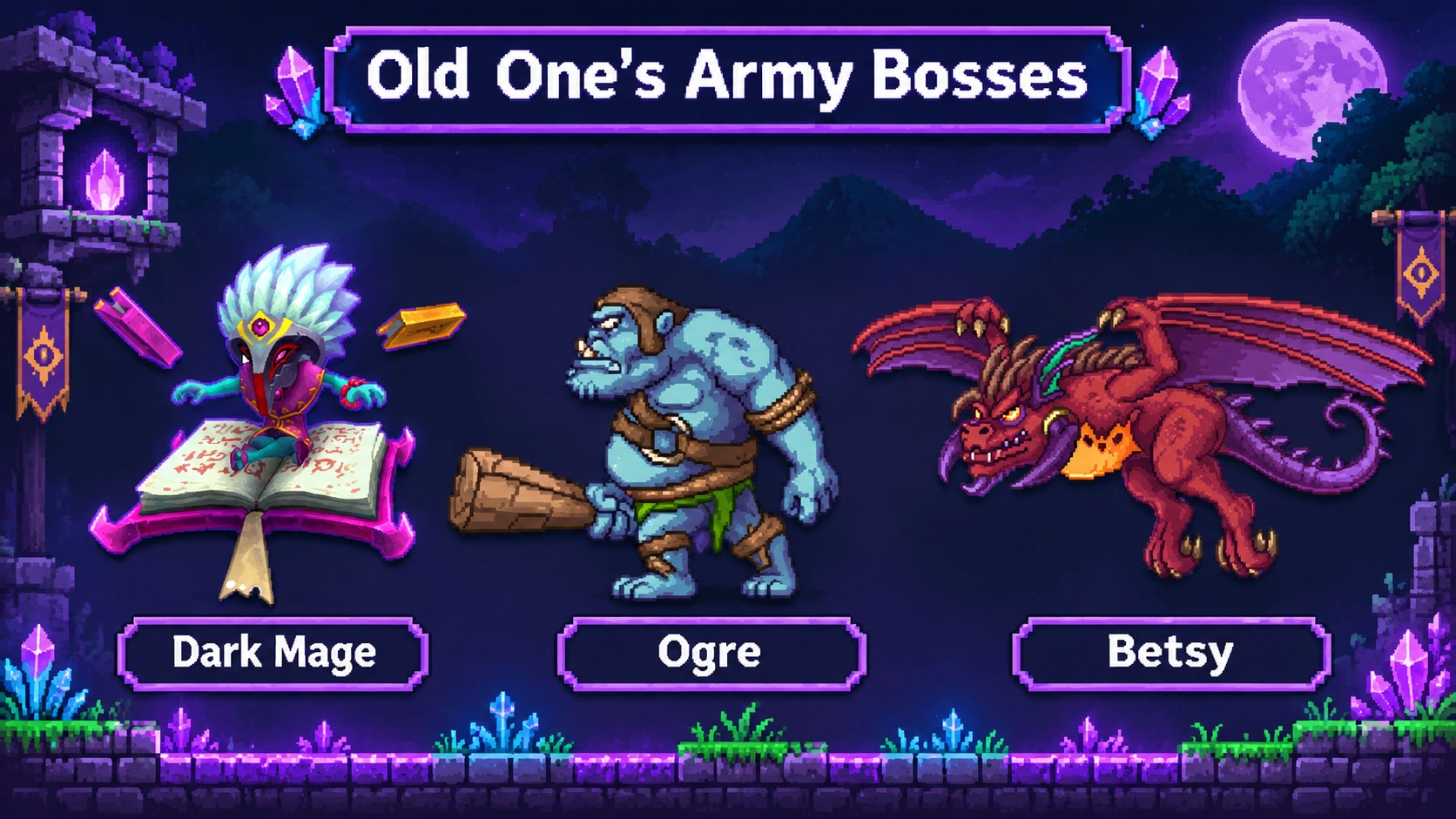
The Old One’s Army is a wave-based crossover event inspired by Dungeon Defenders II. Players start it using an Eternia Crystal and Eternia Crystal Stand, with increasingly difficult tiers becoming available as the game progresses.
The event contains three boss-type enemies:
- Dark Mage: A magic-using mini-boss encountered during the first and third tiers of the event.
- Ogre: A large, powerful mini-boss found in the second and third tiers.
- Betsy: A dragon that appears during the final wave of the third tier, unlocked after defeating Golem.
Pirate Invasion Boss: Flying Dutchman
The Flying Dutchman is a flying pirate ship that appears during the Pirate Invasion. Players must destroy its cannons to defeat it. The invasion can occur naturally in Hardmode or be started with a Pirate Map. Although the Flying Dutchman isn’t part of the main boss progression, it counts among Terraria’s event bosses and can drop useful pirate-themed rewards.
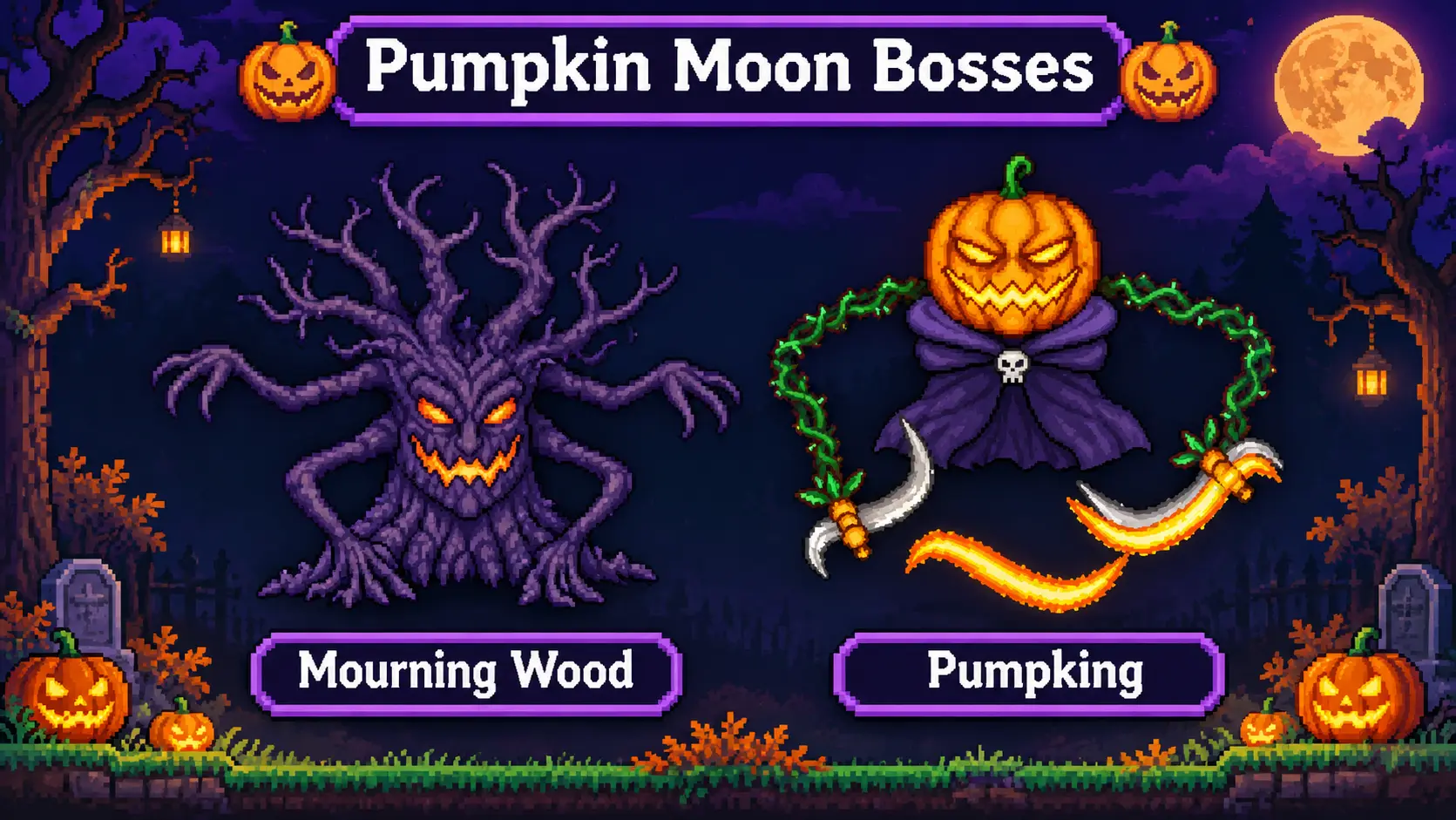
Pumpkin Moon Bosses
Pumpkin Moon is a challenging nighttime event that players activate using a Pumpkin Moon Medallion. It features two boss-type enemies that can appear multiple times as the event progresses:
- Mourning Wood: A monstrous burning tree that appears during the earlier event waves.
- Pumpking: A floating pumpkin-headed creature armed with enormous blades, encountered in later waves.
Frost Moon Bosses
Frost Moon is another challenging nighttime event, started by using a Naughty Present. Its three Christmas-themed bosses are considerably more dangerous than their festive appearances suggest.
- Everscream: A giant animated Christmas tree.
- Santa-NK1: A heavily armed mechanical version of Santa Claus.
- Ice Queen: A flying ice-themed boss that appears in later waves.
Like Pumpkin Moon, Frost Moon becomes increasingly difficult as players survive more waves. Its bosses can also appear multiple times during the event.

Martian Madness Boss: Martian Saucer
The Martian Saucer appears during the Martian Madness invasion, which can be triggered after Golem by allowing a Martian Probe to detect the player and escape. The Saucer is a large flying machine equipped with lasers and other weapons. It’s one of the more memorable invasion encounters, particularly because of its unusual sci-fi design and powerful rewards.
The Four Celestial Pillars
The Celestial Pillars appear after defeating the Lunatic Cultist. Although they don’t behave like ordinary moving bosses, they’re classified among Terraria’s event bosses and are essential to the final progression.
| Celestial Pillar | Associated theme |
| Solar Pillar | Melee |
| Nebula Pillar | Magic |
| Vortex Pillar | Ranged |
| Stardust Pillar | Summoning |
Each pillar is protected by a shield that players must disable by defeating enemies in its surrounding area. Once the shield disappears, the pillar becomes vulnerable. Destroying all four triggers the arrival of Moon Lord, provided the usual event progression continues.
What About Torch God and Dungeon Guardian?
Two other encounters sometimes cause confusion when players look for a complete Terraria boss list. Torch God is a special underground event triggered by placing enough torches in a suitable area. It’s technically classified as a boss in the Bestiary, but isn’t included among the 33 standard boss encounters. Dungeon Guardian, meanwhile, is an exceptionally powerful enemy that appears when players enter the Dungeon before defeating Skeletron. Despite its strength, it isn’t classified as a regular boss.
Neither is missing from the list by accident; they simply belong to different encounter categories.
Mechdusa: Terraria’s Special World Seed Boss
Mechdusa is one of the easiest bosses to miss when looking through an ordinary Terraria progression guide. This enormous mechanical creature combines The Destroyer, The Twins, and Skeletron Prime into a single encounter. It appears in the special get fixed boi world seed, which combines several secret-world features. Players can summon Mechdusa using Ocram’s Razor, an item created specifically for this encounter.
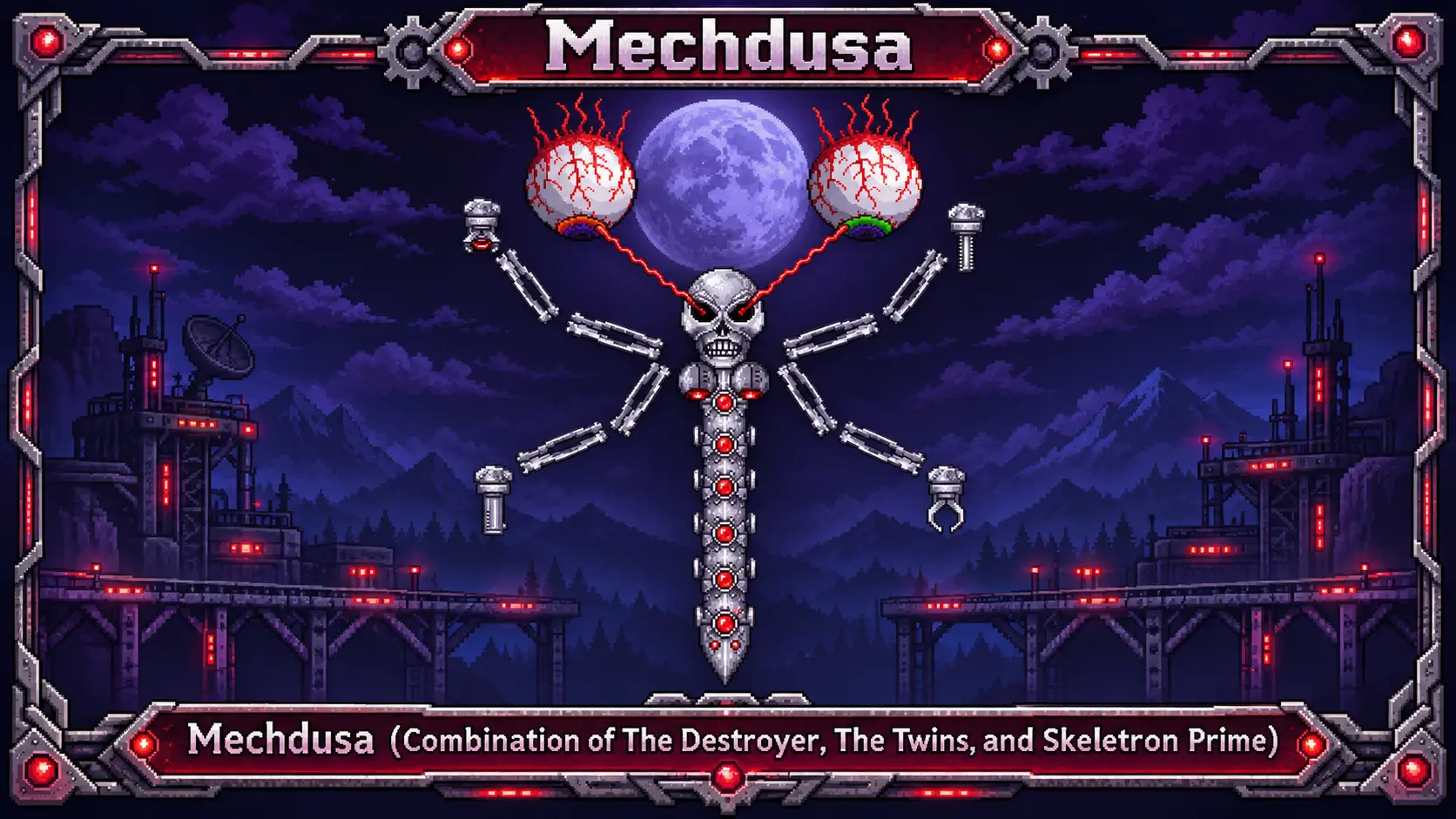
Although Mechdusa is counted separately in Terraria’s official boss list, it’s technically a combined mechanical boss encounter, rather than an entirely independent creature. It replaces the three separate mechanical boss encounters in this special world, which explains why many ordinary progression guides leave it out.
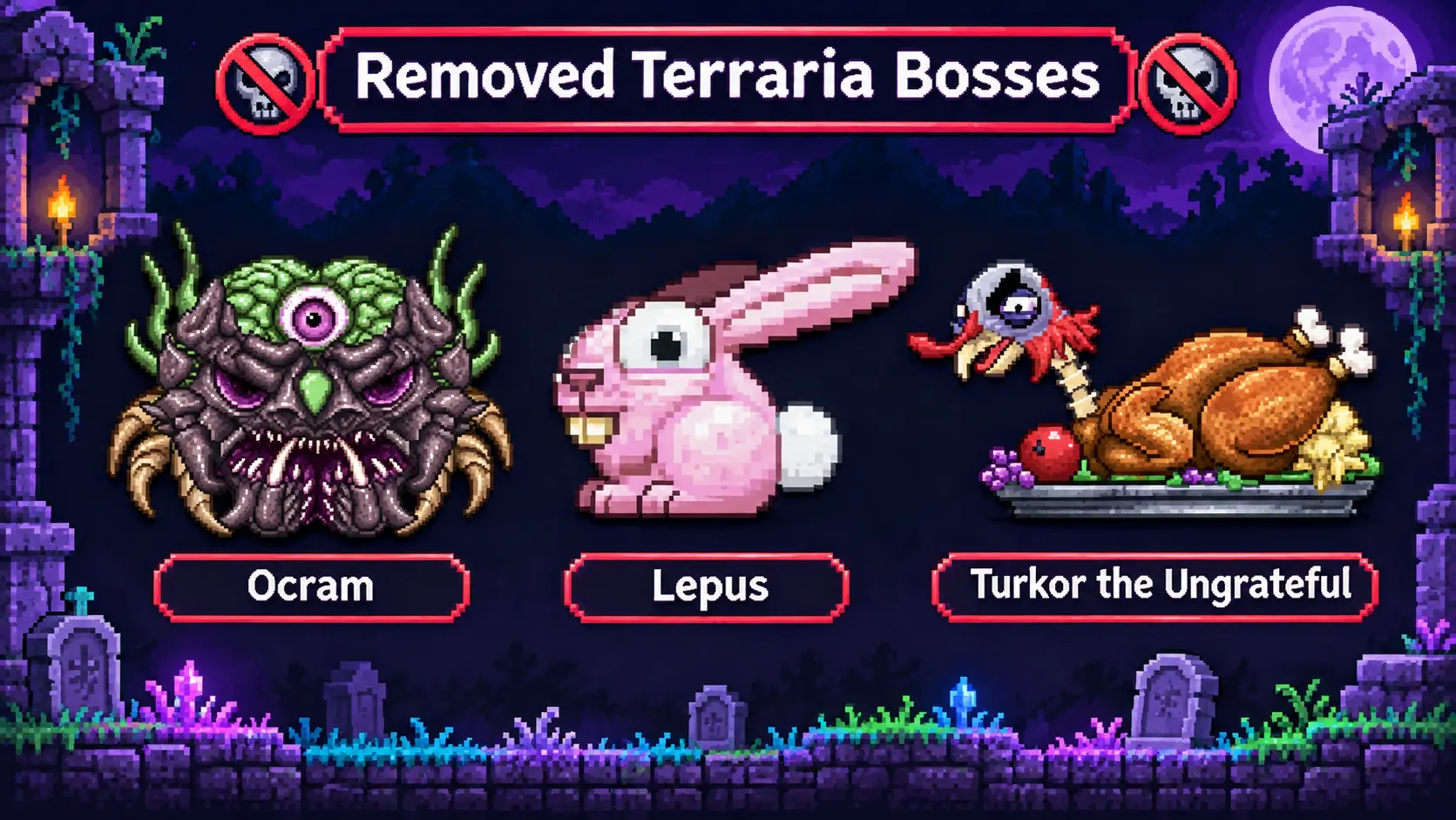
Removed Terraria Bosses: Ocram, Lepus, and Turkor the Ungrateful
If you’ve watched older Terraria videos or explored discussions about the game’s early console and mobile releases, you may have come across bosses that don’t appear in modern versions. Three former bosses are worth mentioning, particularly because they were once exclusive to certain platforms.
Ocram
Ocram was a Hardmode boss found in Terraria’s older console editions, including the Nintendo 3DS version. It was once one of the most important late-game encounters on those platforms. The boss had a large, grotesque appearance and dropped materials associated with exclusive equipment. Ocram was removed from updated console versions as Terraria’s platforms were brought closer together, although it remains accessible in certain discontinued legacy editions. The original boss never became part of the standard PC version, but its name lives on through Ocram’s Razor, the item used to summon Mechdusa.
Lepus
Lepus was an Easter-themed boss that appeared in older mobile releases and the Nintendo 3DS edition. It resembled an enormous rabbit and could produce smaller enemies and additional copies of itself through eggs. Lepus was removed from the updated mobile version and isn’t available in modern Terraria, although players using certain legacy editions can still encounter it.
Turkor the Ungrateful
Turkor the Ungrateful was a Thanksgiving-themed boss found in older mobile releases and the Nintendo 3DS edition. It took the form of a giant turkey with a separate head and body, making it one of the game’s more unusual historical encounters. Like Lepus, Turkor was removed from updated mobile versions but remains part of Terraria’s legacy content.
Important: These three bosses are not included in the modern count of 33. They remain accessible in certain discontinued legacy editions, but players using current PC, console, or mobile releases won’t encounter them in ordinary gameplay.
Which Terraria Bosses Are Actually Required?
One thing I find interesting about Terraria’s progression is how much freedom it gives players. The game has a final boss, but that doesn’t mean every encounter on the way there is compulsory. For the usual progression route, the important milestones are:
- Skeletron: Defeat him to unlock the Dungeon and meet a requirement for the later Lunatic Cultist encounter. He can be fought before or after entering Hardmode.
- Wall of Flesh: Defeat it to enter Hardmode.
- The three mechanical bosses: Defeat The Destroyer, The Twins, and Skeletron Prime to unlock Plantera’s Bulbs.
- Plantera: Defeat her to progress toward the Jungle Temple.
- Golem: Defeat it to unlock the late-game cultist encounter, provided Skeletron has also been defeated.
- Lunatic Cultist and Celestial Pillars: Complete the Lunar Events to reach the final boss.
- Moon Lord: Defeat Terraria’s final main-progression boss.
A Corruption or Crimson boss is also important for unlocking conventional early-game equipment and progression, but players aren’t required to defeat every Pre-Hardmode boss before fighting the Wall of Flesh. Bosses such as King Slime, Queen Bee, Deerclops, Queen Slime, Duke Fishron, and Empress of Light can be skipped entirely.
I wouldn’t necessarily recommend ignoring all of them, though. Some offer equipment that makes later encounters more manageable, while others are simply interesting fights worth experiencing.
Who Is the Final Boss in Terraria?
Moon Lord is the final boss in Terraria’s standard progression. Defeating him provides access to powerful endgame equipment, but it doesn’t end the game or prevent further exploration. Players can continue building, collecting items, completing events, or challenging bosses again in different difficulty modes.
There’s also Mechdusa in the special get fixed boi seed, but that encounter doesn’t replace Moon Lord as the final boss. Terraria may have a defined progression route, yet defeating its final boss is far from the only reason to keep playing. With so many optional encounters, events, and unusual world settings, there’s a lot to discover beyond the main path.

I’m Alex Mercer, a gaming writer at GamingIMBA, covering video games, esports, and industry news. My work spans game guides, competitive gaming, indie titles, and major updates, with a focus on explaining mechanics, trends, and developments that matter to players. I aim to make every article clear, accurate, and genuinely useful.