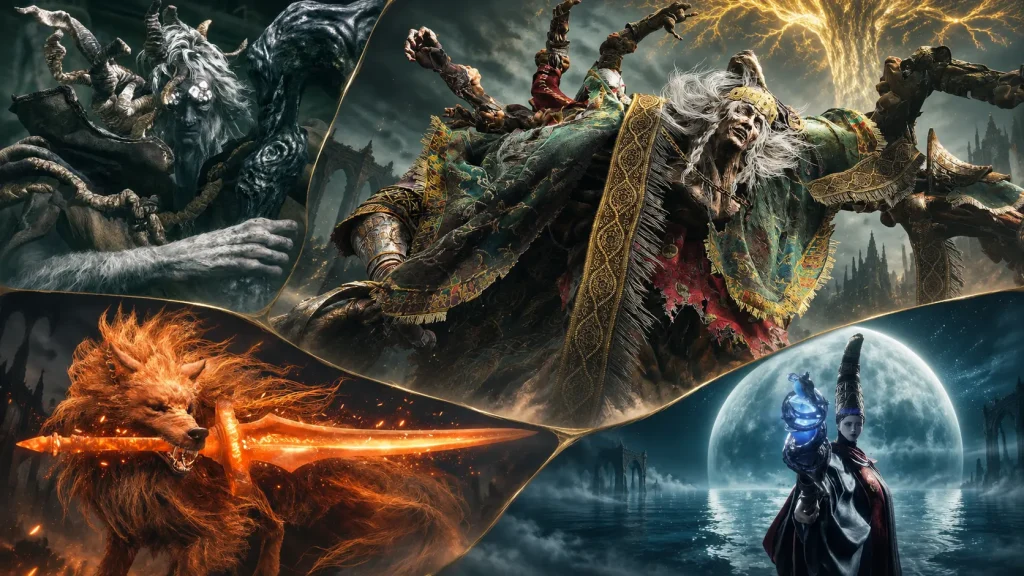
Elden Ring doesn’t waste much time introducing players to dangerous enemies. Within minutes of entering Limgrave, you can encounter a heavily armored knight on horseback who is more than capable of killing an inexperienced character in a few hits. You can fight him immediately, but the game doesn’t particularly care whether you’re ready.
That’s a good introduction to how Elden Ring handles bosses.
Some stand in your way as you progress through the story. Others are hidden inside castles, caves, catacombs, and underground cities. A few are wandering around the open world, waiting for someone unfortunate enough to approach them.
Not every boss is equally important, either. Some reward you with a handful of runes and useful equipment, while others change the world, open new locations, or determine how close you are to finishing the game.
This guide covers the main Elden Ring bosses, the different types of encounters, where to find the most important enemies, and which fights are necessary to complete the game. It also includes the bosses introduced in Shadow of the Erdtree.
Spoiler warning: This article mentions major bosses, locations, and late-game encounters from Elden Ring and its expansion.
How Many Bosses Are in Elden Ring?
Elden Ring contains well over 200 boss encounters when the original game and Shadow of the Erdtree are considered together.
The exact total depends on how encounters are counted. Some bosses appear in multiple locations, while others share a health bar or fight alongside another enemy. Different checklists also disagree about whether certain powerful named enemies should be included.
The most useful distinction is between ordinary boss encounters and Remembrance bosses.
The original Elden Ring contains 15 Remembrance bosses, while Shadow of the Erdtree introduces another 10, bringing the combined total to 25.
Remembrance bosses are generally among the game’s most important encounters. Defeating one awards a unique Remembrance that can usually be exchanged for powerful weapons, spells, or other equipment through Finger Reader Enia at Roundtable Hold.
However, not every particularly difficult enemy drops a Remembrance. The enormous dragon Bayle the Dread, for example, has a different reward.
For players who simply want to finish the main story, the good news is that defeating every boss is completely unnecessary.
Different Types of Elden Ring Bosses
Although the game doesn’t divide every boss into one simple official classification, several useful categories help explain what players will encounter.
Main Story Bosses
These bosses stand along the route toward completing Elden Ring. Important encounters include Morgott, the Omen King, Fire Giant, Maliketh, and the final confrontation against Radagon and the Elden Beast.
Some encounters are unavoidable once you reach a particular stage, while others depend on the route you’ve chosen.
For example, you need to obtain two Great Runes before progressing through Leyndell, but the game gives you several possible shardbearers to defeat.
Demigods and Shardbearers
Demigods play central roles in Elden Ring’s story, and several carry Great Runes, powerful fragments of the shattered Elden Ring.
Notable shardbearers include Godrick the Grafted, Rennala, Starscourge Radahn, Rykard, Morgott, Mohg, and Malenia.
Rennala is a special case: she possesses the Great Rune of the Unborn but is not herself a demigod.
These encounters are often particularly memorable because they connect directly to the history of the Lands Between.
Field Bosses
Field bosses appear across the open world, sometimes without warning.
Tree Sentinel is one of the earliest examples. Other familiar enemies include Night’s Cavalry, Deathbirds, Erdtree Avatars, and various dragons.
Some only appear under particular conditions. Night’s Cavalry, for example, can be encountered at specific locations during the night.
One thing I particularly like about these encounters is that they make exploration feel unpredictable. Finding a new location can mean discovering valuable equipment, an unusual enemy, or a boss you have absolutely no business fighting yet.
Dungeon and Optional Bosses
Caves, tunnels, catacombs, and other smaller areas frequently end with a boss encounter.
These fights are generally less important to the main story, but their rewards can be surprisingly useful.
Bloodhound Knight Darriwil, for example, drops Bloodhound’s Fang, an excellent weapon that can remain effective throughout much of the game.
Optional bosses aren’t necessarily easy, either. Some of Elden Ring’s hardest battles are completely avoidable.
Major Elden Ring Bosses and Their Locations
The following table covers the most important encounters from the original game, including story bosses and several major optional fights.
| Boss | Location | Optional? |
| Margit, the Fell Omen | Stormveil Castle entrance | Yes, depending on route |
| Godrick the Grafted | Stormveil Castle | Yes |
| Red Wolf of Radagon | Raya Lucaria Academy | Yes |
| Rennala, Queen of the Full Moon | Raya Lucaria Academy | Yes |
| Starscourge Radahn | Redmane Castle, Caelid | Yes |
| Rykard, Lord of Blasphemy | Volcano Manor | Yes |
| Draconic Tree Sentinel | Capital Outskirts | Can be bypassed via an alternative route |
| Godfrey, Golden Shade | Leyndell | No |
| Morgott, the Omen King | Leyndell | No |
| Mohg, Lord of Blood | Mohgwyn Palace | Yes |
| Fire Giant | Mountaintops of the Giants | No |
| Godskin Duo | Crumbling Farum Azula | No |
| Maliketh, the Black Blade | Crumbling Farum Azula | No |
| Malenia, Blade of Miquella | Elphael, Haligtree | Yes |
| Dragonlord Placidusax | Crumbling Farum Azula | Yes |
| Sir Gideon Ofnir | Leyndell, Ashen Capital | No |
| Godfrey / Hoarah Loux | Leyndell, Ashen Capital | No |
| Radagon / Elden Beast | Erdtree | No |
Being optional doesn’t make a boss unimportant. Godrick, Rennala, Radahn, Rykard, and Mohg can all contribute toward the Great Rune requirement, even though none is individually essential to finishing the original game.
Similarly, Radahn and Mohg must both be defeated if you want to enter Shadow of the Erdtree.
The Most Memorable Elden Ring Bosses
With so many encounters available, a handful stand out because of their unusual designs, stories, or fighting styles.
Margit, the Fell Omen
Margit is one of the earliest major obstacles players encounter.
His delayed attacks, magical weapons, and unpredictable combinations punish anyone who expects every movement to follow a simple rhythm.
I think he’s an excellent early boss precisely because he can seem unfair at first. The fight becomes much more manageable once you pay attention to when an attack actually lands instead of dodging the moment an animation begins.
Margit also teaches one of Elden Ring’s most valuable lessons: exploring somewhere else and returning stronger is often a perfectly reasonable strategy.
Starscourge Radahn
Radahn offers one of the most spectacular encounters in the original game.
The battle takes place across an enormous desert, where players can summon several warriors participating in the Radahn Festival.
Armed with gigantic swords and gravity magic, Radahn feels more like an army-sized threat than an ordinary opponent.
The fight also has major consequences for the world. Defeating him allows the stars to move again, leading to a meteor strike that opens the way into Nokron, Eternal City.
His unusual appearance, particularly the tiny horse carrying his enormous body, makes him instantly recognizable.
Rykard, Lord of Blasphemy
Rykard is fought inside Volcano Manor, where he first appears as the God-Devouring Serpent.
The encounter is unusual because players can obtain the Serpent-Hunter weapon inside the arena. Its special attacks are designed for this particular battle.
Rather than encouraging you to rely entirely on your normal weapon, the fight introduces an alternative way to defeat a gigantic opponent.
Rykard’s transformation and unsettling appearance make this one of the strangest encounters in Elden Ring.
Malenia, Blade of Miquella
Malenia is easily among the game’s most recognizable bosses.
Found deep within Elphael, she is an entirely optional opponent who has become famous for her extraordinary difficulty.
Her attacks restore health when they connect, even against a blocking shield. Her Waterfowl Dance attack can also deal enormous damage through a rapid sequence of slashes.
The second phase introduces additional attacks involving Scarlet Rot.
Of all the original game’s bosses, Malenia is arguably the best example of how one mechanic can completely change a battle. Her ability to heal means surviving an attack isn’t always enough; you also need to prevent her from recovering the health you’ve already taken away.
Maliketh, the Black Blade
Maliketh is encountered in Crumbling Farum Azula.
The battle begins against the Beast Clergyman before changing into a much faster confrontation.
His second phase features spectacular aerial movements and attacks associated with Destined Death, which can temporarily reduce maximum health and continue draining it.
Maliketh doesn’t have the largest health pool among late-game bosses, but his speed makes every mistake feel expensive.
For me, he’s one of the strongest examples of a boss that feels intimidating without relying purely on enormous amounts of health.
Elden Ring Bosses by Region
The Lands Between is divided into several major regions, each containing its own collection of bosses.
Some enemies appear more than once, and certain regions have significantly stronger opponents than their neighboring areas.
The following overview highlights notable encounters rather than every individual boss.
| Region | Notable Bosses |
| Limgrave | Tree Sentinel, Margit, Godrick, Flying Dragon Agheel |
| Weeping Peninsula | Leonine Misbegotten, Ancient Hero of Zamor, Erdtree Avatar |
| Liurnia of the Lakes | Rennala, Red Wolf of Radagon, Royal Knight Loretta, Glintstone Dragon Smarag |
| Caelid | Starscourge Radahn, Commander O’Neil, Decaying Ekzykes |
| Dragonbarrow | Black Blade Kindred, Flying Dragon Greyll, Putrid Avatar |
| Altus Plateau | Elemer of the Briar, Godskin Apostle, Ancient Dragon Lansseax |
| Mt. Gelmir | Rykard, Godskin Noble, Full-Grown Fallingstar Beast |
| Leyndell | Morgott, Godfrey’s Golden Shade, Mohg the Omen |
| Mountaintops of the Giants | Fire Giant, Commander Niall, Borealis the Freezing Fog |
| Consecrated Snowfield | Astel, Stars of Darkness, Great Wyrm Theodorix |
| Underground Regions | Regal Ancestor Spirit, Mimic Tear, Mohg, Lichdragon Fortissax |
| Miquella’s Haligtree | Loretta, Knight of the Haligtree, Malenia |
| Crumbling Farum Azula | Godskin Duo, Maliketh, Dragonlord Placidusax |
Some locations are considerably more dangerous than they initially appear. Dragonbarrow, for example, contains enemies much stronger than those in many parts of southern Caelid.
I wouldn’t recommend clearing every region completely before moving to the next. Elden Ring frequently encourages players to explore several areas at once, particularly when they encounter an unusually difficult boss.
Elden Ring Bosses in Shadow of the Erdtree
Shadow of the Erdtree introduces the Realm of Shadow, a large new area filled with dangerous enemies, unfamiliar locations, and additional boss encounters.
To access the expansion, players must first defeat Starscourge Radahn and Mohg, Lord of Blood in the original game. Afterward, interacting with Miquella’s arm in Mohg’s arena transports them to the new region.
The expansion introduces 10 Remembrance bosses.
| DLC Boss | Location |
| Divine Beast Dancing Lion | Belurat, Tower Settlement |
| Rellana, Twin Moon Knight | Castle Ensis |
| Putrescent Knight | Stone Coffin Fissure |
| Commander Gaius | Scaduview |
| Scadutree Avatar | Scadutree Base |
| Romina, Saint of the Bud | Church of the Bud |
| Midra, Lord of Frenzied Flame | Midra’s Manse |
| Metyr, Mother of Fingers | Finger Ruins of Miyr |
| Messmer the Impaler | Shadow Keep |
| Promised Consort Radahn | Enir-Ilim |
The expansion also features several major encounters that don’t grant Remembrances, including Bayle the Dread, Ancient Dragon Senessax, Death Knights, and various mausoleum bosses.
One important difference between the original game and the expansion is the Scadutree Blessing system.
Collecting Scadutree Fragments increases your character’s offensive and defensive capabilities within the Realm of Shadow. Ignoring these upgrades can make even an experienced, high-level character feel surprisingly weak.
I think this is worth emphasizing because entering the DLC with a powerful character doesn’t automatically mean you’re prepared for its hardest encounters.
Which Elden Ring Bosses Are the Hardest?
There isn’t one universally accepted difficulty ranking.
Different weapons, spells, summons, and character builds can completely change how challenging an encounter feels.
Nevertheless, several bosses regularly stand out in discussions about the game’s toughest fights:
- Malenia, Blade of Miquella: Her healing and Waterfowl Dance punish mistakes heavily.
- Promised Consort Radahn: The DLC’s final boss combines aggressive attacks with a particularly demanding second phase.
- Bayle the Dread: A spectacular dragon encounter featuring devastating area attacks.
- Messmer the Impaler: Fast spear combinations, fire attacks, and dangerous transformations.
- Maliketh, the Black Blade: High mobility and attacks that make recovering from mistakes difficult.
- Rellana, Twin Moon Knight: Relentless sword combinations supported by fire and magic.
- Mohg, Lord of Blood: Bloodflame attacks and a dangerous phase transition.
Personally, I think difficulty rankings become much more interesting when they explain why a fight is difficult rather than simply placing one boss above another.
Malenia challenges players through healing and precision, while Maliketh demands quick reactions. Bayle creates difficulty through size, movement, and powerful attacks covering large areas.
These are very different types of challenges, and a player’s preferred fighting style can make one encounter far more manageable than another.
Do You Need to Defeat Every Boss to Finish Elden Ring?
No. Only a relatively small portion of Elden Ring’s bosses must be defeated to complete the main story.
The game requires you to obtain two Great Runes before progressing through Leyndell. There are several possible shardbearers, allowing different routes through the earlier regions.
After reaching the capital, progression becomes more structured.
Important required encounters along the later story route include Morgott, Fire Giant, Godskin Duo, Maliketh, Sir Gideon Ofnir, Godfrey, and the final confrontation against Radagon and the Elden Beast.
Some bosses that appear compulsory in a typical playthrough, such as Margit and Godrick, can be avoided by pursuing different routes.
Meanwhile, Malenia, Dragonlord Placidusax, and several other major encounters are optional.
There is also no requirement to defeat every boss to earn all of Elden Ring’s achievements. Completing every named boss encounter is a separate challenge for players who want to explore absolutely everything.
What Do You Get for Defeating Bosses?
Defeating bosses generally rewards players with runes, but many encounters also provide weapons, spells, talismans, Spirit Ashes, or other valuable items.
Some rewards are particularly useful:
| Boss | Notable Reward |
| Bloodhound Knight Darriwil | Bloodhound’s Fang |
| Godrick the Grafted | Godrick’s Great Rune and Remembrance |
| Rennala | Character rebirth and Remembrance |
| Starscourge Radahn | Radahn’s Great Rune and Remembrance |
| Rykard | Remembrance exchangeable for Blasphemous Blade |
| Alecto, Black Knife Ringleader | Black Knife Tiche Spirit Ashes |
| Malenia | Malenia’s Great Rune and Remembrance |
| Mohg, Lord of Blood | Mohg’s Great Rune and Remembrance |
For Remembrance bosses, players can exchange their Remembrances for unique rewards rather than simply consuming them for runes.
Certain Remembrances can also be duplicated, allowing players to obtain additional rewards.
Not every valuable piece of equipment comes from a major story boss, which is another good reason to explore optional areas.
Frequently Asked Questions
Who Is the First Boss in Elden Ring?
The Grafted Scion is the first boss-style encounter players normally face during the opening sequence. Soldier of Godrick serves as the optional tutorial boss, while Tree Sentinel is one of the first powerful enemies encountered in Limgrave.
Who Is the Final Boss of Elden Ring?
The final encounter in the original game consists of Radagon of the Golden Order followed immediately by the Elden Beast.
Shadow of the Erdtree has its own final boss, Promised Consort Radahn.
Are All Elden Ring Bosses Optional?
No. Several bosses must be defeated to progress through the main story, although many others can be skipped entirely.
The particular shardbearers you defeat early in the game can vary.
Can Elden Ring Bosses Respawn?
Defeated bosses generally do not respawn when resting at a Site of Grace. However, the same boss type may appear in multiple locations.
Players can encounter bosses again in a new game cycle or participate in certain fights through cooperative multiplayer.
Can You Fight Bosses With Friends?
Yes. Many encounters support cooperative multiplayer, allowing players to summon others for assistance.
Availability and restrictions depend on the location and encounter.
Does Shadow of the Erdtree Have More Difficult Bosses?
The expansion contains several of Elden Ring’s most demanding encounters. However, its Scadutree Blessing system provides an important way to improve your character’s effectiveness.
Final Thoughts
Elden Ring’s bosses are much more than obstacles between locations. They are a major part of how the game tells its story, rewards exploration, and encourages players to experiment with different approaches.
Some encounters, like Margit, teach important lessons early. Others, such as Radahn and Rykard, are memorable because of their scale and unusual mechanics. And then there are bosses like Malenia, Maliketh, and Promised Consort Radahn, whose difficulty has made them famous far beyond the game’s community.
What I appreciate most about Elden Ring’s boss design is the variety. A battle against a giant dragon demands a different approach from a duel against a fast-moving knight, and an intimidating enemy doesn’t always need to be defeated immediately.
With hundreds of encounters across the original game and Shadow of the Erdtree, there’s no shortage of enemies to discover.
You don’t need to defeat every single one to finish the story, but exploring beyond the required path is where many of Elden Ring’s most memorable encounters are waiting.

I’m Alex Mercer, a senior gaming and esports writer at GamingImba. I’ve been involved in gaming for as long as I can remember, and for more than a decade I’ve been writing about competitive play, industry trends, and the culture that grows around games.
My work focuses on esports, online gaming platforms, and how technology continues to shape the way people play, compete, and connect. I’m especially interested in meta shifts, balance changes, and the business decisions that influence modern games behind the scenes.
At GamingImba, I aim to break down complex topics in a way that’s clear, honest, and useful—whether that means analyzing a major tournament, exploring new gaming platforms, or looking at how player behavior evolves over time.
I follow global esports scenes closely, experiment with different games and mods in my free time, and enjoy digging into the details that most players notice but rarely stop to question.