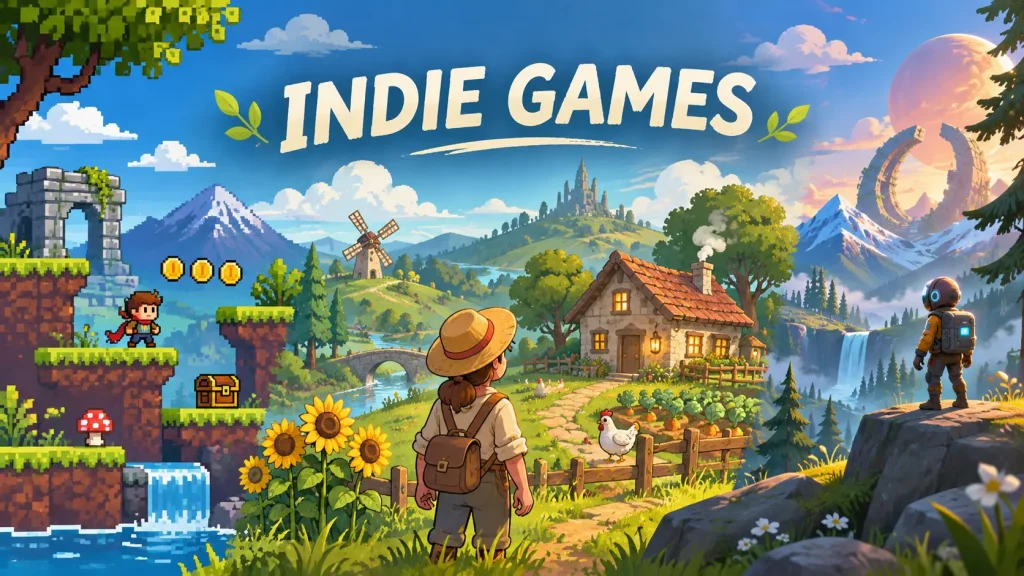
You don’t need a massive development team, a Hollywood-sized budget, or a famous publisher to make a great video game. Some of the most memorable games have come from a handful of developers working on ideas they simply wanted to bring to life.
Stardew Valley, Hollow Knight, Terraria, Undertale, and Hades are all examples of indie games. They look and play very differently, but they share something important: they were created by independent developers rather than being developed within the traditional big-budget gaming system.
Indie games have been around in one form or another for decades. What started with individual programmers and small teams has grown into a major part of the gaming industry, with independent releases regularly attracting worldwide attention. So, what exactly makes a game indie, where did independent game development begin, and what kinds of games fall into this category?
What Does Indie Game Mean?
Indie is short for independent. In gaming, the term generally describes video games developed by individuals or independent studios that retain significant control over their projects. There is no single official definition, and independence can involve creative decisions, financing, publishing, or a combination of these.
An indie developer might handle programming, artwork, music, and game design alone. Others work in teams of several people or run established independent studios with dozens of employees. The important part is that the developers have meaningful control over their work, rather than simply the size of the team.
Unlike large productions, where developers may have to satisfy investors, publishers, and corporate management, many indie studios have greater freedom over what they create and how they release it. That doesn’t mean every indie game is completely self-funded or self-published. Some independent studios work with publishers for financing, marketing, localization, or distribution while retaining creative control over their games.
Indie is not a genre, a graphics style, or a measure of quality. A pixel-art platformer, a realistic horror game, and a complicated management simulator can all be indie games.
When Did Indie Games Start?
There isn’t a single game or year that marks the beginning of indie gaming. Independent development existed long before the term became widely used in the video game industry.
The 1970s and 1980s: Games Made by Individuals
During the late 1970s and early 1980s, home computers opened up game development to people outside established technology companies. Machines such as the Apple II, Commodore 64, BBC Micro, and ZX Spectrum allowed enthusiasts to write their own software, often from their bedrooms.
In the United Kingdom, these independent programmers became associated with the bedroom coder scene. Some sold games through small software businesses, mail-order services, or commercial publishers.
One notable example is Elite (1984), developed by David Braben and Ian Bell for the BBC Micro and published by Acornsoft. Its ambitious space exploration and trading systems demonstrated what a tiny development team could achieve with limited hardware. Elite wasn’t an indie game in the modern marketing sense, but it belongs to the history of small-team game development.
Many early developers went on to establish studios, build publishing businesses, or join the growing commercial gaming industry.
The 1990s: Shareware and Independent PC Developers
By the 1990s, developing and selling PC games had become a more established business. Large publishers were increasingly influential, but smaller developers found other ways to reach players. One important method was shareware.
Instead of asking customers to buy an unfamiliar game immediately, developers distributed a portion of it for free. Interested players could then purchase additional episodes or the full version.
Companies such as id Software helped popularize this distribution model with games including Commander Keen, Wolfenstein 3D, and Doom. These releases were commercially significant, and id Software’s situation was different from that of many modern indie studios. Still, shareware demonstrated that developers didn’t always need conventional retail distribution to reach an audience.
Smaller independent RPGs, strategy games, and experimental PC titles also found dedicated communities throughout the decade.
The 2000s: The Modern Indie Scene Takes Shape
The 2000s were especially important for the identity of indie games as we understand them today. Broadband internet, digital storefronts, and more accessible development tools gradually made it easier for small teams to distribute games without securing traditional boxed retail deals.
Cave Story (2004), developed by Daisuke Amaya, became an influential example of what an individual creator could accomplish. Its exploration, combat, pixel art, and storytelling attracted attention well beyond its original Japanese release.
Then came several games that helped indie development reach a much wider audience:
- Braid (2008): A puzzle-platformer known for its time-manipulation mechanics.
- World of Goo (2008): A physics-based puzzle game built around connecting living balls of goo.
- Castle Crashers (2008): A colorful cooperative beat ’em up.
- Super Meat Boy (2010): A demanding platformer built around tight movement and precision.
- Minecraft (first publicly released in 2009): A sandbox game that began as an independent project before becoming a global phenomenon.
Xbox Live Arcade played a particularly important role by giving smaller digital games a place on home consoles. Braid’s 2008 launch is often cited as a milestone in the modern indie movement. The Independent Games Festival, established in the late 1990s and first held in 1999, also helped independent developers gain industry recognition.
The 2010s: Indie Games Become Mainstream
During the 2010s, indie games became a familiar part of PC and console gaming rather than something mainly followed by dedicated enthusiasts.
Digital distribution expanded, and developers gained more ways to release games directly to customers. Steam introduced Greenlight in 2012 and replaced it with Steam Direct in 2017, while itch.io launched in 2013 as a marketplace particularly welcoming to independent creators.
Games such as Undertale (2015), Stardew Valley (2016), Hollow Knight (2017), Celeste (2018), and Among Us (2018) showed just how varied and commercially successful independent development could become. Some reached audiences through strong word of mouth, while others benefited from YouTube videos, Twitch streams, fan communities, and social media.
Among Us is an interesting example: despite releasing in 2018, it experienced its enormous surge in popularity in 2020. Independent developers also began producing increasingly ambitious 3D games, complex simulations, and lengthy RPGs. Indie gaming was no longer closely associated with short, pixel-art experiences.
What Are the Main Indie Game Genres?
Indie games aren’t limited to a particular genre. However, some types of games have become particularly popular among independent developers because they allow smaller teams to focus on distinctive mechanics, atmosphere, or storytelling.
Platformers and Metroidvanias
Platformers are among the most recognizable indie games. They typically revolve around movement, jumping, combat, or navigating difficult environments. Metroidvanias add interconnected worlds, exploration, and abilities that gradually open up previously inaccessible areas.
Popular examples: Hollow Knight, Celeste, Shovel Knight, and Axiom Verge.
Survival and Crafting Games
Survival games ask players to gather resources, build shelters, manage supplies, and stay alive in challenging environments. Some focus on exploration and creativity, while others add hostile creatures, hunger, weather, and multiplayer cooperation.
Popular examples: Terraria, Valheim, Don’t Starve, Project Zomboid, and Raft.
Roguelikes and Roguelites
These games frequently use randomized elements and repeated attempts as part of their design. Dying can mean starting a new run, although roguelites often include upgrades or other forms of progress that carry over. They work especially well when combat, movement, and character builds offer plenty of variety.
Popular examples: Hades, Dead Cells, The Binding of Isaac: Rebirth, Enter the Gungeon, and Vampire Survivors.
Horror and Psychological Horror
Independent horror developers often rely on sound, limited visibility, unusual settings, or unsettling mechanics rather than expensive cinematic sequences. Some focus on story-driven horror, while others have become particularly popular as multiplayer experiences.
Popular examples: Phasmophobia, Lethal Company, Darkwood, and Amnesia: The Dark Descent.
RPGs and Story-Driven Adventures
Not every RPG needs a huge open world or thousands of voiced dialogue lines. Independent developers have created memorable role-playing and narrative games through strong characters, player choices, distinctive writing, and unusual combat systems.
Popular examples: Undertale, Disco Elysium, OMORI, and To the Moon.
Simulation, Management, and Strategy
Some of the deepest indie games are built around systems rather than cinematic presentation. Players might manage a colony, design factories, run a farm, or try to keep a spaceship crew alive. These games can offer hundreds of hours of gameplay despite relatively modest production budgets.
Popular examples: Stardew Valley, RimWorld, Factorio, Oxygen Not Included, and FTL: Faster Than Light.
Puzzle and Experimental Games
Independent developers have also produced games built around ideas that might be difficult to pitch as traditional blockbuster releases. The player might need to change the rules of a puzzle, investigate events through photographs, or solve problems through unusual interactions with the environment.
Popular examples: Baba Is You, The Witness, Return of the Obra Dinn, and Papers, Please.
These are only a few common categories. There are indie racing games, shooters, visual novels, rhythm games, sports titles, and countless hybrids that don’t fit neatly into one genre.
Indie Games vs AAA Games: What’s the Difference?
AAA games are generally large productions backed by major development budgets, extensive marketing, and substantial teams. Think of major franchises such as Call of Duty, Assassin’s Creed, or Grand Theft Auto.
Indie games generally operate with fewer resources and more independence. These differences describe common industry patterns rather than fixed rules.
| Feature | Indie games | AAA games |
| Development teams | Often individuals or smaller studios | Usually large teams, sometimes across multiple studios |
| Budget | Generally lower, but varies considerably | Usually high |
| Creative decisions | Often controlled by the developer | Frequently influenced by publishers and corporate priorities |
| Graphics | Everything from pixel art to realistic 3D | Often technically ambitious, high-fidelity visuals |
| Distribution | Digital storefronts, self-publishing, or indie publishers | Major publishers and established retail or digital channels |
| Pricing | Often lower, but not always | Commonly premium-priced |
| Development risks | Financial and production limits | Large financial exposure and commercial expectations |
Some independent studios have considerable budgets and large teams, while certain AAA productions experiment with unusual ideas. Likewise, an indie game can look more impressive than a major commercial release in particular areas.
The difference is primarily how a game is produced and controlled, not whether one is automatically better than the other.
What About AA Games?
You might also come across the term AA games, which generally refers to productions positioned somewhere between smaller projects and major AAA releases in terms of budget, team size, or production scope.
Unlike indie, which focuses largely on independence, AA is an informal description of production scale. An AA game can come from an independent studio or one working with a publisher, so the two labels aren’t mutually exclusive.
Famous Indie Games That Made an Impact
Some independent games have become so successful that players may not even associate them with the indie scene anymore.
Minecraft
Minecraft began as an independent project created by Markus Persson in 2009. Its open-ended building, exploration, and survival mechanics helped it become one of the most recognizable games ever made.
However, Minecraft is also a good example of how a game’s business status can change. Microsoft acquired Mojang and the Minecraft franchise in 2014, so it is best described as a game with indie origins, rather than a currently independent franchise.
Stardew Valley
Stardew Valley is one of the clearest examples of successful solo development. Eric Barone, also known as ConcernedApe, spent approximately four and a half years developing the original version, handling its programming, artwork, music, and design.
Released in 2016, it combined farming, relationships, exploration, and RPG progression into a game that attracted a huge audience. Although Stardew Valley was initially published by Chucklefish, Barone developed the original game entirely on his own. Other contributors later joined work on its updates and ports.
Hollow Knight
Developed by Team Cherry, Hollow Knight became well known for its interconnected world, challenging combat, atmospheric soundtrack, and hand-drawn visual style. Its success helped demonstrate the enduring appeal of exploration-heavy 2D action games.
Undertale
Toby Fox’s Undertale brought unusual storytelling and memorable characters to a retro-styled RPG. Its combat system allowed players to approach encounters in ways that went beyond simply defeating enemies.
It also developed an enthusiastic online community whose interest extended to its music, characters, and alternative story outcomes.
Hades
Supergiant Games’ Hades combined fast-paced roguelite combat with an ongoing story inspired by Greek mythology. Its art, voice performances, music, and responsive gameplay showed that independently developed games could deliver a highly polished production without following the usual blockbuster formula.
Among Us
Created by Innersloth, Among Us became a multiplayer sensation thanks to its simple social deduction concept. Players work together to complete tasks while impostors secretly attempt to sabotage the group.
Its rise in popularity during 2020, well after its original release, also showed how online communities and streamers could transform a game’s fortunes.
Why Are Indie Games So Popular?
There isn’t just one reason players enjoy indie games. For some, it’s the chance to discover something different from familiar blockbuster franchises. For others, it’s the lower price, the distinctive art style, or the satisfaction of supporting a smaller team.
Several characteristics have helped indie games build loyal audiences:
- Unusual gameplay ideas: Smaller developers may be willing to explore mechanics that are difficult to justify in a production costing tens of millions of dollars.
- Distinctive visual styles: Pixel art, hand-drawn animation, low-poly environments, and stylized 3D graphics can give games a recognizable identity without requiring cutting-edge technology.
- Strong communities: Many independent developers interact directly with players through community forums, Discord servers, development blogs, and early-access programs.
- A wide range of experiences: Indie gaming includes short narrative adventures, cooperative horror, complicated simulations, and games that can occupy players for hundreds of hours.
Of course, independence doesn’t automatically guarantee originality. Indie developers follow trends, revisit familiar formulas, and produce sequels just like larger studios. And when a small game finds a clever way to use a familiar idea, it can be every bit as entertaining as something completely new.
Are Indie Games Always Cheap or Free?
No. Although indie games are frequently more affordable than big-budget releases, there is no official indie price range.
Some independent games are free, particularly prototypes, experimental releases, and projects developed during game jams. Others are sold at premium prices that reflect their development costs, scope, and intended audience.
Games can also use paid expansions, optional supporter packs, or early-access pricing. Being indie doesn’t determine whether a game is free, inexpensive, or expensive. It describes the development circumstances rather than the price tag.
What Are the Downsides of Indie Games?
Independent development offers creative opportunities, but it also comes with practical limitations. Small teams may struggle with optimization, accessibility features, console certification, translation, customer support, or maintaining frequent updates.
Some games launch with bugs or incomplete features, especially when developers rely on early-access revenue to continue production. Projects can also be delayed or abandoned because of funding problems, burnout, or unexpected technical challenges.
Marketing is another obstacle. With so many games competing for attention, even a well-made indie release can struggle to find an audience.
Players shouldn’t assume that every independent game is an overlooked masterpiece. As with AAA releases, quality varies widely. The advantage is that there’s an enormous selection to explore, and a little research can help identify games worth playing.
Where Can You Find Indie Games?
Indie games are available across PC, consoles, and mobile devices. Some of the easiest places to discover them include:
- Steam: Offers a large indie catalog, player reviews, demos, discovery tools, and curated events.
- itch.io: Particularly useful for experimental games, small releases, game jam projects, and free downloads.
- GOG: Offers a selection of independent PC games, with an emphasis on DRM-free releases.
- Nintendo eShop: Includes many indie titles for Nintendo Switch and other supported Nintendo platforms.
- PlayStation Store and Xbox Store: Both carry independently developed games alongside major releases.
Events such as Steam Next Fest and indie-focused showcases are also useful for finding upcoming titles. Gaming communities, developer websites, and gameplay videos can help reveal smaller games that might otherwise be easy to miss.
Can Anyone Make an Indie Game?
In principle, yes. You don’t need to own a professional studio or have a major publishing agreement to start developing a game.
Tools such as Godot, Unity, Unreal Engine, and GameMaker have made game development accessible to hobbyists and small teams. Some engines offer free entry options, although licenses and commercial terms vary.
But accessibility doesn’t mean making a successful game is easy. Even a relatively simple project may involve programming, level design, animation, sound, testing, marketing, and ongoing support. A solo developer often has to learn several of these skills or collaborate with others.
Game jams offer one way to begin. Participants build a small game within a limited period, often around a particular theme. They are a useful opportunity to experiment, practice, and work with other creators.
Many notable independent games began as modest projects, although relatively few go on to achieve major commercial success.
The Place of Indie Games in Modern Gaming
Indie games have grown far beyond their reputation as small, inexpensive alternatives to blockbuster titles. They can be ambitious simulations, beautifully animated adventures, unconventional RPGs, or multiplayer games that become popular almost overnight.
Their developers range from solo creators working at home to established independent studios with experienced teams. That variety is one of the most interesting things about independent gaming. There isn’t a single formula that an indie game has to follow.
And while blockbuster games will always have their audience, there’s plenty of room for developers who want to try something different – whether that means reinventing a familiar genre or creating a game that doesn’t fit into one at all.

I’m Alex Mercer, a senior gaming and esports writer at GamingImba. I’ve been involved in gaming for as long as I can remember, and for more than a decade I’ve been writing about competitive play, industry trends, and the culture that grows around games.
My work focuses on esports, online gaming platforms, and how technology continues to shape the way people play, compete, and connect. I’m especially interested in meta shifts, balance changes, and the business decisions that influence modern games behind the scenes.
At GamingImba, I aim to break down complex topics in a way that’s clear, honest, and useful—whether that means analyzing a major tournament, exploring new gaming platforms, or looking at how player behavior evolves over time.
I follow global esports scenes closely, experiment with different games and mods in my free time, and enjoy digging into the details that most players notice but rarely stop to question.