If you’re learning how to play Dungeons & Dragons after Baldur’s Gate 3 or Divinity: Original Sin, the biggest adjustment comes before you roll a die. On screen, you choose from the actions the game offers. At the table, the Dungeon Master (DM) describes what’s happening and you say what your character wants to do. You can ask for a detail you missed, suggest a plan or turn to another player for help. The DM tells you what happens next and whether the outcome calls for a roll.
For a first D&D session, I’d start with a one-shot, an adventure designed for a single sitting, and ask for a ready-made character. That gives you an evening to find out what you enjoy about tabletop play before you spend money on books or hours choosing abilities. If you already like planning a party’s moves or talking your way through an RPG, you’ve got something to contribute from the moment play begins.
How do Baldur’s Gate 3 and Divinity: Original Sin compare with tabletop D&D?
Of the two games, Baldur’s Gate 3 is the closer match for the rules. Larian adapted its turn-based combat from fifth-edition D&D. Terms such as Armor Class, advantage and attack bonus will look familiar on a tabletop character sheet. Knowing roughly what they mean frees you up to listen while the Dungeon Master describes what’s happening. Check the details of your abilities on the sheet your group is using. A tabletop spell or class feature can work differently from the version you remember on screen.
The original Divinity: Original Sin uses its own rules. Its strongest preparation for D&D is the habit of reading a battlefield. Position, terrain and the order in which allies act can change what makes sense on your turn. At a physical table, some of that information may exist only in the Dungeon Master’s description. Before committing to a move, check how far away you are, what you can see and where your allies are standing. Asking for a clearer picture is part of playing.
Both games also give you a feel for travelling with people whose priorities differ from yours. At the table, the other adventurers belong to the other players. Give them time to answer for themselves, even when you’ve spotted a combination that would make excellent use of their abilities. If you enjoy coordinating a party, a good habit is to explain what you’re trying to achieve and leave the other player room to improve on your plan.
What do you need for your first D&D session?
Start with the group. Ask which rules they’re using, what level the characters will be and whether the Dungeon Master will provide character sheets. Groups may use the 2014 fifth-edition rules, the 2024 revision or an agreed mix. That choice affects which class features and spells belong on your sheet. If you’re joining an existing campaign, ask what the party is doing at the moment. A few sentences about their current situation will do more for your first evening than a history of the entire setting.
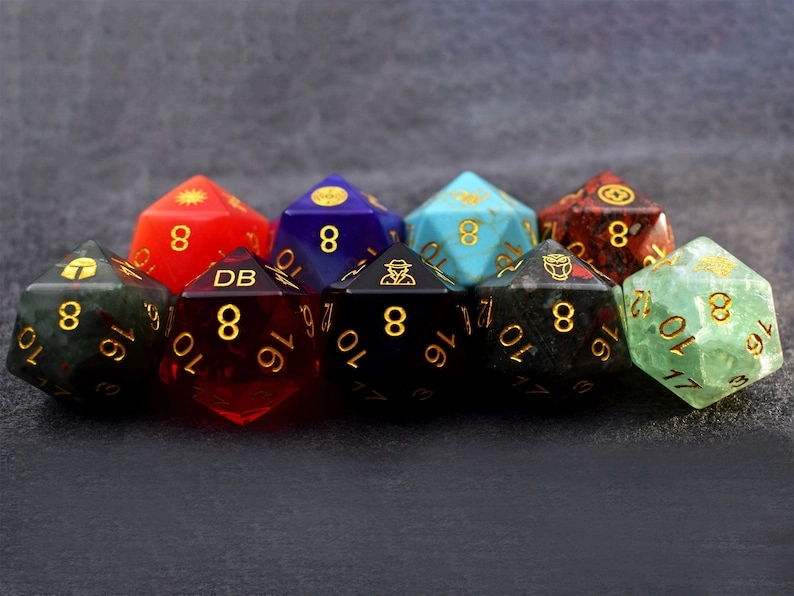
For an in-person game, bring your sheet, a pencil and access to dice. Your host may have a spare set, and a digital roller works if the group is happy to use one. The die you’ll reach for most often has twenty sides and is called a d20. Put it where you can recognize it, then find the die listed for your main weapon or spell. If choosing Custom DND Dice is part of the fun for you, a personalized d20 is one piece you’ll handle regularly. Borrowing one works just as well for your first game.
For online D&D, find out where the group talks and where it keeps the character sheets. A virtual tabletop can display maps, move tokens and handle dice, while the conversation may take place in a separate voice call. Open the invitation before game time, check your microphone and make sure you can access your character. Knowing how to hear the DM and find your sheet matters more than knowing every button on the screen.
You can start learning the game for free. In the D&D rules for playing the game, I’d read the section called “Rhythm of Play” first. It explains when the DM speaks, when you get to act and how the group decides the outcome. Bookmark the combat rules for your first fight. When your group uses a different rules version, ask the DM which reference they prefer.
How do you choose a beginner D&D character?
A pregenerated character comes with the rules decisions already filled in. You can start playing immediately and find out which parts of the character you enjoy before building one from scratch. The official D&D character sheets include ready-to-play options. Check the level and rules version with your host before settling on one, particularly if the group has offered to supply its own.
If you’re choosing a class, look at the decisions you’ll make often. The best beginner D&D class for you is one whose ordinary turn sounds enjoyable. These four are a good place to narrow the choice.
| D&D class | What you’ll spend time deciding |
|---|---|
| Fighter | Where to stand, which enemy to engage and when to use your combat features. A good fit if you enjoy weapon combat. |
| Rogue | Where you can move safely and when you qualify for Sneak Attack. Your skills also give you plenty to do during exploration. |
| Cleric | Which spells to prepare and when the party needs protection, healing or an attack. You get to make decisions in all three roles. |
| Wizard | Which spells belong in your prepared selection and when to spend a spell slot. A good fit if choosing abilities is part of the fun. |
Class describes your character’s training. You also get to decide what matters to them and why they’d stick with this group. Give your character one reason to go adventuring and one reason to care what happens to the others. That gives you something to draw on in a conversation, even with a backstory that fits in the margin. If you enjoy choosing a look for the character as well, DND Class Dice are an optional way to carry that choice onto the table.
Before play, find four entries on your sheet. You’ll use them often enough that they’re worth marking in pencil.
- Hit points (HP) track how much damage you can take before dropping to zero.
- Armor Class (AC) is the number an attack roll generally needs to reach to hit you.
- Attack bonus is what you add to the d20 when you use the listed attack.
- Damage tells you which dice to roll and what to add when that attack hits.
If you choose a spellcaster, also mark your cantrips, which you can normally cast without spending a spell slot. Knowing which magic is always available makes deciding when to spend a limited slot much easier.
How do roleplay, dice rolls and combat work in D&D?
A D&D session moves between conversation, exploration and combat. The Dungeon Master describes the world and plays the people and creatures your party meets. You decide what your character attempts. Tell the DM both your goal and how you’re going about it. They may describe the result straight away or ask you to roll because the outcome is uncertain. Waiting for that call gives the DM enough information to choose a rule that fits your idea.
Roleplay begins with making a decision from your character’s point of view. You can speak in character or describe the substance of what they say in your everyday voice. Either approach gives the DM something to respond to. If you’re used to reading every dialogue option before selecting one, take a moment to listen to what the person in the scene actually wants. Your next question can be as much of a contribution as the most persuasive speech in the room.
Much of the arithmetic comes down to rolling a d20 and adding a modifier from your sheet. An ability check resolves an uncertain task. The DM sets a target number called the Difficulty Class (DC). If your total reaches it, you succeed. An attack roll determines whether an attack hits. A saving throw determines how well you resist or avoid an effect. With advantage, you roll two d20s and use the higher number. With disadvantage, you use the lower. A natural one automatically misses on an attack roll. It doesn’t automatically fail an ordinary ability check.
When combat begins, initiative sets the turn order. On your turn you can normally move up to your speed and take an action. Some features and spells also give you a specific use for a bonus action. A reaction has its own trigger and can happen during another creature’s turn. If you’re deciding what to learn first, get comfortable with movement and your main action. Then look at what your particular class lets you add.
The easiest way to keep a first combat moving is to pick a likely action while another player takes their turn, then reassess when initiative reaches you. If the situation has changed, ask one short question about the new position. Other players can help with the mechanics while you keep control of the decision.
How do you find a beginner-friendly D&D group?
When you’re searching for Dungeons & Dragons for beginners, look for two details in the listing. Does the group welcome first-time players, and how many sessions are you committing to? A one-shot makes it easy to try a group. A campaign carries characters and storylines across several sessions and suits players who want a regular game. For a local table, ask a game shop which events welcome first-time players. To play online, Roll20’s game finder lets you filter for games that welcome new players, including free games and one-time sessions. Check the time zone, session length and any fee before signing up.
If you’re joining a campaign, ask about session zero. This is the group’s conversation about the game it wants to play. You can find out how much time the group spends on combat or roleplay, agree on subjects to leave out and check what happens if someone misses a night. A beginner-friendly group should be able to tell you how it helps someone learn during play.
A regular group can also give friends an easy way to keep in touch. In Roll for Insight, Orla Walsh and Conor Linehan interviewed ten D&D players. Some participants described the routine of having a game to look forward to as a source of comfort. If part of your interest in tabletop gaming is reconnecting with a friend, the “Connect” guidance in Five Ways to Wellbeing encourages making time to talk and listen. A one-shot gives you a specific evening to invite that friend to and a chance to decide together whether you’d like another.
Once you’ve found a date, ask the host for your starting sheet. Circle your main attack, jot down why your character is traveling with the party and keep the page handy. When the DM finishes describing the opening scene, you’ll be ready to say what you’d like to do.

Leonie is the founder of DND Den, a New Zealand-based shop specializing in dice and accessories for Dungeons & Dragons. A passionate tabletop RPG player, she draws inspiration from her own adventures and experiences at the gaming table. She currently plays a College of Lore bard in a Dungeon of the Mad Mage campaign. Her love for character creation and storytelling inspired DND Den’s approach to helping players find dice and accessories that reflect their characters’ personalities and classes.