Chell solves a room by changing where a fall ends. Ro connects impossible walkways, Katrielle Layton investigates puzzling cases, and the player of Unpacking reads a woman’s life through the objects she brings into each new home. These games make logic, spatial awareness, and environmental manipulation central to how their gameplay-explained/”>female protagonists’ stories unfold.
The distinction needs one qualification: Portal includes lethal hazards and destructive confrontations. Chell belongs here because its core gameplay rewards puzzle-solving rather than conventional combat, while Monument Valley 2, Layton’s Mystery Journey, and Unpacking offer more straightforward examples of progression without fighting.
That difference creates room for several kinds of female agency. Escaping an institution, exercising professional judgment, teaching a child, and establishing a home require different decisions. Puzzle design can give each of those experiences its own playable form.
The Silent Strategist: Chell and the Science of Spatial Logic
Chell uses the Portal Gun in Portal and Portal 2 to connect surfaces, redirect movement, and carry momentum through Aperture Science’s test chambers. Her persistence becomes visible through the player’s repeated attempts, while her silence gives GLaDOS’s constant commentary an unusually one-sided character.
A typical momentum puzzle starts with a ledge that Chell cannot reach by jumping. Place one portal beneath a drop and another on a wall facing the destination, and gravity supplies the speed needed to launch her across the room. The fall remains a fall, but its exit changes. Understanding that relationship is more useful than a faster reaction or a stronger weapon.
The resulting satisfaction comes from revising an assumption. A deep pit initially looks like a threat; with the right portal placement, it becomes part of the solution. Aperture’s architecture repeatedly asks the player to distinguish what a surface looks like from what it can do.
That lesson also supports Chell’s resistance to GLaDOS. The facility teaches her rules in controlled chambers, then discovers that she can apply those rules beyond its intended routes. Her escape follows from knowledge that Aperture itself helped her acquire.
Chell’s silence sharpens this relationship. GLaDOS offers instructions, insults, and explanations, but Chell never supplies the conversational response that might validate them. As a critical reading, her continued movement functions as a refusal to accept the machine’s account of who she is.
There is no speech announcing her determination. The player experiences it while adjusting an angle, missing a landing, and trying again. Her characterization is sparse, but the effort required to continue gives that sparseness substance.
Portal 2 expands the puzzle vocabulary with lasers, gels, and other devices, increasing the number of relationships the player must understand. Chell’s role remains practical: observe the chamber, test an arrangement, and find a route through it.
The danger matters. Turrets can kill her, and some encounters require redirecting destructive machinery. Chell’s intelligence is a survival skill exercised under pressure, which gives her a different kind of resolve from the calmer protagonists elsewhere in this article.
Perspective and Emotion: Ro in Monument Valley 2
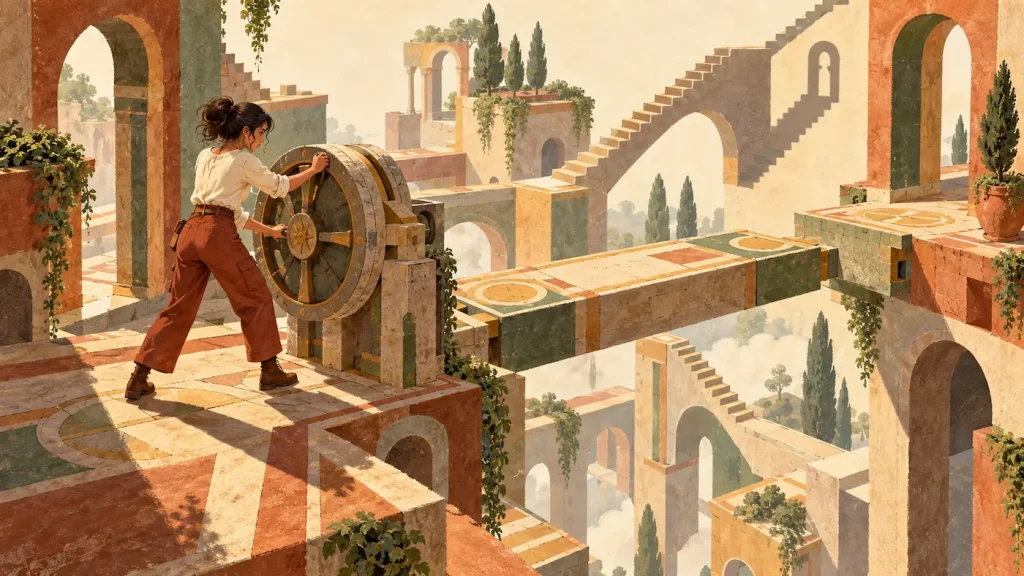
Ro and her daughter progress through Monument Valley 2 by reshaping architecture and joining paths through optical illusion. Its Sacred Geometry frames a maternal story in which guidance gradually makes room for independence.
The game treats visual alignment as a rule the player can use. Rotate a structure, and two walkways that should occupy different positions can appear to meet. Once the image connects them, the characters can cross.
This differs from Chell’s spatial logic. Portal asks the player to predict the consequences of a physical system; Monument Valley 2 asks them to recognize which arrangement makes an impossible route readable. Careful observation matters more than mathematical calculation.
The mother-and-child relationship changes how those routes feel. In one early sequence discussed by the developers, the daughter becomes stranded on a separate platform and follows Ro from a distance. Although an exit is accessible to the mother, players understood that reuniting them mattered because earlier movement had established their closeness.
That is a precise use of puzzle design as storytelling. The game establishes an expectation through movement, then disrupts it through separation. The emotional problem appears in the same space as the architectural one.
As the daughter becomes more independent, the relationship acquires a different rhythm. One persuasive reading is that Ro’s expertise succeeds when her child no longer needs to follow every step. Parenthood becomes a process of passing on understanding.
Ro also has a life beyond that teaching role. Ustwo described its interest in portraying a mother who is both a parent and a creator of the world. Her maternal identity therefore includes knowledge and authorship, with room for her own development.
The gentle difficulty helps preserve attention to these changes. Solving a path gives the player something to do while the positions of the two figures communicate what is happening between them.
Deduction Over Force: Katrielle Layton and Environmental Storytelling in Unpacking
Katrielle Layton combines investigation with standalone logic puzzles in Layton’s Mystery Journey: Katrielle and the Millionaires’ Conspiracy. Unpacking uses object placement to reveal a predetermined female coming-of-age story, giving the player freedom over arrangement without control over the protagonist’s major life events.
Katrielle Layton: Observation as professional authority
Katrielle’s work begins with gathering information. The player explores London, examines locations, and talks to residents to uncover evidence, while brainteasers punctuate the investigation.
Those activities test related but distinct skills. Examining a location supports the fiction of detective work; solving a standalone puzzle might require pattern recognition, spatial reasoning, or spotting a misleading assumption in its wording. Not every brainteaser reproduces the deduction needed to resolve the case around it.
That distinction is worth keeping because it explains the game’s particular appeal. Layton’s Mystery Journey offers a mixture of mystery fiction and puzzle collection, with Katrielle providing continuity between them.
Her authority comes from curiosity, confidence, and a willingness to question appearances. She occupies the professional role at the center of the investigation, directing attention toward details that other characters have overlooked.
Her sociability gives that intelligence a recognizable personality. Katrielle can be playful and eccentric while remaining the person expected to explain the mystery. Compared with Chell’s isolation, her competence depends on entering conversations and making sense of other people.
Unpacking: When placement becomes evidence
Unpacking follows an unseen woman across eight house moves through the possessions that accompany her. Minimal text and recurring objects provide continuity, while placement restrictions turn domestic spaces into evidence about her circumstances.
The player learns through handling. Books, clothes, keepsakes, and creative materials arrive without a narrator explaining their importance. Familiar objects gain meaning because the player recognizes them from earlier rooms.
A particularly revealing example appears when she moves into her boyfriend’s apartment. There is no suitable wall space for her framed diploma; placing it under the bed is an accepted solution. The task communicates a painful mismatch between a personal achievement and the home available to receive it.
The broader spatial imbalance was deliberate. Witch Beam’s developers explained that the boyfriend’s belongings occupied so much room that the player had to struggle to accommodate hers, making him less likable than they had initially intended.
The interpretation develops through frustration. The apartment asks her possessions to fit around a life that already seems complete without them. That makes the question of storage inseparable from the question of belonging.
The player does not decide whether she enters or leaves that relationship. Her biography is authored, and object placement offers a way to experience and interpret it. This limitation makes the storytelling more precise: a small interaction can reveal a major circumstance without pretending to offer a branching life simulation.
Her character growth remains implicit. New possessions, changing rooms, and the return of familiar belongings suggest what she values and how her life develops. Everyday organization becomes enough to carry a personal story.
Summary Table: Non-Combat Female Protagonists in Puzzle Games
These characters use different forms of understanding, including physical reasoning, visual perspective, and investigation. In Unpacking, the distinction is especially important: the player solves placement puzzles while interpreting the unseen protagonist’s life.
Chell – Portal / Portal 2
- Puzzle mechanics: Portal placement, momentum redirection, and physics-based environmental puzzles.
- Narrative focus: Persistence, autonomy, and escape from Aperture Science’s control.
Ro – Monument Valley 2
- Puzzle mechanics: Architectural manipulation, perspective shifts, and pathways shaped by Sacred Geometry.
- Narrative focus: Motherhood, patient guidance, and personal independence.
Ro’s Daughter – Monument Valley 2
- Puzzle mechanics: Following transformed pathways and gradually learning to proceed independently.
- Narrative focus: Curiosity, growing confidence, and a changing relationship with her mother.
Katrielle Layton – Layton’s Mystery Journey: Katrielle and the Millionaires’ Conspiracy
- Puzzle mechanics: Evidence gathering, conversations, investigative reasoning, and standalone logic puzzles.
- Narrative focus: Professional confidence, sociability, and curiosity about everyday mysteries.
The Unnamed Woman – Unpacking
- Puzzle mechanics: Player-directed object placement, spatial organization, and environmental storytelling.
- Narrative focus: Personal attachment, relationships, belonging, and growth revealed through possessions and changing homes.
Why Non-Combat Protagonists Resonated with Players and Critics
Puzzle games can make a protagonist’s intelligence tangible by asking the player to perform the thinking that moves her story forward. Recognition for Unpacking demonstrates that everyday interactions can sustain an acclaimed narrative, while the reasons for each game’s appeal remain open to critical interpretation.
Unpacking won the Narrative award at the 2022 BAFTA Games Awards and the public-voted EE Game of the Year award. These are concrete signs of recognition from both an awards jury and participating players.
A persuasive explanation for the appeal of these games is the closeness between their mechanics and their stories. Chell learns a system well enough to escape it. Ro’s guidance changes as her daughter grows. Katrielle’s professional identity depends on asking questions. Unpacking makes personal space something the player must physically arrange.
These examples represent a widening set of design priorities, rather than evidence that the industry has abandoned combat. They give observation, experimentation, care, and interpretation more space to carry a game.
They also broaden female representation without requiring one model of strength. Chell’s stubborn survival and Katrielle’s conversational confidence differ substantially from Ro’s mentorship or the intimate biography in Unpacking. Their individual circumstances determine what competence looks like.
The value lies in that variety. Women can be capable fighters, but games can also make their expertise, relationships, and ordinary decisions worth playing. A difficult jump, a daughter’s separate path, an overlooked clue, or a diploma with nowhere to hang can give a character’s situation weight through a specific action.

I’m Alex Mercer, a senior gaming and esports writer at GamingImba. I’ve been involved in gaming for as long as I can remember, and for more than a decade I’ve been writing about competitive play, industry trends, and the culture that grows around games.
My work focuses on esports, online gaming platforms, and how technology continues to shape the way people play, compete, and connect. I’m especially interested in meta shifts, balance changes, and the business decisions that influence modern games behind the scenes.
At GamingImba, I aim to break down complex topics in a way that’s clear, honest, and useful—whether that means analyzing a major tournament, exploring new gaming platforms, or looking at how player behavior evolves over time.
I follow global esports scenes closely, experiment with different games and mods in my free time, and enjoy digging into the details that most players notice but rarely stop to question.