Minecraft seems like both an obvious movie idea and a terrible one. It is the best-selling video game of all time, with a world recognizable from a single grass block. But what story do you adapt when the whole point is that players make their own?
That is what interests me most about A Minecraft Movie. You can spend an evening building a castle, exploring underground, or making a questionable dirt house because the sun is going down. None of those experiences requires a Hollywood screenplay.
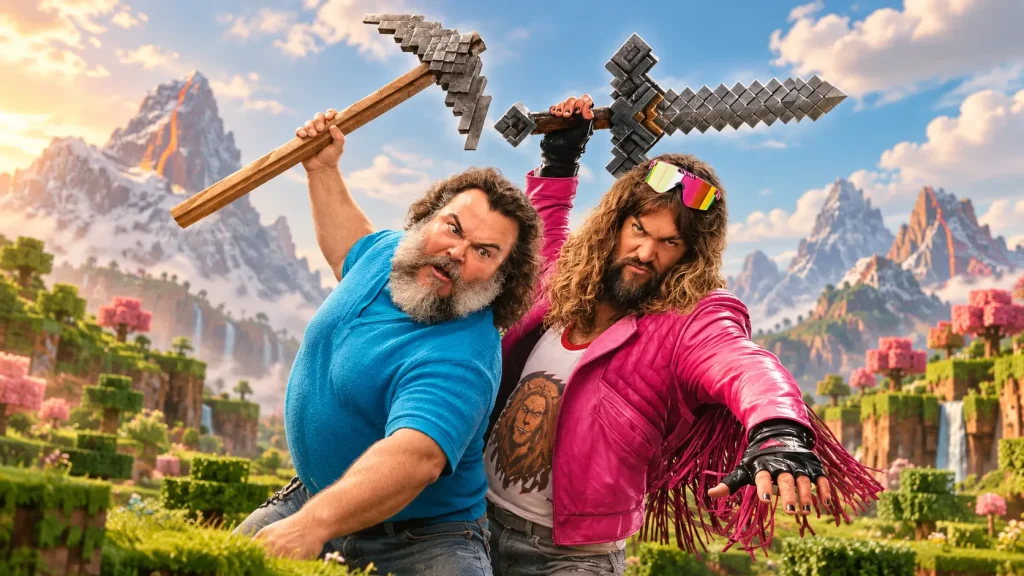
Director Jared Hess takes a different approach: put Jack Black, Jason Momoa, and a group of unlikely adventurers inside the Overworld, then let the weirdness do much of the work.
The result is a noisy, occasionally inspired family adventure with an uneven story and an impressive ability to turn ordinary game terminology into internet comedy. My biggest reservation is that the film celebrates imagination while following a surprisingly familiar path.
It has personality. I just wish it trusted its own creativity a little more.
The Visual Style: Live-Action Meets Cubes
The central question in the live-action Minecraft vs. animated style debate is easy to understand: why put realistic people inside a world famous for looking nothing like reality?
I can see the appeal. A human face reacting to a square animal creates an immediate visual joke. The actors also give newcomers a way into the setting. They are confused by this place, so nobody watching needs to feel embarrassed about being confused too.
But the combination is inconsistent.
The Overworld looks strongest when the film gives its landscapes room to breathe. Cubic terrain, forests, and improbable structures make the setting feel inviting. There is something appealing about a place where the scenery doubles as building material.
The creatures are more divisive. Adding detailed fur, skin, and expressive faces to Minecraft’s simple designs produces an odd middle ground. Some are charming. Others look as though they have been waiting outside your bedroom door to explain a dream.
For me, the issue is visual consistency. The actors, environments, and creatures do not always feel equally present in the same space. During busy action scenes, the abundance of digital detail can make the world feel less tangible rather than more convincing.
A fully animated film could have offered a more unified appearance. Still, I understand why Hess went with the stranger option. This hybrid gives the movie an identity, even when that identity involves making a sheep slightly unsettling.
I admire the commitment more than I love every result.
Jack Black as Steve: Exactly as Subtle as You Would Expect
The Jack Black Steve Minecraft movie pairing makes sense once you accept that this Steve is a specific comic character.
In the game, Steve can function as a largely blank player avatar. Here, he is an enthusiastic expert crafter who introduces the newcomers to the Overworld. Black stars alongside Jason Momoa, Emma Myers, Danielle Brooks, and Sebastian Eugene Hansen.
Black brings his familiar mix of theatrical confidence, musical energy, and wholehearted silliness. He delivers information as though naming an item is already a major dramatic event.
Sometimes, that is very funny.
Sometimes, I want the film to give him a quieter beat before the next announcement arrives.
The performance works best when Steve’s enthusiasm helps explain the appeal of Minecraft. His delight in making things gives the film a warmer center. He understands this world as somewhere to experiment, which is more interesting than simply knowing where the next dangerous creature lives.
The limitation is that Black’s personality occasionally overwhelms the character. If you enjoy his comic style, there is plenty to enjoy here. If you find him exhausting, a blue shirt will probably not change your mind.
Jason Momoa Understands the Assignment
Of the two leads, Jason Momoa gets the more surprising comic role.
He plays Garrett “The Garbage Man” Garrison, a former arcade champion whose confidence has outlasted his glory days. The pink fringed jacket tells you quite a lot before he has even opened his mouth.
What I like about Garrett is how thoroughly Momoa commits to making him ridiculous. His size and action-star presence suggest competence, while his behavior keeps undermining that impression.
Garrett approaches unfamiliar situations with the certainty of someone who has already decided the tutorial is beneath him.
His scenes with Steve benefit from their competing egos. Black supplies frantic expertise; Momoa supplies misplaced confidence. The pairing gives the film much of its comic momentum.
The supporting cast provides a more grounded contrast. Hansen’s Henry connects most directly with the creative possibilities of the Overworld, while Myers’ Natalie and Brooks’ Dawn bring responsibility and warmth to the group. I would have liked more room for their relationships to develop, particularly when the story separates its characters.
Jennifer Coolidge also brings her own wonderfully odd energy to the real-world subplot. Whether those scenes feel like welcome interruptions will depend on your tolerance for the movie wandering away from its main adventure.
Storytelling in a Sandbox: Plenty of Ingredients, a Familiar Recipe
The premise is straightforward. Garrett, Henry, Natalie, and Dawn are pulled through a portal into the Overworld. With Steve’s help, they must navigate its dangers and find a way home.
That is an accessible setup for families. Parents do not need a working knowledge of crafting recipes, and younger viewers can understand the immediate stakes.
My frustration is how conventional the adventure becomes.
Minecraft offers an unusually open foundation for storytelling. Its players build communities, invent challenges, create elaborate machines, and turn accidental disasters into stories worth retelling. The movie channels those possibilities into a recognizable quest involving magical objects, a threatening villain, and a route back home.
It functions, but it rarely feels as inventive as its source material allows.
To be fair, Minecraft is not completely without goals or lore. Survival progression, the Nether, and the Ender Dragon give players things to pursue. What it lacks is a mandatory linear campaign that everyone experiences in the same order. A film therefore has to choose one story from a game built to accommodate countless others.
I do not object to that choice. I wanted the chosen story to take more chances.
Crafting, Creepers, and the Difference Between Recognition and Payoff
The film includes plenty of familiar elements: crafting tables, creepers, redstone, a Nether portal, and piglins. These give experienced players something to recognize while establishing the world’s possibilities for newcomers.
The strongest uses involve problem-solving. Gathering materials, building protection, and making equipment give the characters something active to do. Those moments connect the adventure to Minecraft’s central pleasure: looking at what you have and deciding what you can make from it.
Redstone is particularly useful in that respect. It suggests a world with systems that can be understood and manipulated, rather than scenery that exists only to be admired.
The weaker references feel closer to a roll call. Recognition delivers a quick reward, but a familiar object becomes more satisfying when it changes the action or reveals something about a character.
The piglin antagonist, Malgosha, supplies an understandable threat and a direct conflict with the film’s celebration of creativity. I find the idea serviceable, although the villain is less memorable than the world she threatens.
There is enough Minecraft here to establish affection for the game. I wanted more of its improvisational spirit to shape the screenplay.
The Memes Became Part of the Movie’s Identity
Any A Minecraft Movie review has to acknowledge that the film’s cultural life extended well beyond its plot.
The first teaser drew criticism over the live-action approach and creature designs. Images and lines rapidly became material for online jokes, including Steve’s introduction. That early skepticism did not prevent the finished film from finding an enthusiastic audience.
“Chicken jockey” became the clearest example. Black’s delivery helped turn a recognizable game encounter into a viral audience-participation moment. Reports from US theaters described cheering and, at some screenings, disruptive behavior that prompted warnings.
I understand why a shared joke became part of the attraction. For younger audiences, knowing the line before it arrives can create the same anticipation as a favorite song at a concert. Throwing drinks is considerably harder to defend, especially for the people cleaning the theater afterward.
The wider Minecraft creator and YouTube community matters for a deeper reason. Many fans know this world through other people’s builds, challenges, streams, and running jokes as much as through their own play sessions. American audiences are part of that global culture, where a personal attachment to a creator can carry more emotional weight than another recognizable mob.
The tribute to Technoblade captures that connection beautifully. A crowned pig acknowledges the late American Minecraft YouTuber, and Steve identifies him as a legend. It is a small moment with significance that reaches beyond the film’s immediate story.
For me, that is more meaningful fan service than a reference included simply because viewers will recognize it. It acknowledges the people who helped give Minecraft its cultural life.
Minecraft Movie US Box Office: The Audience Showed Up
Whatever my reservations about the screenplay, the commercial result is clear.
Released in US theaters on April 4, 2025, A Minecraft Movie earned approximately $162.8 million on its domestic opening weekend, $424.1 million domestically, and $960.4 million worldwide, according to The Numbers. “Domestic” here means the US and Canada combined, rather than the United States alone.
Those figures establish the Warner Bros. and Legendary Pictures release as a major theatrical success. They also illustrate why Hollywood keeps returning to games: a familiar world can bring together children, longtime players, families, and viewers drawn by its online presence.
My reading is that the movie became an occasion as much as an adaptation. The cast, recognizable imagery, and shared jokes gave different groups different reasons to participate.
That does not make every creative decision successful. It does help explain why objections to the visuals were never the whole story.
Where It Fits Alongside Mario and Sonic
I find The Super Mario Bros. Movie more visually coherent. Animation lets its characters, movement, and environments operate within the same stylized logic.
The Sonic the Hedgehog films take another route, using relationships between animated characters and human companions to give their adventures an emotional foundation.
A Minecraft Movie sits somewhere between those approaches. It uses live actors, but much of its appeal depends on a digitally constructed world and viewers’ existing affection for that world.
Its particular strength is comic eccentricity. Jared Hess allows the characters to be awkward, vain, and deeply silly. Momoa especially benefits from that freedom.
Its weakness is that the emotional journey does not always keep pace with the spectacle. The movie talks persuasively about creativity, but the characters need more opportunities to express it in ways that develop their relationships.
Would I put it among the best video game movies? It falls short of my top tier. I would place it among the more culturally distinctive adaptations, with several performances and moments that survive beyond the basic adventure.
For Hollywood’s gaming adaptation trend, the lesson I take from it is that familiarity gets audiences interested, while personality gives them something to talk about afterward. A stronger story would make that conversation more rewarding.
My Rating: 6.5/10
A Minecraft Movie is an entertaining but uneven family adventure, carried by committed comic performances and an unmistakable world.
Momoa’s ridiculous confidence, Black’s enthusiasm, and the moments built around crafting give it real charm. The hybrid visuals take some adjustment, and the predictable quest structure leaves too much of Minecraft’s creative potential unexplored.
It will work best for younger Minecraft fans, viewers who enjoy broad comedy, and families looking for a lively adventure. Parents should also know that its PG rating covers action, language, rude or suggestive humor, and some scary images.
Players hoping for the quiet satisfaction of exploring, building, and discovering things at their own pace may find it overwhelming. This is one very loud interpretation of a game that can mean very different things to different people.
My final feeling is that the film has assembled a promising collection of materials. It builds something fun with them. I just wish it had spent a little longer working on the structure.

I’m Alex Mercer, a senior gaming and esports writer at GamingImba. I’ve been involved in gaming for as long as I can remember, and for more than a decade I’ve been writing about competitive play, industry trends, and the culture that grows around games.
My work focuses on esports, online gaming platforms, and how technology continues to shape the way people play, compete, and connect. I’m especially interested in meta shifts, balance changes, and the business decisions that influence modern games behind the scenes.
At GamingImba, I aim to break down complex topics in a way that’s clear, honest, and useful—whether that means analyzing a major tournament, exploring new gaming platforms, or looking at how player behavior evolves over time.
I follow global esports scenes closely, experiment with different games and mods in my free time, and enjoy digging into the details that most players notice but rarely stop to question.