Watching someone play video games, chat with strangers, or react to videos for a living sounds like a dream job. And for a small group of Twitch creators, it really has become an incredibly profitable career. But behind the celebrity streamers, expensive streaming setups, and viral clips is a much less glamorous reality.
How much do Twitch streamers actually make? Some earn only a few dollars a month, others make enough to cover their living expenses, and a relatively small number have turned streaming into multimillion-dollar businesses. Twitch doesn’t pay creators a fixed salary based on their audience size, which means a channel averaging 200 viewers could potentially earn more than one attracting 1,000.
The difference comes down to how viewers support a channel, how often the creator streams, and whether they have additional income from sponsors or other platforms. Let’s look at the actual payment systems, realistic calculations, and the types of creators who have managed to turn Twitch into a career.
How Much Do Twitch Streamers Make Per Month?
There’s no standard monthly salary for Twitch streamers. Simply going live or attracting followers doesn’t generate a guaranteed paycheck. Creators earn through subscriptions, advertising, Bits, direct tips, sponsorships, and sometimes businesses outside Twitch.
Rather than assigning an invented average salary to every audience size, it’s more useful to examine how much specific amounts of community support can generate.
The following examples assume the streamer receives $2.50 from each paid subscription, equivalent to a 50% share of an illustrative $5 in eligible net subscription revenue. Bits are calculated at the standard rate of $0.01 per Bit cheered.
| Paid Subs | Bits Cheered | Example Monthly Revenue |
| 10 | 500 | $30 |
| 50 | 2,000 | $145 |
| 100 | 5,000 | $300 |
| 500 | 10,000 | $1,350 |
| 1,000 | 25,000 | $2,750 |
| 5,000 | 100,000 | $13,500 |
These are mathematical examples, not typical Twitch incomes or industry averages. They include only the specified subscription and standard Bits revenue, excluding advertising, sponsorships, direct tips, taxes, and business expenses. Actual subscription payouts vary.
The table shows how a community can generate meaningful revenue without relying on assumptions about advertising or sponsorship deals. However, a streamer with 100 average viewers doesn’t automatically have 100 paying subscribers. Some channels have unusually supportive communities, while others attract substantial audiences with relatively few people spending money.
A creator earning $300 one month might also earn considerably less the next if subscriptions expire or viewer contributions slow down. Monthly earnings depend on ongoing support, not simply how many people have watched a stream.
Why Average Viewers Matter More Than Followers
Imagine two Twitch channels. One has 100,000 followers but averages 80 live viewers, while another has 8,000 followers and regularly attracts 300 viewers. Despite its much smaller follower count, the second channel may be more attractive to advertisers and potential sponsors.
Followers measure how many accounts have chosen to follow a creator, not how many people actively watch. Someone might follow a streamer after a viral clip and never return, while another viewer may spend several hours watching every week without following hundreds of other channels.
Average concurrent viewers (ACCV) show how many people are watching at the same time over a given period. That makes the metric more useful for understanding the size of a streamer’s regular audience, although it still doesn’t reveal how much money they make.
How Do Twitch Streamers Make Money?
Most established Twitch creators combine several income sources rather than depending on one. Some receive most of their money directly through Twitch, while others earn more through sponsors, YouTube, merchandise, or other businesses.
1. Twitch Subscriptions
Subscriptions allow viewers to support a creator while receiving benefits such as custom emotes, badges, and other channel perks. Twitch offers three paid subscription tiers, along with gifted subscriptions that viewers can purchase for other members of a community.
In the United States, a standard Tier 1 web subscription costs $5.99, but that doesn’t mean the creator receives $5.99 or even exactly half of it. Twitch calculates revenue-sharing payments using eligible net subscription revenue, which can differ from the advertised customer price.
| Subscription Agreement | Creator’s Share of Eligible Net Revenue |
| Standard agreement | 50% |
| Plus Program Level 1 | 60% |
| Plus Program Level 2 | 70% |
The Twitch Plus Program provides qualifying Affiliates and Partners with a higher subscription revenue share. To reach Level 1, creators must maintain at least 100 Plus Points for three consecutive months. Level 2 requires 300 Plus Points over the same period.
Recurring Tier 1 subscriptions contribute one Plus Point, Tier 2 subscriptions contribute two, and Tier 3 subscriptions contribute six. Gifted and Prime subscriptions don’t count toward the qualification thresholds, although eligible gifted subscriptions can generate revenue under the creator’s applicable subscription split.
Higher revenue shares can make a considerable difference for creators with large subscriber communities. However, not every subscription generates the same amount of revenue, even when two viewers are subscribing to the same channel.
2. Advertising Revenue
Advertisements can provide income when viewers watch a livestream, but Twitch doesn’t offer a universal payment per viewer. Advertising earnings depend on how many eligible advertisements are delivered, where viewers are located, advertiser demand, and other factors.
Eligible Twitch Affiliates and Partners can receive 55% of net advertising revenue by running at least three minutes of ads per hour through Ads Manager. Running those ad breaks can also disable pre-roll advertisements for incoming viewers.
Still, a 55% revenue share doesn’t reveal the actual dollar amount a creator will earn. A channel with a large audience in one country could receive different advertising revenue from an equally popular channel whose viewers are primarily located elsewhere.
Some creators run more advertisements to increase monetization opportunities, while others limit interruptions to keep viewers engaged. Advertising revenue is not a guaranteed amount per 1,000 viewers, and adding more ads doesn’t necessarily improve a streamer’s long-term earnings.
3. Twitch Bits
Bits are Twitch’s virtual cheering currency, allowing viewers to support creators directly during broadcasts. For standard Cheering in chat, participating streamers generally receive $0.01 per Bit.
| Bits Cheered | Standard Creator Revenue |
| 100 | $1 |
| 500 | $5 |
| 1,000 | $10 |
| 5,000 | $50 |
| 10,000 | $100 |
A viewer cheering 5,000 Bits therefore generates $50 for the streamer under the standard arrangement. Viewers pay Twitch to acquire Bits, so the price of purchasing those Bits is not the same as the amount the creator receives.
There’s also a distinction between ordinary Cheering and Bits used through certain Twitch Extensions. For eligible Bits-enabled Extensions, the creator ordinarily receives 80% of one US cent per Bit, while the remaining 20% goes to the Extension developer.
Bits can be a useful revenue source during special streams, community challenges, and celebrations, but the number received can change considerably from one month to another.
4. Direct Tips and Viewer Support
Some streamers accept financial contributions through third-party payment services. These contributions don’t necessarily pass through Twitch’s subscription or Bits systems, so the creator’s final earnings depend on payment processing fees, refunds, chargebacks, and applicable taxes.
Direct support can be particularly meaningful for small channels. A single $20 tip could exceed the advertising revenue generated by a small audience over several broadcasts. However, these contributions are voluntary and unpredictable, making them difficult to include in a reliable income forecast.
5. Sponsorships and Brand Deals
Sponsorships can become a major source of income for established Twitch creators, particularly those with recognizable personalities or audiences interested in specific products.
Brands may pay streamers to demonstrate gaming hardware, play a new release, feature a product during a broadcast, or create promotional content across Twitch and other social platforms. Some agreements involve one sponsored stream, while others cover several months of promotion.
There’s no official Twitch sponsorship rate. Compensation depends on the creator’s audience, the campaign, expected deliverables, and negotiations with the brand. A channel averaging 500 engaged viewers interested in a particular game may be valuable to a specialized gaming company, even if another creator has a much larger general entertainment audience.
Sponsorship earnings also shouldn’t be confused with profit. A creator may need to pay an agent, production staff, editors, or other expenses associated with delivering a campaign.
6. YouTube, Merchandise, and Other Businesses
A livestream doesn’t have to stop generating opportunities when the broadcast ends. Many streamers turn their best moments into YouTube videos, Shorts, compilations, and social media clips, which can attract additional viewers and potentially generate advertising revenue.
Others sell merchandise, offer paid products, run events, or develop businesses built around their online popularity. This is particularly relevant when discussing famous streamers who have grown beyond Twitch.
A creator’s total annual income and the amount Twitch pays them are two different things. Someone earning millions through sponsorships, merchandise, and outside contracts may receive only part of that money through Twitch’s own monetization systems.
How Much Does Twitch Pay Per Subscriber?
The simplest way to understand subscription earnings is to start with eligible net revenue rather than the price viewers see at checkout.
Suppose each paid subscription generates $5 in eligible net revenue. Here’s what different subscriber counts would produce under the three revenue-sharing agreements.
| Paid Subscriptions | 50% Share | 60% Share | 70% Share |
| 10 | $25 | $30 | $35 |
| 50 | $125 | $150 | $175 |
| 100 | $250 | $300 | $350 |
| 500 | $1,250 | $1,500 | $1,750 |
| 1,000 | $2,500 | $3,000 | $3,500 |
| 5,000 | $12,500 | $15,000 | $17,500 |
The $5 net revenue assumption is purely illustrative. These amounts are not Twitch’s published payouts per subscription. Actual payments depend on subscription type, regional pricing, adjustments, and the creator’s agreement.
A channel with 1,000 qualifying paid subscriptions could therefore receive $2,500 under the example’s standard 50% arrangement, or $3,500 at 70%. But 1,000 followers, 1,000 viewers, and 1,000 paid subscribers are completely different measurements.
Do Prime Subscriptions Pay the Same Amount?
No. Prime Gaming subscriptions use country-specific fixed creator payout rates instead of the standard percentage-based calculation for ordinary paid subscriptions.
According to Twitch’s published Prime subscription rates, last updated in October 2025, the creator amounts include:
| Subscriber’s Country | Creator Revenue Per Prime Sub |
| United States | $2.25 |
| United Kingdom | $1.80 |
| Germany | $1.55 |
| France | $1.55 |
| Bulgaria | $1.45 |
| Brazil | $0.45 |
These are Twitch’s stated fixed rates before any applicable payout-related taxes, fees, or other costs. Prime subscriptions also don’t automatically renew: eligible Prime members must redeem their monthly subscription benefit again.
This explains why even knowing someone’s total subscriber count isn’t enough to calculate their income accurately. A channel with a mixture of regular paid subscriptions, gifted subscriptions, and Prime subscriptions will have a different revenue profile from a channel with the same subscriber count but a different mix.
How Much Do Small Twitch Streamers Make?
Small Twitch channels make up a substantial part of the streaming community, even though they rarely appear in headlines about creator earnings. Many are run by people who stream after work, during university, or simply because they enjoy sharing games with friends.
For someone averaging 10 to 30 concurrent viewers, earning enough to cover a microphone, streaming software, or a new game might already feel like progress. Let’s imagine a monetized channel with the following activity during one month.
| Revenue Source | Example Monthly Earnings |
| 20 paid subscriptions | $50 |
| 1,500 Bits cheered | $15 |
| Advertising | $8 |
| Direct tips | $25 |
| Total revenue | $98 |
This example assumes $2.50 per subscription, standard Bits revenue, and hypothetical advertising and tip amounts. It’s not an average for channels with 10 to 30 viewers.
The creator could earn considerably more during a special event or significantly less during a quiet month. They may also have streaming expenses that exceed their income, particularly if they’re buying equipment or paying for editing tools.
I’d treat the early stages of streaming as building an audience and learning what makes people return, rather than expecting immediate financial returns. Someone can genuinely enjoy streaming while earning very little from it, and that doesn’t necessarily mean their content is unsuccessful.
How Much Do Twitch Streamers Make With 100, 500, or 1,000 Viewers?
Reaching 100 average concurrent viewers is a meaningful milestone, and maintaining 500 or 1,000 represents a much larger regular audience. But none of those viewer counts comes with an automatic Twitch salary.
To illustrate the possibilities without inventing typical earnings, let’s compare three hypothetical channels. Their subscription and Bits revenue can be calculated from the assumptions provided; advertising and sponsorship figures are deliberately excluded because they cannot be reliably predicted from viewer counts alone.
| Example Channel | 100 Avg. Viewers | 500 Avg. Viewers | 1,000 Avg. Viewers |
| Assumed paid subs | 40 | 200 | 400 |
| Assumed Bits cheered | 1,000 | 5,000 | 10,000 |
| Subscription revenue | $100 | $500 | $1,000 |
| Bits revenue | $10 | $50 | $100 |
| Example total | $110 | $550 | $1,100 |
These are mathematical scenarios, not typical subscriber counts, Bits activity, or expected earnings for the stated audience sizes. Calculations use $2.50 per paid subscription and $0.01 per standard Bit. Actual channels may generate substantially different revenue.
The larger hypothetical channel has more subscribers and Bits, but that’s an assumption in the example, not a rule that applies to real Twitch audiences. Another creator averaging 1,000 viewers might attract far more paying supporters, while a different channel could receive very little subscription activity.
How Do Streaming Hours Affect Earnings?
Average viewer count doesn’t tell us how many hours a creator broadcasts. A channel averaging 100 viewers across 20 hours of streaming has much less total viewing time than one maintaining the same average audience across 160 hours.
Under a simple calculation, the first channel generates around 2,000 viewer-hours, while the second generates approximately 16,000 viewer-hours. This isn’t a direct measure of advertising impressions, but it helps illustrate how much viewing activity can differ between channels reporting the same average audience.
Streaming eight times longer doesn’t guarantee eight times more advertising revenue. Different viewers may receive different advertisements, some might be subscribed or use Twitch Turbo, and demand varies throughout the month.
Longer broadcasts may create more opportunities for subscriptions, Bits, and audience interaction, but streaming excessive hours can also affect energy, content quality, and long-term consistency.
Which Types of Twitch Streamers Can Make the Most Money?
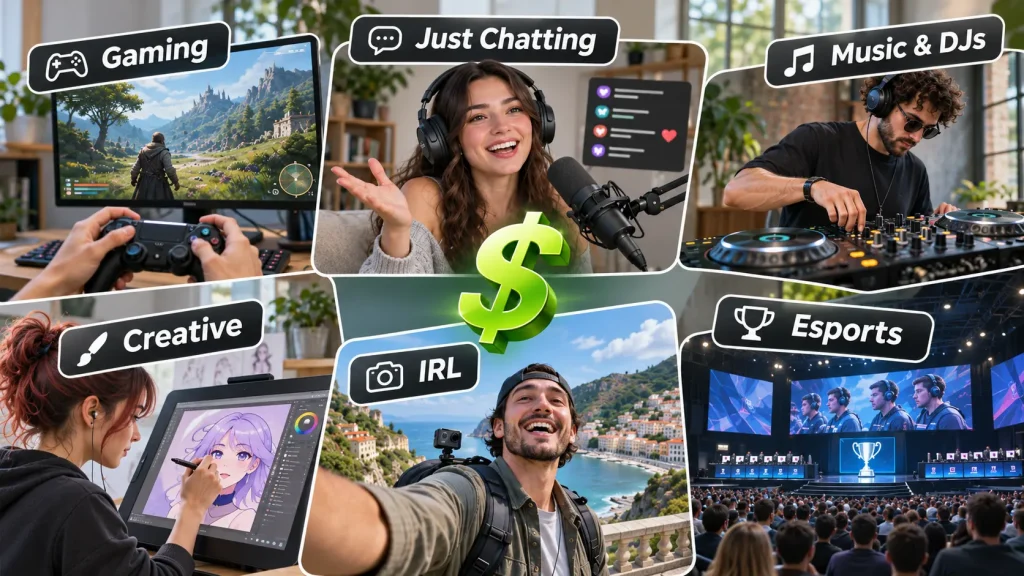
Twitch has grown well beyond traditional gaming broadcasts. Just Chatting, competitive gaming, variety content, IRL events, VTubing, music, and creative streams all attract different audiences.
There’s no reliable public dataset proving that one category consistently produces the highest earnings for individual creators. However, different types of content offer different opportunities for sponsorships, recurring subscriptions, and businesses outside the platform.
Just Chatting and Entertainment Streamers
Just Chatting centers on conversations, reactions, interviews, challenges, and entertainment rather than exclusively playing games. Its strongest personalities can attract viewers regardless of the activity they’re broadcasting, which gives them more freedom to experiment.
Kai Cenat is one of the best-known examples, combining comedy, celebrity guests, gaming, and marathon streams into large entertainment productions. His content often generates viral moments that reach people far beyond Twitch. HasanAbi, meanwhile, is associated with political commentary, current events, and reactions, attracting viewers interested in discussion and his perspective on the news.
The financial potential comes from building audiences around recognizable personalities rather than a single game. These creators can participate in different types of campaigns and develop content for other platforms, although keeping audiences entertained across long broadcasts requires considerable effort.
Competitive Gaming Streamers
Competitive gaming creators often become popular because of exceptional ability, detailed game knowledge, or distinctive commentary.
Ninja became an internationally recognized streamer through Fortnite, helping introduce livestreaming to a broader audience. Jynxzi is strongly associated with Rainbow Six Siege, combining competitive gameplay with energetic reactions and community entertainment. Caedrel, a former professional League of Legends player and commentator, attracts viewers through esports analysis, co-streaming, and his understanding of professional matches.
These audiences often share a specific interest in the games being played, making them relevant to gaming hardware brands, publishers, esports events, and related products. The challenge is that popularity can be tied to the success of a particular game or competitive scene.
Variety Gaming Streamers
Variety creators move between games, reactions, and different entertainment formats. Instead of depending entirely on one title, they encourage viewers to follow them for their personalities and presentation styles.
xQc is a prominent example, known for streaming different games alongside reaction and entertainment content. Auronplay and Rubius have also built large Spanish-speaking communities through gaming, humor, and personality-led broadcasts.
Variety streaming can create opportunities for a wider range of game promotions and sponsorships. However, audiences originally attracted by one game may not always remain interested when a creator changes direction. Established personalities often have more freedom to experiment than newcomers who are still developing a recognizable identity.
IRL and Event Streamers
IRL, short for in real life, includes broadcasts involving travel, public activities, challenges, and special events. Much of the appeal comes from unpredictable interactions and experiences outside conventional gaming.
Ibai Llanos provides an interesting example of how streaming popularity can expand into event production. His La Velada del Año boxing events have demonstrated the ability of internet creators to attract audiences to large-scale entertainment productions.
These events can generate opportunities involving sponsors, ticket sales, merchandise, and commercial partnerships, but they also require significant investment. Venues, production crews, security, technical equipment, and participating talent can create substantial expenses.
A major event’s revenue shouldn’t be confused with the organizer’s personal profit.
VTubers and Virtual Personalities
VTubers perform through animated virtual avatars instead of appearing on camera in the conventional way. Their content can include gaming, music, chatting, and character-driven entertainment.
Ironmouse is one of the most recognizable VTubers associated with Twitch, showing how audiences can develop strong connections with a virtual personality. For successful VTubers, monetization opportunities can extend beyond subscriptions into character merchandise, music, and commercial collaborations.
Virtual production can also introduce additional costs, such as custom character models, animation, and tracking equipment. A simple avatar may be relatively inexpensive, while a more elaborate setup can require a substantial investment.
Music, Art, and Educational Streamers
Not every successful Twitch creator focuses on gaming or dramatic reactions. Musicians perform for their communities, digital artists share their work, and educational creators teach programming, design, and other subjects.
These channels may attract smaller audiences than major entertainment broadcasts, but they can build communities around specific interests. A digital artist might receive commissions from viewers, while a programming creator may develop courses, educational resources, or relationships with software companies.
For these creators, Twitch can serve as both an income source and a way to reach customers for their work outside streaming. That makes judging their financial success from Twitch revenue alone particularly difficult.
Do the Biggest Twitch Streamers Make Millions?
Yes, some major streaming personalities have built businesses generating millions of dollars. However, there’s an important difference between Twitch payments, total business revenue, and personal net worth.
Searching for the earnings of Kai Cenat, Ninja, xQc, or Ibai often produces websites claiming to know their exact annual incomes. Many of these estimates are difficult to verify because the creators’ private sponsorships, commercial contracts, expenses, and other financial arrangements aren’t publicly disclosed.
One particularly revealing example comes from Kai Cenat’s September 2025 Mafiathon 3, when his channel surpassed one million active subscriptions. This was an extraordinary subscription milestone, but it doesn’t tell us his exact take-home income.
Subscriptions obtained through an event can include gifted purchases, different tiers, Prime subscriptions, and payments made at varying regional prices. Some may expire after the event, and revenue can be affected by applicable agreements and adjustments.
One million subscriptions during a major event is not the same as having one million recurring paid subscribers every month.
The same caution applies to reports of multimillion-dollar streaming contracts. A reported contract value isn’t necessarily the amount a creator receives immediately, and it may depend on conditions or payments spread over time.
For the biggest personalities, Twitch can be one part of a much larger entertainment business.
How Much Does Twitch Pay Per 1,000 Views?
Twitch doesn’t have a universal fixed payout per 1,000 stream views. This is an important distinction because livestreaming uses several different measurements that are sometimes confused.
Concurrent viewers represent the number watching at the same time, while unique viewers count distinct people who watched during a given period. Advertising impressions measure qualifying instances of ads being delivered, which aren’t interchangeable with either viewer count.
Imagine two channels that each attract 1,000 unique viewers. One broadcasts for 30 minutes, while the other streams for eight hours with several advertising breaks. Despite having the same number of unique viewers, their opportunities to show advertisements can differ considerably.
Advertising rates also change depending on geography, demand, eligible impressions, and other factors. Therefore, claims that Twitch automatically pays a particular dollar amount per 1,000 views should be treated cautiously unless they refer to a clearly defined calculation or a specific creator’s reported experience.
Can You Make a Living Streaming on Twitch?
It’s possible to earn a full-time living on Twitch, but revenue isn’t the same as take-home income. A creator generating $3,000 each month still needs to account for equipment, editing software, production expenses, accounting, taxes, and potentially other people involved in running the channel.
Here’s a simple example of what the finances might look like for an independent streamer.
| Monthly Calculation | Amount |
| Total streaming-related revenue | $2,500 |
| Editing, software, equipment, and other business expenses | −$400 |
| Remaining before personal taxes and applicable contributions | $2,100 |
| Hours spent streaming and managing the channel | 160 |
| Effective earnings per hour before personal taxes and contributions | $13.13 |
These are hypothetical amounts, but they demonstrate a practical issue that is easy to miss when discussing streaming income. The creator may appear to be earning $2,500, yet the remaining amount is lower, and there are still personal taxes or other obligations to consider.
There’s also work outside the broadcasts themselves. Streamers may spend hours editing videos, responding to sponsors, planning content, managing online communities, and maintaining social media accounts. Those activities can be essential to growing the channel even though viewers never see them.
Income can fluctuate as well. Sponsorship campaigns end, subscriptions expire, games lose popularity, and audiences move between platforms. A successful streaming career needs consistent revenue and manageable expenses, not just one impressive month.
How to Start Earning Money on Twitch in 2026
Twitch expanded access to monetization and community tools during 2026. From May 13, eligible streamers around the world began receiving access to features such as subscriptions, Bits, emotes, badges, and Channel Points without first having to qualify as Affiliates.
However, access to monetization tools doesn’t automatically mean eligibility for cash payouts. Streamers generally need Affiliate or Partner status to withdraw their Twitch earnings.
In early June 2026, Twitch also introduced easier Affiliate qualification requirements. To qualify, creators must meet the following milestones within the applicable 30-day period:
- 25 followers.
- 4 total streaming hours.
- Streams on 4 different days.
- At least 3 average concurrent viewers on 4 streaming days.
Meeting these requirements allows qualifying creators to receive an Affiliate invitation and complete the onboarding process. The reduced thresholds make the first milestone more accessible, particularly for people who stream alongside work or education.
Nevertheless, becoming an Affiliate doesn’t guarantee meaningful income. A creator still needs an audience that wants to return regularly, interact with the channel, and potentially provide financial support.
I’d focus on finding a content format that’s enjoyable enough to maintain consistently. Whether that’s competitive gaming, entertaining commentary, creative challenges, or educational streams, giving viewers a reason to come back matters more than simply increasing the number of broadcasting hours.
When Does Twitch Pay Streamers?
Twitch generally uses a Net-15 payment schedule, meaning eligible payments are initiated within 15 days after the end of the month in which the revenue was earned.
For most supported payout methods, the minimum threshold is $50, while wire transfers require $100. If a streamer doesn’t reach the required threshold during a month, their eligible balance generally carries forward until it is sufficient for payment.
For example, a creator with $35 in eligible earnings won’t normally receive a payout if their minimum threshold is $50. If they earn another $25 the following month, their accumulated $60 may qualify for payment, provided their account and payment arrangements are eligible.
The time required for funds to reach a bank account can vary, and some revenue types may be processed later than the standard schedule. Twitch’s Prime subscription documentation, for example, notes that certain Prime subscription payments can take longer.
Is Twitch Streaming Still Worth It in 2026?
I think the answer depends on what someone expects from streaming. If the goal is to make money quickly, Twitch is a difficult place to start. Building a regular live audience takes time, and even creators with loyal viewers can earn relatively little during their early months.
But streaming can be rewarding for people who genuinely enjoy gaming, entertaining, teaching, or sharing creative work. A livestream can introduce people to a creator’s YouTube channel, produce clips for social media, lead to collaborations, or create opportunities that wouldn’t have existed otherwise.
The most successful streamers often build recognizable identities that reach beyond Twitch itself. Their audiences follow them not only for a particular game or activity, but because they enjoy the person or character behind the content.
The real opportunity isn’t simply attracting more viewers. It’s creating something people want to return to and support. That doesn’t guarantee financial success, but it provides a much stronger foundation than expecting every new follower or thousand views to translate directly into income.

I’m Alex Mercer, a senior gaming and esports writer at GamingImba. I’ve been involved in gaming for as long as I can remember, and for more than a decade I’ve been writing about competitive play, industry trends, and the culture that grows around games.
My work focuses on esports, online gaming platforms, and how technology continues to shape the way people play, compete, and connect. I’m especially interested in meta shifts, balance changes, and the business decisions that influence modern games behind the scenes.
At GamingImba, I aim to break down complex topics in a way that’s clear, honest, and useful—whether that means analyzing a major tournament, exploring new gaming platforms, or looking at how player behavior evolves over time.
I follow global esports scenes closely, experiment with different games and mods in my free time, and enjoy digging into the details that most players notice but rarely stop to question.